


Do You Need Winter Tyres to Drive in Kyushu? Where Fukuoka's Lowlands End and the Mountains of Yufuin, Aso and Kurokawa Begin
The short answer first: if you stay on the flat around Fukuoka city, Itoshima and Dazaifu, you will not need winter tyres on most winter days. If your trip touches Yufuin, Kurokawa or Aso, or takes the Oita Expressway past Hita, treat winter tyres as a booking condition. Kurokawa Onsen's official site is the most direct: from December to March, come with winter tyres or chains without fail. Yufuin's official travel site also asks drivers to fit winter tyres and carry chains.
Kyushu gets far less snow than Hokkaido, which is exactly why it gets underestimated. GoodCars only touches on this briefly in the Kyushu car rental guide; this article takes it road by road: where the line falls, whether expressways are safe, and which months count. For how to actually drive on snow, see the Hokkaido winter driving guide, which is not repeated here.

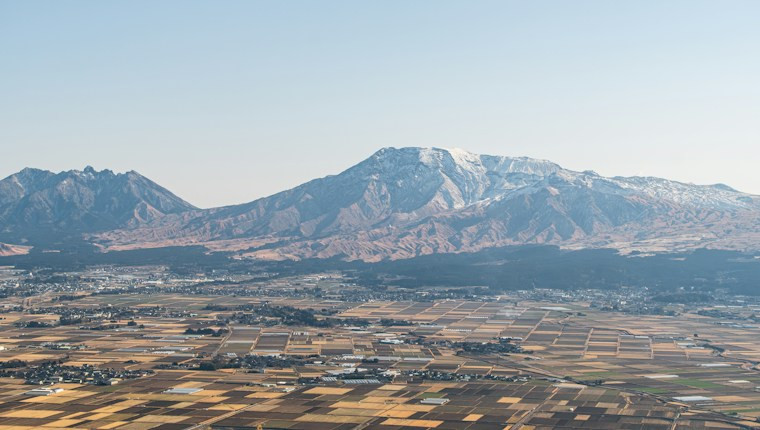
The snow line is not printed on any map: lowlands and highlands can be in different seasons on the same day (illustrative image)
First, find your layer
The most useful line comes from Yufu City's winter notice: take particular care on any route above 500 metres, and on cold days, rain on the flat often means snow in the mountains. Using that line, northern Kyushu splits like this:
| Zone | Typical places (elevation / average January low) | Winter tyres? |
|---|---|---|
| Lowland | Fukuoka (about 3 m / 3.9°C) | Not needed on most days; heavy-snow forecasts are the exception |
| Valleys and basins | Hita (83 m / −0.2°C), Kusu (331 m / −2.0°C), Yufuin (about 450 m / −2.2°C), Aso Valley (about 490 m / −2.7°C) | For Yufuin and the Aso Valley, confirm winter tyres when booking; if only going to Hita, check the forecast |
| Mountains | Kurokawa (about 700 m), Mizuwake Pass (710 m), Handa Highlands (870 m), Senomoto (960 m) | Essential |
| Highlands | Aso-san weather station (1,142 m / −4.5°C), Makinoto Pass (about 1,330 m) | Essential; do not plan this without snow experience |
Temperatures are Japan Meteorological Agency (JMA) climate normals; elevations come from JMA stations, Yufu City, the Ministry of the Environment and Kurokawa's official site. The mountain zone has no matching normals, but it is usually colder with height. Fukuoka sees snow on about 23 days a year, but total snowfall for the year is only about 2 cm, so most of it never settles.

Most winter days on the flat look like this, but those are only the ordinary days (illustrative image)
In terms of common trips:
| Trip | Verdict |
|---|---|
| Fukuoka city, Dazaifu, Itoshima | Usually not needed |
| Fukuoka to Kumamoto city (Kyushu Expressway) | Usually not needed; check for heavy-snow forecasts before leaving |
| Fukuoka to Yufuin (Oita Expressway) | The official site asks you to fit winter tyres and carry chains |
| Fukuoka to Kurokawa | The official site asks for winter tyres or chains |
| Fukuoka to the Aso Valley (Kyushu Expressway, then Route 57) | Winter tyres recommended |
| Yamanami Highway, top of Aso | Not recommended for beginners, even with winter tyres |
Which months count? Sources disagree, so here is how we read them
The sources we checked all say something different, mainly at the two ends of the season:
| Source | What it says |
|---|---|
| Kurokawa Onsen official site | December to March |
| A Japanese rental comparison site's FAQ | December to around the following April, depending on snow |
| JMA Aso-san station (days with snow) | November about 4, December about 16, January about 20, February about 14, March about 13, April about 3 |
Real cases side with the longer window. One mid-March, the Mizuwake to Senomoto section of the Yamanami Highway was still under a winter tyre restriction, and the next day out-of-season snow in Aso left about 40 vehicles stranded on the Milk Road, Route 265 and elsewhere, according to local media. So GoodCars reads it this way: from December to March, assume winter tyres in the mountains; in late November and early April, you cannot rule them out by the calendar, so watch the forecast in the days before you leave.
The rule follows the road surface, not the month
Japan has no rule saying winter tyres start in a given month. The Kyushu Regional Development Bureau's notices are clear: driving on a snowy or icy road without anti-skid measures breaks prefectural rules. In Oita Prefecture, for example, you must fit chains, snow tyres or other effective measures, and the penalty for an ordinary car is 6,000 yen. In other words, the same car on the same day can be fine in Fukuoka and in breach at Mizuwake Pass.
For expressways in snow, NEXCO West Japan describes four stages, in the usual order:
| Situation | What you need |
|---|---|
| Speed restriction (最高速度規制) | Follow the temporary limit, usually 50 or 80 km/h; go by the signs on the road |
| Winter tyre restriction (冬用タイヤ規制) | Winter tyres on all wheels, or chains on the drive wheels; cars on normal tyres are turned off the expressway |
| Chain restriction (チェーン規制) | When conditions worsen or in exceptional snow, chains are required even with winter tyres |
| Full closure (通行止め) | No vehicles at all |
NEXCO's FAQ singles out regions such as Kansai and Kyushu, where fewer cars have winter tyres: in snow they may go from a speed restriction straight to full closure, skipping the two stages in between. Another question on the same page is more direct: most Kyushu expressways, except in the Oita area, do not run the kind of winter tyre restriction used in other regions. So on the Kyushu Expressway in snow, winter tyres may not get you through. Do not count on all-season tyres either; NEXCO says they may not be allowed, depending on the snowfall.
The expressway line: past Hita it is a different road
Leaving Fukuoka Airport, Dazaifu and Tosu are still on the flat. The split comes after Tosu: the Kyushu Expressway heads to Kumamoto, and the Oita Expressway heads to Yufuin and Kurokawa.

Fog hides the road ahead: the weather can change from one section of an expressway to the next (illustrative image)
- The Oita Expressway is the first line. NEXCO West Japan describes it as high and snowy. In snow, a winter tyre restriction applies from Hita IC to Hiji JCT, and Yufuin IC sits inside that stretch. Yufuin's official site also names "the Expressway from Fukuoka" as a road that can freeze or take snow.
- It can close before Hita too. Officials have warned of a high chance of closure between Asakura IC and Hita IC, listing the parallel Route 210 at the same time.
- If the expressway closes, the national road may not save you. One late December, the Oita Expressway closed from Chikugo-Ogori IC to Hiji JCT, and Route 210 also closed completely from Kokonoe to Yufu City. Near Mizuwake Pass there is also a record of about 100 vehicles held up and a closure of about 9 hours.
- The Kyushu Expressway is not immune. A precautionary closure has been announced from Fukuoka IC to Hirokawa IC. In another January snowstorm the expressway closed for a long period, and the roughly 35 km of Route 3 from Dazaifu IC to Hirokawa IC, normally about 1 hour, took about 6.
That is the exception to the lowland layer: on days with an official heavy-snow forecast, the question is no longer tyres but whether to travel another day. The Kyushu bureau's published list of roads subject to precautionary closure also includes Yagiyama Pass between Fukuoka and Iizuka and Unzen in Nagasaki, so do not picture these roads as "Kyushu, where it hardly snows".
Yufuin, Yamanami and Kurokawa: the line into the mountains

The basin looks calm; the roads in and out are what matter (illustrative image)
Yufuin: the station area is at 450 m, just under the line, but coming from Fukuoka or Beppu means crossing it. Yufu City's figures put the area around Yufuin IC at 560 m, Mizuwake Pass at 710 m and, towards Beppu, the Yufudake trailhead at 770 m and Kijima Highlands at 690 m. The 5-day Kyushu loop itinerary suggests taking ordinary roads from Yufuin to Beppu; that advice assumes snow-free roads, so rethink it in winter.
Yamanami Highway (Prefectural Route 11): we found no fixed winter closure period; restrictions are issued according to conditions. Road updates posted by local tourism offices show anti-skid equipment often required between Mizuwake Pass and Senomoto, restrictions running for days on end in late January, and one on a sunny morning in early March because of ice. GoodCars does not recommend putting the climb from the Handa Highlands to Makinoto Pass in a winter itinerary.
Kurokawa Onsen: at about 700 m, its official site says snow and ice are frequent from December to March. The routes it lists, Route 212, Route 57 and the Yamanami Highway, all involve mountain roads. The site puts Aso, Yufuin and Hita each about an hour away, then immediately warns of mountain roads and of snow and ice from December to March, and it gives no separate winter time, so do not plan on one hour in winter. The official route from Yufuin follows the Yamanami Highway to Senomoto, which crosses Makinoto Pass, the stretch we advise against in the paragraph above.
Do not expect the road to have been treated for you either. Oita Prefecture's Kusu civil engineering office states that its snow clearing assumes vehicles carry anti-skid equipment, that it may not be in time at night or in the early morning, and that it cannot cover every prefectural road. Yufuin's official site adds that winter dark comes around 5 pm and many mountain roads have no street lights, so plan to arrive before sunset.
- You have never driven on snow or ice
- You cannot confirm winter tyres when booking
- You expect to reach mountain lodging after dark
- Mountain roads and your flight home fall on the same day
Check Fukuoka Airport pick-up options
Aso: the valley floor, the outer rim and the summit are three different roads

Snow on the peak does not mean snow on the grassland below (illustrative image)
| Section | Road | What to watch |
|---|---|---|
| Aso Valley floor | Route 57 (Kumamoto to Aso) | Managed by the national government, with live cameras, but the average January low is below zero, so the surface may be icy early in the morning |
| Outer rim | Milk Road (Prefectural Route 339), Daikanbo (about 936 m) | One of the stranding sites from that March; Kurokawa's official route from Kumamoto also uses it |
| Summit area | Aso Panorama Line (Prefectural Route 111 and others) | The Aso-san station's January maximum snow depth averages about 17 cm. A third-party source says the road closes when snow lies; we could not find an official fixed period |
| Aso to Minamioguni | Mazeno Mystery Road (a farm road) | The only road we found that closes on fixed dates every year: last season from the afternoon of December 8 to the morning of March 23. Check Aso City's notice for the current season, and reroute if navigation sends you this way |
| Towards Taketa, Oita | Route 57 at Takimurozaka | On the official list of precautionary closures for heavy snow, with a high share of snow and ice restrictions. The replacement Takimurozaka Road is officially due to open at the end of November; check the current status |
Whether the crater is open is a separate volcanic matter, covered in the Kyushu loop itinerary. Aso's official winter guide also says to prepare winter tyres or chains as needed, and that winter bus services may change.
Booking winter tyres: what to ask for a Fukuoka Airport pick-up
Kyushu is not Hokkaido. The public notices we found from national rental chains list winter tyres as standard in areas such as Hokkaido, Tohoku and Hokuriku, not Kyushu, and one says that if you do not book them you get normal tyres. GoodCars has one pick-up point in Kyushu, Fukuoka Airport. Whether you can specify winter tyres there, and whether they cost extra, depends on the supplier, so confirm when booking and go by what the booking page shows.

Chains go on the drive wheels; check whether the car has them and whether you can fit them (illustrative image)
- Can you specify winter tyres on all wheels? Keep the answer in your booking or in writing.
- Are chains available, and do they fit this car? NEXCO advises carrying chains even with winter tyres.
- Check the sidewall at pick-up. Winter tyres are marked STUDLESS or SNOW. For the pick-up process, see the Fukuoka Airport pick-up guide.
- Check the cost separately. Typical prices are in the Japan car rental price guide; for insurance, go by the booking page.
- If you cannot get them, change the plan. GoodCars cannot guarantee winter tyres on a supplier's behalf; without them, please stay off the mountains.
Most visitors need a 1949 Geneva Convention International Driving Permit, their home licence and their passport. Japan accepts only the Geneva format; a Vienna-format permit is not valid. Switzerland, Germany, France, Belgium, Monaco and Taiwan are the exception: drivers from these places need their licence plus an official Japanese translation from JAF or their embassy, and a self-made translation does not count. Licences from mainland China and Indonesia cannot be used in Japan, even with a permit. You may drive for up to one year from entry, within your licence's validity. Details are in the complete guide to renting a car in Japan.
Where to check before you leave, and how to change the plan
| What | Where |
|---|---|
| Expressways | iHighway (NEXCO West Japan) |
| Oita prefectural roads | おおいた防災情報ポータル (Oita disaster information portal): choose 道路規制情報, then the すべり止め必要 layer |
| Kumamoto prefectural roads | 防災情報くまもと (Kumamoto disaster information): road restriction information |
| National roads and live images | 道路情報提供システム (national road information system), 九州道路ライブカメラ (Kyushu road cameras) |
| Snowfall forecast | JMA 今後の雪 (snow forecast) |
| Around Kurokawa | Kurokawa Onsen official site, 最新の天候&交通状況 (latest weather and traffic) |

Seeing an icy-road sign on the spot is too late: check the night before, and again before you set off (illustrative image)
What local posts call a "chain restriction" (チェーン規制) appears on Oita's official map as すべり止め必要, meaning anti-skid equipment required. Open the entry to see the actual requirement.
- To Yufuin: take the JR limited express Yufuin no Mori, a little over 2 hours from Hakata, all seats reserved.
- To Kurokawa: the direct highway bus from Fukuoka runs 3 round trips a day with all seats reserved, and you must book by the day before. The ride takes about 2 hours 45 minutes to 3 hours.
- To Aso: take the Shinkansen to Kumamoto, then the JR Hohi Line or the Kyushu Odan Bus.
- Stay on the flat: switch to Itoshima and Karatsu or Fukuoka city.
- On the way back: spend the night before drop-off near Fukuoka, so mountain roads and your flight never fall on the same day.
In heavy snow, officials warn that public transport can also see major delays or cancellations. On those days the best option is to postpone.
Frequently asked questions
Q1. Do I need winter tyres just for Fukuoka city and Dazaifu?
Not on most days. Fukuoka's annual snowfall totals about 2 cm. But when a heavy-snow forecast is issued, even the flat can see snow and road closures, so change your plans that day.
Q2. Can I drive the expressway from Fukuoka to Yufuin on normal tyres?
In settled weather you will get there, but in snow a winter tyre restriction applies east of Hita IC, and cars on normal tyres are turned off. Yufuin's official site also asks drivers to fit winter tyres and carry chains. GoodCars suggests making winter tyres a booking condition.
Q3. Does Kurokawa Onsen really require winter tyres?
Its official site says to come with winter tyres or chains from December to March, as snow and ice are frequent. If you have no snow experience, GoodCars suggests the highway bus instead.
Q4. Are winter tyres still needed in March?
In the mountains, yes. Restrictions and stranded cars have occurred in mid-March, and the Aso-san station averages about 13 days of snow in March. Trips on the flat usually do not need them.
Q5. Do I need both winter tyres and chains?
Under a winter tyre restriction on the Oita Expressway, either one gets you through, but NEXCO advises winter tyres on all wheels plus chains in the car, because a chain restriction requires chains even with winter tyres. Most other Kyushu expressways do not run a winter tyre restriction, so even with both you may meet a closure. What is actually available depends on the supplier.
Q6. Can I skip winter tyres if I rent a 4WD?
No. The rule looks at anti-skid measures, not the drive system. A 4WD on normal tyres is stopped by a restriction just the same.
Q7. Can I specify winter tyres when I book a Fukuoka Airport pick-up through GoodCars?
It depends on the supplier, and GoodCars cannot guarantee it in advance. Confirm when booking and go by what the booking page shows.
Book a Fukuoka Airport pick-up
- Fukuoka Airport (Kyushu)
- New Chitose Airport (Hokkaido)
- Narita Airport / Chiba Station / Kinshicho Station (Tokyo and Kanto)
- Naha Airport (Okinawa)