


Itoshima and Karatsu Self-Drive Route: A Coastal Day from Fukuoka, and Why the Morning Decides Everything
Driving west from Fukuoka Airport along the Genkai Sea to Karatsu in Saga Prefecture is the easiest self-drive day in Kyushu. The route hugs the coast almost the whole way, with no mountain passes, no volcanic roads and nothing that demands winter-driving experience. When GoodCars mapped this route, the thing that breaks people's plans turned out not to be distance at all — Itoshima to Karatsu is barely an hour's drive — but how you spend the morning.
The reason is simple. The Yobuko morning market north of Karatsu closes at 12:00 sharp, while the sightseeing boat at Keya no Oto in Itoshima stops running between 12:30 and 13:30. Both attractions only exist in the morning, and they sit at opposite ends of the route. The GoodCars advice is to decide which side gets your morning before you leave; everything else falls into place after that.

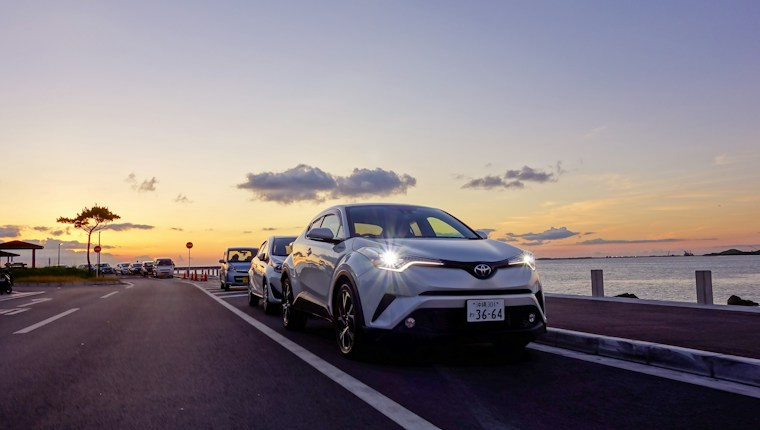
The route follows the shoreline almost end to end, so driving back east in the evening puts the sunset ahead of you (illustrative image)
Itoshima and Karatsu sit on one road, but the morning only stretches to one of them
The geography is straightforward. Heading west from Fukuoka Airport you pass, in order, central Fukuoka, the Itoshima peninsula, the city of Karatsu in Saga Prefecture, and then Yobuko further north. It is one continuous coastal line, not the kind of peninsula where you must pick an eastern or western side.
The conflict is in the opening hours. The Yobuko morning market runs daily from 7:30 to 12:00 and closes only on 1 January. From Fukuoka Airport that is more than an hour and a half of driving, which means leaving by around 08:30 with no stops along the way. The Keya no Oto sightseeing boat departs every 45 minutes on weekdays and every 30 minutes at weekends and on holidays, running 9:30 to 12:30 in the morning and resuming at 13:30 — a full hour with no sailings in between.
One morning cannot hold both. GoodCars breaks it into two workable plans:
| Plan | Morning | Afternoon | Best for |
|---|---|---|---|
| A: Yobuko first | Drive straight from Fukuoka Airport to the market, no stops | Karatsu Castle, Mt. Kagami, coastal Itoshima on the way back | Early risers who came for the seafood |
| B: Itoshima morning | Itoshima coast and the Keya no Oto boat | Karatsu Castle, the pine grove, sunset at Futamigaura | Families and anyone wanting a slower day |

In Itoshima the farmland runs straight down to the water, with houses and small shops lining the road — this is not an empty scenic highway (illustrative image)
Leaving Fukuoka Airport: this expressway is part toll road, part free road
The main artery west is the Nishi-Kyushu Expressway, but it does not charge a toll from end to end. The roughly 14.2 km stretch from Fukuoka's Nishi Ward to eastern Itoshima is the Fukuoka-Maebaru Road, operated by the Fukuoka Prefectural Road Public Corporation as a toll section. North of Karatsu, sections such as Karatsu-Chichika-Yamada towards Kitahata opened as toll-free motorway. Further towards Nagasaki, the Sasebo section moved to NEXCO West management and now charges a flat 370 yen for standard cars whether or not you use ETC.
Most visitors take the Fukuoka Urban Expressway from the airport, join the Nishi-Kyushu Expressway and reach central Karatsu in roughly 70 minutes. Exiting at Maebaru and following National Route 202 along the coast takes about 40 minutes to Karatsu, but with far more traffic lights and small-town stretches, so the real figure depends on season and time of day. For how cross-prefecture distances work across the region, see the Kyushu car rental guide; for driving inside Fukuoka itself, see the Fukuoka city car rental guide.

The coastal stretch has wide views but uneven speeds — the car ahead may brake for a car park entrance at any moment (illustrative image)
GoodCars covers ETC cards in full in the complete guide to renting a car in Japan. The toll sections on this route are short enough that paying cash at the booth is perfectly workable, and a single day out here does not justify buying any regional expressway pass.
Check Fukuoka Airport pick-up options
Plan A: straight to Yobuko, because 12:00 means 12:00
Yobuko hosts one of Japan's three great morning markets, open daily from 7:30 to 12:00 and closed only on New Year's Day. Stalls line the street, run largely by local women selling squid landed that morning, sea urchin and dried fish.
There are two parking options. The market's own car park is free but holds only 29 standard cars; the nearby Yobuko harbour car park charges from around 100 yen per hour. Over the New Year period and on long weekends both fill by mid-morning. GoodCars suggests arriving between 09:30 and 10:30 — any earlier and not every stall is open, any later and both the parking and the best produce are gone.

The market closes at 12:00 as a block — it does not wind down gradually as the crowd thins (illustrative image)
- Around 08:00 — pick up at Fukuoka Airport (the GoodCars partner counter there operates 08:00 to 21:00)
- 08:30 — depart via the Nishi-Kyushu Expressway, no stops
- 10:00–11:30 — Yobuko morning market, lunch in Yobuko
- 13:00–15:00 — Karatsu Castle and central Karatsu
- From 16:00 — east along the coast into Itoshima, reaching Futamigaura by dusk
Plan B: keep the morning in Itoshima and work around the boat's lunch gap
Keya no Oto is a basalt sea cave in a headland that can only be seen from the water, so the sightseeing boat is the only way to experience it. The trip takes about 30 minutes, with departures every 45 minutes on weekdays and every 30 minutes at weekends, running 9:30 to 12:30 and then 13:30 until roughly 16:15 or 16:30.

The cave mouth is not visible from the land-side car park — the boat is the whole point of stopping here (illustrative image)
If you want one more Itoshima stop, Shiraito Falls sits halfway up Mt. Hagane at around 530 m. The facilities there open 9:00 to 17:00, extending to 18:00 in July and August, and close on Wednesdays from December through March. Parking is free with roughly 200 spaces, although the city is reviewing charges for the first three car parks. It is a mountain road, at least 20 minutes up from the coast, so adding it to Plan B leaves room for only Karatsu Castle later.
Karatsu Castle and Mt. Kagami: the real deadline is 16:40
Karatsu Castle stands on a hill above Karatsu Bay and is the only paid historic site on this route. The keep opens 9:00 to 17:00, but last admission is 16:40 — twenty minutes before closing, and the single most common mistake visitors make here. Entry is 500 yen for adults and 250 yen for primary and junior high school students, free for preschool children, with the castle closed 29 to 31 December.
Parking is at the Higashi-Jonai car park, roughly 170 spaces. Between 6:00 and 22:00 it charges 100 yen for up to an hour, 300 yen for up to two hours and a flat 400 yen beyond that, with a flat 300 yen overnight from 22:00. For a stop of this length you are realistically looking at 300 to 400 yen.

Last admission falls twenty minutes before closing, so the whole day should be planned backwards from it (illustrative image)
Below the castle lies Niji no Matsubara, a pine grove stretching about 4.5 km along Karatsu Bay and some 500 m deep, with roughly a million black pines. It ranks with Miho no Matsubara and Kehi no Matsubara as one of Japan's three great pine groves, and the road through it is itself the attraction. Parking is free with about 135 spaces, around 20 minutes from the Karatsu interchange.
To see the bay and the entire grove at once, drive up to the Mt. Kagami observatory. The climb follows Saga Prefectural Route 250 for four to five kilometres and includes fifteen hairpin bends; sources put the summit car park at anywhere from 130 to 175 spaces, including coach bays. The road is not difficult, but the bends come in quick succession, so get a feel for the width of your rental car before heading up.

From the observatory the bay and the full sweep of the pine grove sit in one frame (illustrative image)
Futamigaura on the way home: sunset is the crush, and there are 47 official spaces
The wedded rocks at Sakurai Futamigaura are Itoshima's best-known sunset spot, and they fall naturally on the drive back east. But the official car park holds only 47 cars and has charged a fee for the past few years; nearby private car parks bill separately.
The hour before sunset is the worst of it. The GoodCars suggestion is practical: on a weekend or public holiday, give up on parking directly in front of the rocks, park further out and walk. The coastal road is narrow, stopping on the shoulder for a photograph blocks traffic behind you and attracts enforcement. Paid parking is becoming the norm across Itoshima's popular spots, so carrying some 100-yen coins saves trouble.
- Yobuko morning market closes at 12:00, open daily except 1 January
- Keya no Oto boat pauses 12:30–13:30, and sails roughly mid-March to November only
- Karatsu Castle last admission 16:40, twenty minutes before the 17:00 close
- Shiraito Falls facilities close Wednesdays from December to March, otherwise open until 17:00 (18:00 in July and August)
Before you go: whether your licence works in Japan
People are turned away at rental counters over this every year, so GoodCars puts it up front. For most nationalities, driving in Japan requires an International Driving Permit issued under the Geneva Convention of 1949, together with your home licence and your passport — all three, every time. The permit is a translation of your licence, not a licence in itself.
Japan does not accept permits issued in other formats. The Vienna Convention format is not valid in Japan, which matters because some authorities now issue both kinds. Thailand's Department of Land Transport, for example, issues a Geneva-format permit and a Vienna-format one with a longer validity period; travellers heading to Japan must specifically request the Geneva format.
A small group of countries works differently, using the original licence plus an official Japanese translation instead of a permit: Switzerland, Germany, France, Belgium, Monaco and Taiwan. The translation must come from a legally recognised body such as JAF or the issuing authority — your own translation is not accepted. In all cases you may drive for up to one year from your date of entry, and no longer than your licence or permit remains valid.
On insurance, what basic collision cover and Non-Operation Charge cover include varies by supplier plan, so go by what the booking page shows when you book through GoodCars. On a coastal route the common claims are car park scrapes and paint damage from wind-blown grit, so check your cover before you set off. The full picture is in the complete guide to renting a car in Japan, and the airport counter layout is covered in the Fukuoka Airport car rental guide.
Frequently asked questions
Q1. Can Itoshima and Karatsu be done in one day?
Yes. They are barely an hour apart, so distance is not the constraint — morning opening hours are. Yobuko closes at 12:00 and the Keya no Oto boat pauses over lunch, so you take one or the other. Everything else runs into the afternoon and evening.
Q2. Is the route worth driving in winter?
The scenery holds up, but the Keya no Oto boat sails only from around mid-March to November, so winter removes a headline stop, and Shiraito Falls closes on Wednesdays from December to March. In winter, build the day around Yobuko, Karatsu Castle and Mt. Kagami rather than Itoshima.
Q3. Can I drive it without an ETC card?
Yes. The toll sections are short and the booths accept cash. Whether a car has ETC equipment depends on the supplier and the vehicle, so check when you book through GoodCars; a single day out here does not warrant buying an expressway pass.
Q4. Do I have to use the castle's own car park?
It is the closest, with about 170 spaces, 300 yen for up to two hours and a flat 400 yen beyond. It fills during cherry blossom season, so arrive early or park in town and walk.
Q5. Is the Mt. Kagami road too much for a first-timer?
The surface is fine, but the four-to-five-kilometre climb packs in fifteen hairpins and continuous steering. If this is your first time driving on the left in Japan, spend a stretch on the flat coastal road first and decide afterwards.
Q6. Is one day too tight?
One day is right. What causes overruns is trying to fit Shiraito Falls, Keya no Oto and the Yobuko market into the same morning. GoodCars recommends one headline stop before lunch and Karatsu after it.
Q7. Where is the best place to pick up the car?
Fukuoka Airport is the natural start: you head straight west onto the expressway without entering the city. The GoodCars partner counter there operates 08:00 to 21:00, so an early arrival can collect and go. If this day opens a longer trip, continue with the Kyushu loop self-drive itinerary.
Book your Fukuoka Airport pick-up
- Narita Airport / Chiba Station / Kinshicho Station (Tokyo and Kanto)
- New Chitose Airport (Hokkaido)
- Fukuoka Airport (Kyushu)
- Naha Airport Station (Okinawa)