'%3e%3cpath%20fill='red'%20d='M0%200h720v480H0z'/%3e%3cpath%20fill='%23000095'%20d='M0%200h360v240H0z'/%3e%3cg%20fill='%23fff'%3e%3cpath%20d='m154%20126.9-2.5%209.6%209.4%202.6-1.8-7.1zm46.9%205.1-1.8%207.1%209.4-2.6-2.5-9.6zm-41.8-24-5.1%205.1%201.9%206.9z'/%3e%3cpath%20d='m155.9%20120-1.9%206.9%205.1%205.1z'/%3e%3cpath%20d='m154%20113.1-6.9%206.9%206.9%206.9%201.9-6.9zm14%2027.8%205.1%205.1%206.9-1.9zm18.9%205.1%209.6%202.5%202.6-9.4-7.1%201.8z'/%3e%3cpath%20d='m192%20140.9%207.1-1.8%201.8-7.1zm-31.1-1.8%202.6%209.4%209.6-2.5-5.1-5.1zm19.1%205%206.9%201.9%205.1-5.1z'/%3e%3cpath%20d='m173.1%20146%206.9%206.9%206.9-6.9-6.9-1.9zm-12.2-45.1-9.4%202.6%202.5%209.6%205.1-5.1zm-1.8%2031.1%201.8%207.1%207.1%201.8zm45-12%201.9-6.9-5.1-5.1z'/%3e%3cpath%20d='m168%2099.1-7.1%201.8-1.8%207.1zm32.9%208.9-1.8-7.1-7.1-1.8zm5.1%2018.9%206.9-6.9-6.9-6.9-1.9%206.9z'/%3e%3cpath%20d='m200.9%20108-8.9-8.9-12-3.2-12%203.2-8.9%208.9-3.2%2012%203.2%2012%208.9%208.9%2012%203.2%2012-3.2%208.9-8.9%203.2-12z'/%3e%3cpath%20d='m200.9%20132%205.1-5.1-1.9-6.9zm5.1-18.9%202.5-9.6-9.4-2.6%201.8%207.1zm-6.9-12.2-2.6-9.4-9.6%202.5%205.1%205.1zm-26-6.9-9.6-2.5-2.6%209.4%207.1-1.8zm6.9%201.9-6.9-1.9-5.1%205.1z'/%3e%3cpath%20d='m186.9%2094-6.9-6.9-6.9%206.9%206.9%201.9z'/%3e%3cpath%20d='m192%2099.1-5.1-5.1-6.9%201.9zM173.1%20146l-9.6%202.5%204.5%2016.6%2012-12.2zm-5.1%2019.1%2012%2044.9%2012-44.9-12-12.2zm-7.1-26-9.4-2.6-4.4%2016.4%2016.4-4.4z'/%3e%3cpath%20d='m147.1%20152.9-12%2045.1%2032.9-32.9-4.5-16.6zm-12-20.9L102%20165.1l45.1-12.2%204.4-16.4z'/%3e%3cpath%20d='m154%20126.9-6.9-6.9-12%2012%2016.4%204.5zm0-13.8-2.5-9.6-16.4%204.5%2012%2012z'/%3e%3cpath%20d='M135.1%20108%2090%20120l45.1%2012%2012-12zm90%2024-16.6%204.5%204.4%2016.4%2045.1%2012.2z'/%3e%3cpath%20d='m199.1%20139.1-2.6%209.4%2016.4%204.4-4.4-16.4zm-12.2%206.9-6.9%206.9%2012%2012.2%204.5-16.6zm19.1-19.1%202.5%209.6%2016.6-4.5-12.2-12z'/%3e%3cpath%20d='m192%20165.1%2033.1%2032.9-12.2-45.1-16.4-4.4zm7.1-64.2%209.4%202.6%204.4-16.4-16.4%204.4z'/%3e%3cpath%20d='M225.1%20108%20258%2075.1l-45.1%2012-4.4%2016.4zm-12.2-20.9L225.1%2042%20192%2075.1l4.5%2016.4zm12.2%2044.9%2044.9-12-44.9-12-12.2%2012z'/%3e%3cpath%20d='m206%20113.1%206.9%206.9%2012.2-12-16.6-4.5zm-38-38L135.1%2042l12%2045.1%2016.4%204.4z'/%3e%3cpath%20d='m160.9%20100.9%202.6-9.4-16.4-4.4%204.4%2016.4z'/%3e%3cpath%20d='m147.1%2087.1-45.1-12%2033.1%2032.9%2016.4-4.5zm39.8%206.9%209.6-2.5-4.5-16.4-12%2012z'/%3e%3cpath%20d='M192%2075.1%20180%2030l-12%2045.1%2012%2012z'/%3e%3cpath%20d='m173.1%2094%206.9-6.9-12-12-4.5%2016.4z'/%3e%3c/g%3e%3ccircle%20cx='180'%20cy='120'%20r='51.1'%20fill='%23000095'/%3e%3ccircle%20cx='180'%20cy='120'%20r='45.1'%20fill='%23fff'/%3e%3c/g%3e%3c/svg%3e)
'%20d='m0%200%2016%2011h61%2061%2061%2061%2060L47%2037h61%2061%2060%2061L16%2063h61%2061%2061%2061%2060L47%2089h61%2061%2060%2061L16%20115h61%2061%2061%2061%2060L47%20141h61%2061%2060%2061L16%20166h61%2061%2061%2061%2060L47%20192h61%2061%2060%2061L16%20218h61%2061%2061%2061%2060L0%200'/%3e%3c/svg%3e)

'%20d='M-50-12v24m6%200v-24m6%200v24m76%200V1m0-2v-11m6%200v11m0%202v11m6%200V1m0-2v-11'/%3e%3cpath%20transform='rotate(-33.69006752598)'%20d='M-50-12v24m6%200V1m0-2v-11m6%200v24m76%200V1m0-2v-11m6%200v24m6%200V1m0-2v-11'/%3e%3c/g%3e%3cg%20transform='rotate(33.69006752598)'%3e%3cpath%20fill='%23cd2e3a'%20d='M12%200a18%2018%200%2011-36%200%2024%2024%200%201148%200'/%3e%3cpath%20fill='%230047a0'%20d='M0%200a12%2012%200%201124%200%2024%2024%200%2011-48%200%2012%2012%200%201024%200'/%3e%3c/g%3e%3c/svg%3e)


Hokkaido Winter Driving Guide | Snow Tires, 4WD, Black Ice & Whether You Should Drive at All

Let GoodCars say the most important thing first: if you have never driven on snow or ice, the best winter equipment in Hokkaido is not driving at all. That is not scaremongering — it is the local consensus. Winter Hokkaido has an excellent network of trains, intercity buses and day tours, and you can have a full trip without ever touching a steering wheel.
But we also know some itineraries genuinely need a car: traveling with elderly parents or small children, hauling ski gear, reaching an onsen ryokan the bus does not serve. So this guide from GoodCars does two things honestly — gives you a clear go/no-go checklist, and if you do drive, shows you how to cut the risk down as far as it will go. For everything else about renting in Hokkaido year-round, see our Hokkaido car rental guide. This page is only about the snow.
- No winter driving experience = don't drive. Run the checklist before you book
- The four killers: black ice, ground blizzards, snowbanks at junctions, compacted snow ruts
- Hokkaido rentals generally come with studless snow tires fitted as standard in winter, usually at no extra charge
- Golden rules: follow the wheel tracks, keep 2–3x your normal following distance, make every input gentle
- Check road closures and blizzard visibility forecasts before every drive; halve your itinerary, stay on main roads, arrive before dark
The question that matters most: should you drive at all?
Be honest with yourself here. Winter Hokkaido is a level that even drivers from mainland Japan treat with respect. If you drive Canadian prairies or Nordic winters every year, you will manage — black ice still deserves your full attention. If you come from a place where it never snows, the checklist below is for you. If even one item applies, leave the car:
- You have never driven on a snow-covered or icy road.
- Your itinerary has no buffer day — a single road closure would make you miss your flight.
- You plan to drive after dark, or your days end with night sightseeing far from your hotel.
- You are the only driver in the group, with nobody to take over.
- The train or bus actually reaches your destinations — the car is just "convenient".
There is no shame in being talked out of it. The rail spine between Sapporo, Otaru, Asahikawa and Hakodate is solid, and the snow festivals, zoos and onsen towns all run shuttles and day tours. And if your dates are flexible, GoodCars will tell you plainly: the same itinerary in summer or autumn is half the effort and twice the road trip.
The four killers of the Hokkaido winter road
If you have decided to drive, meet your opponents. The danger is not "snow" in general — it is these four specific conditions:
Black ice: it looks wet, it is ice

Black ice is a transparent glaze of ice over the asphalt. From the driver's seat it looks like a road that is merely wet; in reality your braking distance multiplies several times over. It forms at dawn and after dark, on bridges, at tunnel mouths, and in the braking zones before intersections — anywhere melt-and-refreeze happens around freezing point. The only defense is conditional: when the temperature is below about 3°C and the surface "looks wet", treat it as ice. Lift off early, open the gap, and brake gently far earlier than feels necessary.
Ground blizzards: visibility zero in ten seconds

Even under a clear sky, strong wind can lift fallen snow off the fields and turn the road into a whiteout — the infamous jifubuki, or ground blizzard. It strikes hardest on long straight roads through open farmland and along the coast — exactly the terrain of central and eastern Hokkaido. If you are caught in one: fog lights and hazards on, slow right down, and never brake hard or stop dead in the travel lane. If visibility drops to zero, ease off the road at a safe spot and wait — most bursts pass within minutes.
Snowbanks: every junction becomes a wall
Snowplows clear the road by stacking snow one to two meters high along its shoulders. At intersections those banks block your view completely — you cannot see pedestrians or cross traffic, and passing space disappears. Treat every junction as blind: stop, creep, look, then go.
Compacted snow and ruts: the car steers itself
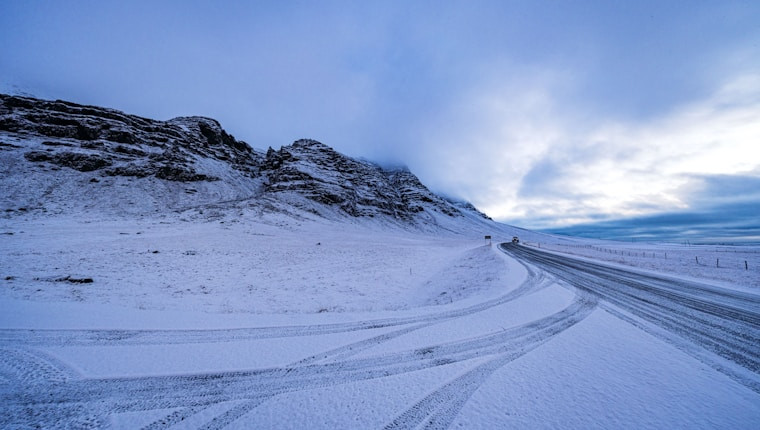
On busy roads the snow gets compacted into a hard, polished surface carved with the ruts of previous cars. Ride the edge of a rut and the wheel tugs; change lanes carelessly and the tug becomes a slide. This is why locals follow the wheel tracks and change lanes as little as possible.
Snow tires, 4WD and chains: gearing up

Good news first: rental cars in Hokkaido generally come with studless snow tires fitted as standard through the winter, and most plans include them at no extra charge — unlike mainland Japan, where winter tires are often a paid option. A few operators use winter seasonal pricing instead, so always confirm the details of your specific plan. The GoodCars booking page lists equipment and fees clearly, in plain English.
What you actually need to decide:
- Snow tires are not optional — they are the law. Prefectural road rules across Japan require winter tires on all wheels, or other anti-skid measures, when driving on snow-covered or icy roads, and violations are enforced. In a Hokkaido winter there is zero grey area.
- 4WD is worth adding — but know what it does. Four-wheel drive helps you pull away and climb without spinning; it does almost nothing for braking distance. City-and-highway itineraries are fine on studless 2WD; mountain roads, rural routes and early-morning starts justify 4WD. The most dangerous driver in Hokkaido is the one who thinks 4WD makes them invincible — in corners and under braking, it will not save you.
- You normally do not need chains. Japan's chain regulation applies during extraordinary snowfall on specifically designated sections — currently almost all on the main island, not on Hokkaido's tourist routes. If a storm reaches that level, the right answer is to change your plans, not to chain up and push through.
GoodCars partners with local Japanese suppliers at New Chitose Airport: car class, snow tires, 4WD, CDW and NOC coverage all confirmed on one clear English booking screen. Winter stock runs out early — 4WD cars go first.
Check winter rentals at New Chitose AirportWinter driving rules: slow, gentle, far

Every snow-driving technique GoodCars can teach you compresses into three words: slow, gentle, far.
- Slow: cut your normal speed by a third, then a bit more. Locals drive faster — do not follow them; they have a lifetime of ice behind the wheel and you do not.
- Gentle: throttle, brake, steering — every input soft and unhurried. Hard braking, hard acceleration and sudden steering are the three sins; nearly every slide starts with the word "sudden".
- Far: keep 2–3 times your dry-road following distance. Braking distances multiply on ice; the goal is never to need an emergency stop in the first place.
- Follow the wheel tracks. The snow there is compacted and grips better — and it proves the line is drivable.
- Learn the red-and-white arrows. The downward arrows hanging over the shoulder (yabane) mark the true edge of the road — in a ground blizzard they are the line between road and ditch.
- Slow down before bridges and tunnel mouths. Bridge decks freeze first and tunnel exits change surface in an instant — set your speed before them, never brake on them.
Where to check road closures and conditions

In a Hokkaido winter, road closures are routine, not exceptional. Mountain passes close preventively for the whole season; expressways and national roads shut at short notice during storms — especially toward Shiretoko and eastern Hokkaido. Any leg of your route may simply not exist on the day. Three sources cover everything:
- Northern Road Navi (northern-road.ceri.go.jp): Hokkaido's central road-information portal — closures, live pass cameras, surface conditions, and crucially the blizzard visibility forecast.
- The Hokkaido Regional Development Bureau road information site: official closure notices for national and prefectural roads.
- JARTIC and the expressway operators' sites: expressway restrictions and winter speed limits.
GoodCars' rule of thumb: the habit matters more than the tool. Check the night before when you plan the route, and again just before departure. A navigation app's "fastest route" may be a closed mountain pass — distrust any suggestion that leaves the main roads.
If you do drive: itinerary design that halves the risk

Passed the checklist, sorted the gear? The last layer of protection is the itinerary itself. GoodCars gives every winter customer the same playbook:
- Halve your summer plan. A 300 km summer day is a 150 km winter day, maximum; multiply summer driving-time estimates by 1.5.
- Main roads only. National routes and expressways are plowed first and traffic keeps the tracks open; the shortcut your app found is unplowed and unvisited — getting stuck there means calling for rescue.
- Follow the sun. Darkness falls around 4pm and black ice forms fast after sunset. Do all your moving in daylight and make arrive-before-dark an iron rule.
- One main destination per day. The rest of the time goes to warming up the car, clearing snow, driving slowly, and the detour you did not plan.
- Keep one full buffer day. A storm closing roads for a day is normal; spend the night before your flight within an hour of the airport.
- Refuel at half a tank. In a storm queue the engine and heater are survival equipment, and rural stations close early in winter.
Documents and insurance
Most visiting drivers need a 1949 Geneva Convention International Driving Permit (IDP) issued in their home country, plus their domestic licence and passport; a handful of countries (including Switzerland, Germany, France and Taiwan) instead use their licence with an official Japanese translation. The full document rules, insurance system and driving basics are covered in the GoodCars Japan car rental guide — we will not repeat them here.
The one thing winter changes is insurance priorities: take full CDW and NOC coverage, no exceptions. Minor scrapes are far more likely in the snow season — sliding into a snowbank and needing a tow, or scratching paint on hardened snow, are everyday stories. The GoodCars booking flow lets you add both in one step; do not economize here.
You have judged yourself honestly and understood the risks — GoodCars handles the rest: New Chitose Airport pickup, studless tires standard, 4WD available, CDW and NOC coverage added in one step, with English support before and during your trip.
Book a Hokkaido winter rentalFAQ
Q1. I have never driven on snow. Can I self-drive Hokkaido in winter?
GoodCars' honest answer: don't. Winter Hokkaido works beautifully by train, bus and day tour, and the drive will still be there in summer. If a car is truly unavoidable, then at minimum: a second driver, a halved itinerary, main roads only, arrive before dark, and a full buffer day.
Q2. Do Hokkaido rentals charge extra for snow tires in winter?
Generally no — studless tires are fitted as standard on Hokkaido rentals through the winter and most plans include them, unlike mainland Japan where they are often a paid option. Some operators use winter seasonal pricing instead, so confirm your plan's details at booking.
Q3. Do I need 4WD?
Not always, but it is a sensible add-on. Studless 2WD handles city-and-main-road itineraries; choose 4WD for mountain routes, rural roads or early starts. Remember: 4WD helps you get moving, not stop — braking distance is essentially the same as 2WD.
Q4. How do I spot black ice?
The brutal answer: with your eyes, you mostly cannot. Judge by conditions instead — below about 3°C, at dawn or night, on bridges, at tunnel mouths and before intersections, treat any "wet-looking" surface as ice: lift off early, open the gap, brake gently.
Q5. What do I do in a ground blizzard?
Fog lights and hazards on, slow right down, follow the wheel tracks, and never brake hard or stop in the middle of the lane. If visibility hits zero, ease off the road at a safe spot and wait it out — bursts usually pass in minutes. Check the blizzard visibility forecast before you set out and avoid the windows it flags.
Q6. Where do I check closures, and how often?
One portal covers most of it: Northern Road Navi — closures, live pass cameras and blizzard visibility forecasts. Check the night before when planning, again before departure, and once more at a rest stop if the weather is rough. For expressways, add JARTIC or the operator's site.
Q7. How far can I plan to drive per day in winter?
Keep it under 150 km of total driving, multiply summer time estimates by 1.5, and be at your hotel by dark — around 4pm. If that sounds like "seeing nothing", the fix is not driving faster; it is shrinking the map — or taking the train.