


Kusatsu & Ikaho Onsen Self-Drive Route: From Tokyo, and Whether You Should Drive in Winter
About two and a half hours' drive north of Nerima IC, on Tokyo's northwest edge, sit two of Gunma's great hot spring towns: Ikaho, with its stone stairway, and Kusatsu, with its steaming Yubatake. From spring to autumn this is one of the easiest two-day drives in the Kanto region. But most people searching this route really want to know something else: can you drive up there in winter? GoodCars will answer that first. If you have no snow driving experience, or you cannot confirm the car has winter tires, do not drive to Kusatsu in winter.
That is not scaremongering. The weather station at Kusatsu sits above 1,200 meters, the average January low is about minus 8°C, and you may well leave Tokyo under a clear blue sky. This guide answers three separate questions, because the answers often differ: can the car get up there, is the road open, and what can you actually see at the top?

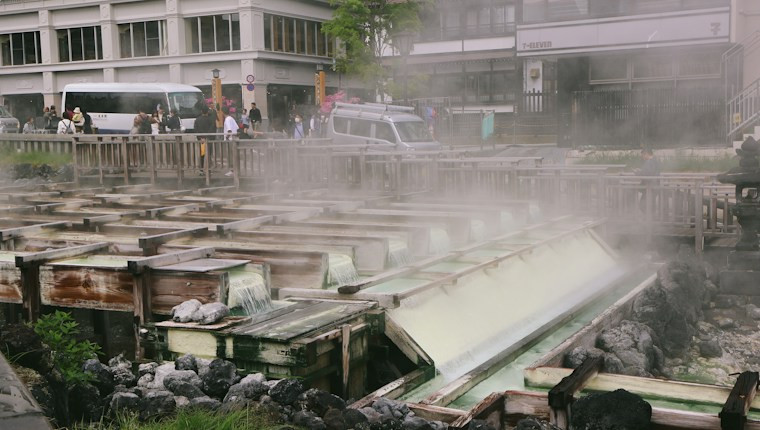
Kusatsu's hot spring scenery sits in the middle of town, so you park on the edge and walk in (illustrative image)
The Short Answer: Three Questions Decide Whether You Drive in Winter
Japan's winter tire rules are not written by calendar month. They depend on the road surface: on snow or ice you must have anti-skid measures. So "you only need winter tires after December" is simply wrong. GoodCars suggests the three questions below. If you cannot answer yes to all of them, take Kusatsu out of your driving plan.
| Question | If the answer is no |
|---|---|
| Have you driven on snow or ice before? | Do not drive to Kusatsu in winter. Take the bus or train |
| Does the booking page clearly state winter tires? | Assume the car does not have them and skip mountain roads |
| Can you arrive before dark and reschedule if it snows heavily? | Do not drive. A flight or hotel booking is no reason to go |
Only with three yeses do you move to the next step: checking conditions on the day. As a rough seasonal guide:
| Period | Road character | GoodCars' position |
|---|---|---|
| Late April to mid-October | Ordinary mountain road | Good for driving |
| Late October to early December | Ice and snow possible even in sun, more so at dawn and after dark | Easiest time to misjudge; check the forecast |
| Mid-December to March | Treat as a snow road | Not recommended for beginners |
| Early to mid-April | Thaw, with ice still possible morning and night | Confirm your tires just the same |
Those months are only a reminder; the real test is the road surface that day. This season, for example, the Shiga-Kusatsu Road was temporarily closed for ice as early as late October, then closed again for snow in early November.
A 500-Meter Gap: Judge Ikaho and Kusatsu Separately
Many itineraries treat these two towns as one area, but their winter difficulty is very different. GoodCars compares them here:
| Item | Ikaho | Kusatsu |
|---|---|---|
| Elevation | About 700 m | About 1,200 m |
| Distance from the Kan-Etsu Expressway | About 10 km, 20 min from Shibukawa-Ikaho IC | About 60 km from Shibukawa-Ikaho IC |
| Road character | Short climb; town streets are narrow and steep | Follows the Agatsuma River, then climbs steadily |
| Average winter low | No reliable figure found, so none given | About -5°C in December, -8°C in January and February |
The takeaway: Ikaho is close to the expressway with a short climb and a short way back if something goes wrong. Kusatsu means sixty kilometers of ordinary roads, finishing with a climb onto a highland. If you must drive in winter, GoodCars suggests going only as far as Ikaho. Even so, Ikaho is not snow-free: treat its hillside roads as icy, and the tire conditions stay the same.
Getting There from Tokyo: The Expressway Only Covers Half of It
The Kusatsu Onsen Tourism Association lists two routes from Tokyo. Distances below come from its official page; drive times are typical estimates from travel sources, counted from Nerima IC, and exclude traffic and breaks.
| Route | How it runs | Distance | Character |
|---|---|---|---|
| Kan-Etsu route (main) | Nerima IC → Kan-Etsu Expressway → Shibukawa-Ikaho IC → Routes 353 and 145 → Naganohara (Otsu) → Route 292 | About 163 km | Passes Ikaho; about 2.5 hours from Nerima IC |
| Joshin-Etsu route | Nerima IC → Fujioka JCT → Usui-Karuizawa IC → Route 18 → Naka-Karuizawa → Routes 146 and 292 | About 185 km | Can include Karuizawa; surface roads cross highland |
From Shibukawa-Ikaho IC, hotels usually quote about 90 minutes to Kusatsu, which means more than half the trip is on ordinary roads. Toll-free bypass sections have been opening along the Agatsuma River in recent years, but the full line is not finished, so your navigation may differ from older guides. Just follow the navigation.

The real route begins after you leave the expressway: traffic in autumn, road surface in winter (illustrative image)
If you are staying in central Tokyo, the GoodCars Kinshicho Station pickup is the most convenient: join the Shuto Expressway, then the Kan-Etsu. The drive times above start at Nerima IC, so from Kinshicho add the time on the Shuto Expressway, and put your actual starting point into your navigation for a real figure. Shuto tips are in our Tokyo and Kanto car rental guide. From Narita Airport you can take the Ken-O Expressway to the Kan-Etsu and skip central Tokyo. If you want to add Karuizawa, first read our Karuizawa and Nikko self-drive routes, which work out the travel cost between areas. We do not quote expressway tolls here; use the official NEXCO toll search with your actual entry and exit. For ETC details see our Japan expressway and ETC card guide.
Check Kinshicho Station Pickup
Planning Two Days: One Line in the Warm Months, Split Up in Winter
You do not need to return to the expressway between Ikaho and Kusatsu. Ordinary roads head west, so from spring to autumn it works as a single line. In winter, split the trip rather than adding the hardest stretch just to tick off both towns.
- Day 1 morning: pick up at Kinshicho Station, drive the Kan-Etsu to Shibukawa-Ikaho IC
- Day 1 midday: walk the Ikaho stone steps and have lunch
- Day 1 afternoon: drive west, check in at Kusatsu before dusk, stroll Yubatake at night
- Day 2 morning: yumomi water-stirring show and Sainokawara Park
- Day 2 afternoon: head back, avoiding the inbound Kan-Etsu on Sunday evening
- Drive in and out by daylight, and confirm your inn's parking location and slope first
- Check the forecast the day before and cancel the drive if snow is predicted
- Do not extend to Kusatsu on a whim
- Take the direct highway bus from Shinjuku to Kusatsu Onsen, about 4 hours
- Or take the train to Naganohara-Kusatsuguchi, then a bus of about 20 minutes
- Keep the rental car for lowland Kanto trips; GoodCars considers this the safest plan for beginners
Ikaho: Do Not Force the Car Up, Park Outside and Walk
Ikaho's centerpiece is its 365 stone steps, about 300 meters from the entrance up to Ikaho Shrine, lined with inns, souvenir shops and a public bath. The whole town is built on a slope and nothing a car can reach is wide. GoodCars recommends deciding where to park before you drive in.

Ikaho's hot spring town climbs a hillside, so lanes are narrow and steep (illustrative image)
- Municipal parking: about seven lots around the steps, from 300 yen for two hours depending on the lot. The Monogiki municipal lot has about 62 spaces, next to the Ikaho Ropeway.
- Free lot by Kajika Bridge: only about 20 spaces. Do not count on it in autumn.
- Autumn leaves: Kajika Bridge peaks from about late October to mid-November, and that is also when it is busiest. Waits for parking can be long on weekends, so arrive early.
- The steps in winter: they can ice over after rain or snow. Wear shoes with good grip.
Kusatsu: Keep the Car Away from Yubatake and Use These Lots
Yubatake sits at the center of town, the surrounding streets are narrow and full of pedestrians, and traffic is restricted during events. If you are staying over, ask your inn where to park. For day visitors, here is the information published by the Kusatsu Onsen Tourism Association, with standard car rates:
| Parking lot | Spaces | Fee | Notes |
|---|---|---|---|
| Yubatake Kanko Parking | About 180 | 700 yen under 2 hours | Closest to Yubatake, often full |
| Onsenmon Parking | About 101 | Free | About a 12-minute walk to Yubatake |
| Sainokawara Park Parking | About 120 | 550 yen under 2 hours | Sainokawara side of town |
| Tengu-yama Lot 1 | About 300 | Free; 1,000 yen at New Year | Closed at night, farther from town |
The easiest thing to schedule is the yumomi and dance show at Netsunoyu. Official show times are 9:30, 10:00 and 10:30 in the morning and 15:30, 16:00 and 16:30 in the afternoon, at 700 yen for adults and 350 yen for elementary pupils, with tickets on sale 30 minutes before each show. Sainokawara Open-Air Bath opens later in winter: 9:00 from December to March, against 7:00 in other months. GoodCars reminds you to check fees and closures on site.

A snowy onsen town is beautiful, but seeing it does not require driving yourself (illustrative image)
Shiga-Kusatsu Road and Mt. Shirane: Check It Is Open First
On the map, Route 292 runs north from Kusatsu as the Shiga-Kusatsu Road, crossing Shibutoge Pass, the highest point on Japan's national routes at 2,172 meters, into Shiga Kogen in Nagano. Many itineraries treat it as a shortcut to Nagano. There are two separate layers to check.
Layer one is the winter closure. The 17.9 km from the Tengu-yama gate in Kusatsu to Shibutoge Pass closes from about mid-November to late April every year. This season Gunma Prefecture has announced a closure from 13:00 on November 11 to 10:00 on April 21, and the reopening can change with snow: an avalanche during clearing work once delayed it by a full month. Outside that period the road can still close temporarily for ice, so go by notices from Gunma Prefecture and the Nakanojo civil engineering office.

The winter closure happens every year, and navigation may not warn you (illustrative image)
Layer two is the volcano. Kusatsu-Shirane is an active volcano, so closures are not always about snow. When the alert level for Mt. Shirane (Yugama area) was raised to 2, about 8.5 km between Sessho-gawara and the Manza junction was fully closed for nearly ten months, reopening only after the level returned to 1. At the time of writing:
- The alert level is 1, but entry is still banned within about 500 meters of the crater, so you cannot currently see Yugama.
- The summit parking area and rest facilities are not open. Kusatsu Town trialed a partial opening but ended it early because crowds and traffic threatened evacuation routes. The town says this was unrelated to volcanic activity, and no reopening date is set.
- The trails on Mt. Motoshirane are also closed.

Active craters can give off volcanic gas, and Yugama cannot be approached for now, so leave it off your plan (illustrative image)
Winter Tires and Chains: Do Not Assume the Car Has Them
GoodCars is a booking channel for Japanese suppliers. Vehicle equipment is decided by each supplier, and this article cannot vouch for it. Whether a Tokyo-area car has winter tires, whether they can be added and whether chains may be used all depend on the supplier and the vehicle, so go by what the booking page shows. If you see nothing clear, assume the answer is no rather than trying your luck at the counter.
The Kusatsu Onsen Tourism Association's snow advice is blunt: summer tires alone will not do. You need winter tires or chains, and it recommends carrying chains in every case except four-wheel drive with winter tires. It also notes that conditions often start to change about ten minutes up from the Otsu junction in Naganohara, and that snow can suddenly start as you enter Kusatsu, even on a clear day.

Road surfaces refreeze after dusk, so plan to arrive before dark in winter (illustrative image)
- Four-wheel drive is not a pass. Under a winter tire restriction on an expressway, a 4WD without winter tires or chains still cannot proceed.
- Winter tires are not a cure-all. In heavy snow, a chains-for-all-vehicles restriction may be issued. Chains only help if you have practiced; the roadside is the worst place to try for the first time.
- Costs if something goes wrong. Insurance and compensation follow what the booking page shows, so read how snow incidents are handled before you leave.
- Be ready to turn back. Roadside chain bays are a reminder of the snow line. If cars ahead are fitting chains, consider turning around.
For basic snow technique, GoodCars goes deeper in our Hokkaido winter self-drive guide, and those principles apply in Gunma too. To compare other routes near Tokyo, see our Mt. Fuji and Lake Kawaguchiko route, but the Kawaguchiko area also gets snow and ice in winter, and the same tire conditions apply.
FAQ
Q1. Can I drive to Kusatsu in November?
From November on, treat snow or ice as possible. This season the higher Shiga-Kusatsu Road had already closed for snow in early November. That is not inside Kusatsu town, but it shows the mountains have turned wintry, so do not judge by the month. Check the forecast the day before. Stay off mountain roads at dawn and after dark; GoodCars suggests arriving before 3 p.m.
Q2. If I rent a 4WD, can I skip winter tires?
No. Four-wheel drive helps you start moving, not stop, and the anti-skid requirement still applies. Kusatsu's own advice ranks 4WD with winter tires first, not 4WD alone.
Q3. Can I take the Shiga-Kusatsu Road from Kusatsu to Nagano?
Outside the closure period, yes, but confirm it is open that day. It closes from about mid-November to late April, and volcanic conditions can close it separately. In winter it is not an option, so do not plan around it.
Q4. Will I be able to see Yugama crater lake?
Not at the time of writing. Entry is banned within about 500 meters of the crater and the summit parking is not open. Treat Mt. Shirane as a bonus if it reopens, not as the main event.
Q5. Is a day trip from Tokyo possible?
Ikaho yes, Kusatsu not recommended. One way takes about 2.5 hours from Nerima IC alone, and picking up at Kinshicho adds the Shuto Expressway on top, so a round trip is well over five hours at the wheel before traffic, and driving at night after a long soak is unsafe. GoodCars recommends at least one night in Kusatsu.
Q6. Do I need an ETC card for this route?
Not strictly, but the Kan-Etsu and Joshin-Etsu are long and ETC is more convenient. If the supplier offers an ETC card, GoodCars suggests confirming it when you book. Whether the car has an ETC unit also depends on the supplier and vehicle.
Q7. What license do I need to drive in Japan?
Most visitors need a 1949 Geneva Convention International Driving Permit plus their home license and passport. Japan does not accept permits in the Vienna Convention format. Switzerland, Germany, France, Belgium, Monaco and Taiwan instead use the original license with an official Japanese translation, and a self-made translation is invalid. Licenses from mainland China and Indonesia cannot be used in Japan. You can drive for up to one year from entry, within your license's validity. See our complete guide to renting a car in Japan.
- Kinshicho Station / Chiba Station / Narita Airport (Tokyo and Kanto)
- New Chitose Airport (Hokkaido)
- Fukuoka Airport (Kyushu)
- Naha Airport (Okinawa)