


Where to Pick Up a Car in Tokyo: Kinshicho vs Chiba Station, No Airport Trip Needed
You have spent a few days in Tokyo and want to drive out for the second half of the trip. The usual snag: your hotel is in the city, but the rental car is back at the airport. Besides Narita Airport, GoodCars has two station pickup points in the Tokyo area, Kinshicho Station and Chiba Station. You can take a train there and start driving, with no trip back to the airport.
Both stations sit on the JR Sobu Line and share the same road corridor heading east. What differs is whether you cover that stretch by train or behind the wheel. GoodCars boils this guide down to one rule: decide which way you are leaving the city, then pick the station.

When you pick up in Tokyo, the first question is not the car but which direction you are leaving in (illustrative image)
The short answer: your direction decides your station
| Where you are heading | Suggested pickup | Why |
|---|---|---|
| Boso Peninsula, Kujukuri, Choshi | Chiba Station | You start east of Tokyo with no Shuto Expressway to deal with |
| Nikko, Karuizawa, points north | Kinshicho Station | Head east to the Keiyo Road, then north on the Gaikan, skipping central Tokyo |
| Hakone, Mount Fuji | Compare all three | Both stations are on the east side, so going west takes extra effort (see below) |
| Leaving straight from a Tokyo hotel with lots of luggage | Kinshicho Station | Closest to central Tokyo, shortest train ride |
| Nervous about the Shuto Expressway, first time driving on the left | Chiba Station | A roughly 30-minute train ride replaces the urban expressway |
If you are staying inside Tokyo the whole time, GoodCars still says don't rent, for the reasons in our Tokyo and Kanto car rental guide. This article is for one kind of traveller: based in Tokyo, driving only for the later part of the trip.
Getting there: one station is in Tokyo, the other is over half an hour out
Kinshicho Station is in Sumida Ward, Tokyo, served by the JR Sobu Line and the Tokyo Metro Hanzomon Line. On the Sobu Rapid Line from Tokyo Station it is the third stop, after Shin-Nihombashi and Bakurocho. The Hanzomon Line runs straight through Otemachi and Shibuya, so many hotels nearby need no JR transfer.
Chiba Station is in Chiba City, a junction of the Sobu, Sotobo, Uchibo and Narita lines. It also has the Chiba Urban Monorail, and Keisei Chiba Station is right next door.
| Route | Train time (approx.) | Note |
|---|---|---|
| Tokyo Station to Chiba Station | 38 minutes | Direct on the Sobu Rapid Line, via Kinshicho |
| Kinshicho Station to Chiba Station | 31–32 minutes | Rapid; local trains take about 45 minutes |
| Narita Airport to Kinshicho Station | 1 hr 16–18 minutes | Direct rapid service via Chiba |
| Chiba Station to Narita Airport | About 29 minutes at best | Some Narita Express trains stop at Chiba |
Times vary by train, so check a route planner on the day. The Sobu Rapid platforms at Tokyo Station are deep underground, so allow extra walking time with large bags.

Kinshicho is in Sumida Ward, close to the Skytree area, which makes it an easy last night before pickup (illustrative image)
Hours: "all day" at Chiba does not mean a staffed counter all night
| Pickup point | Times shown when booking (tested) |
|---|---|
| Kinshicho Station | 08:00–20:00 |
| Chiba Station | 00:00–23:59 |
| Narita Airport | 08:00–20:00 |
These are the time windows we saw in the GoodCars booking system. What the booking page shows always takes priority, so check it again for your own dates.

Beyond the unknown handover, a first drive on unfamiliar roads in the dark is best avoided (illustrative image)
Even if a late pickup turns out to be possible, GoodCars advises against making your first left-side drive a night drive. A morning pickup means readable signs and more breathing room.
Leaving from Kinshicho: easy going east, hardest stretch going west
Kinshicho sits next to the Kinshicho ramps of Shuto Expressway Route 7 (Komatsugawa Line). The route runs about 10.4 km, fully elevated, two lanes each way, with ramps in both directions. Going east and going west on Route 7 are two very different experiences.
East: Route 7 runs straight into the Keiyo Road. With ETC, a standard car pays about 450 yen for the roughly 7.9 km from Kinshicho to the Keiyo Road connection. From there you can continue to Chiba and Boso, or switch to the Gaikan at Keiyo JCT. To skip even that stretch, you can take surface National Route 14 toward Shinozaki and join the Keiyo Road there, at the cost of many traffic lights. Follow your navigation for the actual entrance.
North: from the Keiyo Road, take the Gaikan toward Misato to reach the Joban, Tohoku (Kawaguchi JCT) and Kan-Etsu (Oizumi JCT) expressways. That covers Nikko and Karuizawa without entering central Tokyo. The Gaikan has no fuel stations and just one parking area, so check your tank first.
West: toward the city, Route 7 reaches Ryogoku JCT and then the Hakozaki area. Within less than 2 km the junctions come one after another, with left merges and right exits mixed together. Even Japanese drivers rate it as difficult, and it is a chronic bottleneck. Meeting it right after pickup is unkind to a first-time visitor. Westbound Route 7 also leads only toward Hakozaki, with no junction that turns directly onto the Central Circular Route, so you must get past Hakozaki before you can join it.
Komatsugawa JCT only links Route 7 on the Chiba side with the Central Circular Route on the Saitama side. Heading east from Kinshicho on Route 7, you cannot turn onto the Central Circular Route here. To go around the outside toward the north, use the Keiyo Road and Gaikan route above.
Check Kinshicho Station Pickup
Leaving from Chiba: Boso and Kujukuri are straight down the road
The biggest benefit of Chiba Station is that the train has already taken you past the Shuto Expressway. The Keiyo Road runs along the edge of the city, and GoodCars treats it as one trunk road with several branches:
- South (Boso): follow the Keiyo Road to Soga and join the Tateyama Expressway via Chiba-Minami JCT. For Nokogiriyama, Tateyama and Kamogawa, see our Boso Peninsula self-drive route.
- East (Kujukuri): take the Chiba-Togane Road from Chiba-Higashi JCT to Togane JCT, where it meets the Ken-O Expressway.
- Northeast (Narita, Choshi): join the Higashi-Kanto Expressway at Miyanogi JCT.
- North (Kan-Etsu, Tohoku): take the Keiyo Road toward Tokyo and switch to the Gaikan toward Misato at Keiyo JCT. This junction is not fully directional: the Chiba side and the Takaya side do not connect directly.

Chiba is a big city with real traffic around the station, so set your navigation before pulling away (illustrative image)
The Keiyo Road has its regular trouble spots too. Past public data shows holiday-morning jams toward Chiba around Anagawa IC, holiday-evening jams toward Tokyo around Kaizuka IC, and weekday commuter jams toward Tokyo. If you return on a weekend evening, leave extra time.
The Ken-O Expressway is still opening in stages on the east side of Chiba Prefecture, so new sections may be newer than your car's navigation map. If the route differs from your phone, follow the road signs.

Heading south or east from Chiba Station, the coast is far closer than from central Tokyo (illustrative image)
Avoiding the Shuto Expressway: the goal is to stay out of the centre
How the Shuto merges work and how its route colours read are covered in the Tokyo and Kanto car rental guide. Here we only look at how to route around it from these two stations.

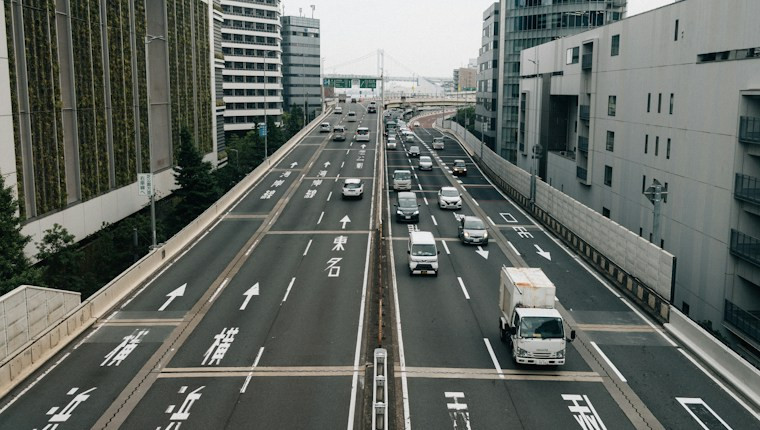
Shuto Expressway viaducts and surface streets often stack on top of each other, so read the sign before taking a ramp (illustrative image)
| Direction | From Kinshicho | From Chiba |
|---|---|---|
| Boso | Route 7 east, Keiyo Road, Tateyama Expressway | Keiyo Road, Tateyama Expressway, no Shuto at all |
| Nikko, Karuizawa | Route 7 east, Keiyo JCT, Gaikan | Keiyo Road, Keiyo JCT, Gaikan |
| Hakone, Mount Fuji | Hard to avoid fully; you reach the Central Circular Route only after Hakozaki, then stay off the Inner Circular Route | Tokyo Bay Aqua-Line to Kawasaki; some Shuto in Kanagawa, but not central Tokyo |
Why is west so awkward? The Gaikan does not yet connect to the Tomei Expressway, so from the east side you either cross Tokyo or take a very long way around. If you do cross, stay on the outer Central Circular Route to Route 3 and keep off the Inner Circular Route. If Mount Fuji and Lake Kawaguchi is your main goal, the Narita option in the next section may be simpler.
On ETC: apart from some exception sections, cash vehicles on the Shuto Expressway pay a single flat base toll, currently 2,130 yen for a standard car, against an ETC minimum of 300 yen. Kinshicho toward the Keiyo Road is one of the exceptions, but exceptions apply only in certain directions, so check the amount with the official toll search. ETC-only entrances are planned to reach 134 in total, and the official goal is to convert all but a few, such as mainline toll plazas. These entrances do not accept cash. We could not find an official list confirming the status of the Kinshicho entrance, so follow the signs on site. If the supplier offers an ETC card, we suggest taking it; whether one is offered is shown on the booking page. If you enter an ETC-only lane by mistake, do not U-turn or reverse. Drive into the lane marked “サポート” (Support), stop, and follow the instructions over the intercom. More in our Japan expressway and ETC card guide.
Compared with Narita Airport: it saves more than driving time

Driving from arrival? Choose Narita. Tokyo first and driving later? Choose a station (illustrative image)
| Point | Kinshicho Station | Chiba Station | Narita Airport |
|---|---|---|---|
| Best for | Tokyo stays, driving at the end | Tokyo or Chiba stays, heading to Boso or Kujukuri | Driving on arrival, or flying out after return |
| From Tokyo Station | Third stop on the Sobu Rapid Line | About 38 minutes | A dedicated trip, the longest of the three |
| Shuto Expressway | Route 7 is likely | Not needed in most directions | Avoidable heading west via the Ken-O |
| To Hakone or Fuji | Must cross Tokyo | Detour or Aqua-Line | Ken-O around the outside, easiest if you dislike the Shuto |
| Times (booking page takes priority) | 08:00–20:00 | 00:00–23:59 | 08:00–20:00 |
Narita's strength is leaving the moment you land; counters, shuttles and returns are covered in our Narita Airport car rental guide. But if your first days are in Tokyo, GoodCars does the maths differently: every extra rental day adds rental cost and hotel parking for a car you barely use. Starting the rental on the day you really leave Tokyo, at the pickup point nearest your hotel, usually works out better.
Think about the return as well. GoodCars suggests checking on the booking page whether a one-way return is available rather than assuming it is. If you fly out of Narita, add the train ride after return: Chiba Station is closer to the airport than Kinshicho.
Before you go: whether your licence works in Japan
Most visitors need an International Driving Permit in the 1949 Geneva Convention format, plus their home licence and passport, all three together. Vienna Convention permits are not valid in Japan. Switzerland, Germany, France, Belgium, Monaco and Taiwan work differently: the original licence plus an official Japanese translation from a recognised body such as JAF. Your own translation is not accepted. You may drive for up to one year from entry, within the licence's validity.
Insurance and coverage vary by supplier plan. When you book through GoodCars, what the booking page shows applies. The wider system is explained in our complete Japan car rental guide.
FAQ
Q1. Kinshicho or Chiba for a first drive in Japan?
If you are heading east or south, Chiba Station lets you skip the Shuto Expressway from the start. As GoodCars sees it, about 30 more minutes on a train buys a much simpler first stretch of road.
Q2. Chiba shows 00:00–23:59. Can I pick up in the middle of the night?
That is what the system shows, but we could not confirm whether staff are present or how handover works late at night, so we don't recommend planning on it. Follow the booking page and your order confirmation, and pick up in daylight where you can.
Q3. Is Kinshicho a good start for Hakone or Mount Fuji?
It is doable, but you must cross Tokyo and meet the Ryogoku to Hakozaki stretch almost immediately. Confident drivers will manage. If the Shuto worries you, compare a Narita pickup and the Ken-O.
Q4. If I book station pickup, is the car at the station?
Not necessarily. Check the booking page and your order confirmation for the location; we found no reliable data, so we give no walking time here. GoodCars suggests allowing time for the walk from the station.
Q5. Is it a problem to go back to a Tokyo hotel for one more night after pickup?
The car becomes a burden. Check first whether the hotel has parking and what its height limits are; see the Tokyo and Kanto guide for city parking costs and limits. It is better to leave Tokyo on pickup day.
Q6. Do I have to have an ETC card?
It is not mandatory, but apart from some exception sections, cash vehicles on the Shuto Expressway pay the flat base toll, so on most trips the difference is obvious. If the supplier offers a card, we suggest adding it when you book. Vehicle equipment and card availability are as shown on the GoodCars booking page.
Q7. For Boso, which is better: Kinshicho or Narita?
If you are staying in Tokyo, choose Chiba Station first and Kinshicho second, as both beat going back to Narita. Choose Narita only if you are heading to Kujukuri or Choshi right after landing.
- Kinshicho Station / Chiba Station / Narita Airport (Tokyo and Kanto)
- New Chitose Airport (Hokkaido)
- Fukuoka Airport (Kyushu)
- Naha Airport Station (Okinawa)