


Boso Peninsula Self-Drive Route | Nokogiriyama, Tateyama and Kamogawa from Narita or Chiba
The Boso Peninsula is the direction most people forget the moment they land at Narita. Almost everyone turns west toward Hakone and Mount Fuji, yet the stretch to the south — the quarried cliffs of Nokogiriyama, the sunset pier at Tateyama, the marine park at Kamogawa — sits one to two hours away by car, and not one of those places is comfortably reachable by train. The question GoodCars hears every season is the same: "Is one day enough for Boso?" This article does not repeat whether you should rent a car in Kanto at all (the Tokyo and Kanto car rental guide already covers that decision). It goes one level deeper, into last admission times, when the car parks close, and which days a venue simply does not open — because on Boso it is never the distance that wrecks an itinerary. It is the cut-off times.

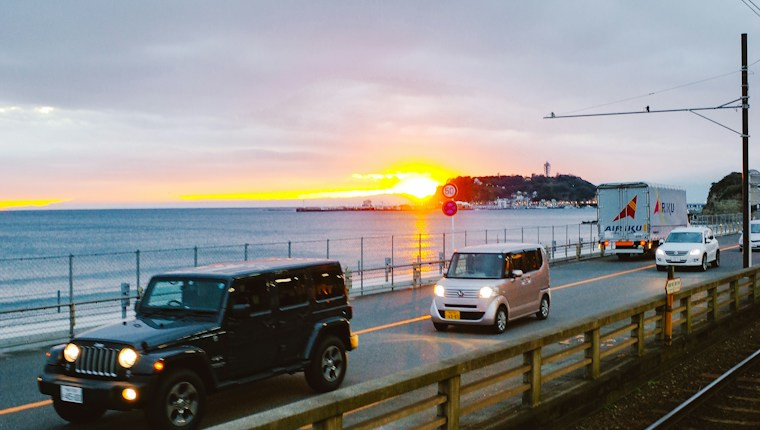
Boso's coastal roads are easy driving; the hard part is arriving at the right place at the right hour (illustrative image)
Start here: Boso is not one route, it is two directions that do not combine

Southern Boso is a loop of coastal towns; the Kujukuri and Choshi side lies on the opposite edge (illustrative image)
Plenty of itineraries treat "the Boso Peninsula" as a single destination, and that is exactly where the planning goes wrong. From Narita there are two directions, and they do not chain together.
| Direction | Highlights | From Narita | GoodCars's note |
|---|---|---|---|
| North-east (upper outer coast) | Kujukuri beach, Choshi and Cape Inubosaki | About 1–1.5 hours | Doable on landing day, works as a half day |
| South (inner and southern Boso) | Nokogiriyama, Tateyama, Kamogawa | About 1.5–2 hours | The three link into a loop — plan two days |
The whole peninsula sits between those two options, so trying to do both in one day spends half of it driving through the middle. GoodCars's advice is blunt: treat the southern loop in this article as a self-contained two-day trip and keep Kujukuri and Choshi for another time.
The reason the southern three work as a loop is geography: Nokogiriyama sits on the west coast, Tateyama at the southern tip, and Kamogawa on the east coast. Follow the shoreline and you never double back. If you genuinely only have one day, choose between "Nokogiriyama plus Tateyama" and "Kamogawa on its own" — they are different kinds of day. One is walking and viewpoints; the other is most of a day inside a single park.
Nokogiriyama: two ways up the mountain, and last admission is an hour before closing

Nokogiriyama's drama comes from the quarried vertical rock faces, not from its height (illustrative image)
Nokogiriyama is only a little over 300 metres high, but generations of stone quarrying left sheer walls, and the ledge jutting out at the top delivers the most memorable view on this route. The temple grounds on the summit, Nihon-ji, charge separate admission and contain the great Buddha and the rock carvings. For a self-driver, only one thing really needs to be understood: there are two ways up, they close at different times, and the temple stops admitting visitors earlier than either of them.

The ropeway and the toll road run on separate clocks — plan around whichever closes first (illustrative image)
| Way up | Hours | Indicative cost | GoodCars's note |
|---|---|---|---|
| Nokogiriyama Ropeway | Roughly 9:00–17:00 in the main season; about 9:00–16:00 in winter (mid-November to mid-February) | Around ¥1,200 return for adults; about four minutes each way | Closed for annual inspection around mid-January, and suspended in bad weather |
| Nokogiriyama toll road | Toll gate closes around 16:30 | Around ¥1,000 for a standard car | The summit car park closes around 16:00 — earlier than the gate |
| Nihon-ji temple | Roughly 9:00–16:00 | Around ¥700 adults, ¥400 children | Last admission around 15:00, an hour before closing |
Stack those three rows and the binding constraint is the 15:00 last admission at the temple — not the ropeway's 17:00, and not the toll gate's 16:30. If you drive up, pull the deadline forward again: the summit car park shuts around 16:00, so you cannot linger until closing. GoodCars's approach is to put Nokogiriyama in the morning and be at the foot of the mountain by midday at the latest. Parking, the temple and the ledge all become comfortable, and you are not racing a closing gate on the way down.
Which way up? Travelling with older parents or small children, or not keen on long stair sections — take the toll road straight to the summit car park and skip the lower trail. Want the ropeway view, or nervous about passing oncoming cars on a mountain road — take the ropeway and leave the car at the base station. One warning from GoodCars: a ropeway is a weather-dependent facility, so check whether it is running on the morning itself. If it is windy, switch to the toll road before you set off rather than improvising at the bottom.
For lunch, the roadside station at Hota Shogakko — a closed primary school converted into a michi-no-eki — is about a minute from the Kyonan-Hota interchange, has free parking for roughly 190 cars, and opens around 9:00–17:00 (individual shops vary). It is the easiest place to park on the entire route.
See GoodCars pickup options at Narita Airport
Kamogawa's marine park has three time gates, and one of them is "is it open today"

This is the one stop on the route measured in hours rather than minutes (illustrative image)
The marine park at Kamogawa is southern Boso's largest attraction and the only place on this route that deserves half a day. Its car park holds around 1,200 cars at roughly ¥1,200 per day for a standard vehicle, so capacity is not the issue. Time is, and in three separate ways:
- Closing time is published day by day. Weekdays are usually 9:00–16:00; weekends, public holidays and peak periods extend to 16:30 or 17:00. It is not a tidy weekend rule — each date is listed individually.
- Ticket sales and the last entry to the car park both stop an hour before closing. On a 16:00 day that means no tickets and no parking after 15:00. This is the single most common trap for overseas visitors.
- There are irregular closed days in winter. Between December and February some days — usually weekdays — the park does not open at all. The dates are not fixed; check the official calendar.
⚠️ The one thing GoodCars most wants you to take away: do not schedule this stop for the afternoon. If you are still at Nokogiriyama or Tateyama in the morning and only head to Kamogawa after lunch, there is a real chance you arrive after ticket sales have closed. The correct plan is to be there at opening on your second morning, and to check the day before whether it is open at all — especially in winter, when full closure days genuinely exist.
Admission runs around ¥3,300 for adults, ¥2,000 for primary and middle school students and ¥1,300 for younger children. GoodCars suggests treating this as the anchor of half a day rather than something you drop in on, which is the only way the ticket and the drive make sense.
Tateyama: the one stop where a parking space decides whether you see the sunset

The pier itself is free and easy; the difficult part is parking in the half hour around dusk (illustrative image)
Tateyama sits at the southern tip and is where you spend the night. Its signature is the Tateyama Sunset Pier, roughly 500 metres long and billed as the longest pier in Japan, which you can walk to the end of to watch the sun drop into the sea. The pier is free and needs no booking, but here is the part most itineraries miss: the pier has no car park of its own.
| Parking option | Indicative capacity | GoodCars's note |
|---|---|---|
| Nagisa-no-Eki, the visitor facility by the fishing harbour | About 91 standard cars | Closes at night — come back after sunset and you may find it locked |
| Around Hojo beach | Roughly 300 free spaces | Fills quickly at dusk and in summer; arrive early |
That is what GoodCars means by a parking space deciding your sunset: sunset does not wait, and the half hour either side of it is exactly when parking here is tightest. In practice, arrive an hour before sunset, park first, then walk out along the pier at your own pace. If you are running late, do not circle looking for a space — drop your bags at the hotel and come back at dawn instead. It looks just as good, with nobody competing for a space.
On sequencing, GoodCars recommends making Tateyama the end of day one: Nokogiriyama in the morning, lunch at the foot of the mountain, then south along the inner-bay coast through the afternoon, arriving in time for sunset and staying the night. Day two runs east to Kamogawa, arriving for opening.
Two counter-intuitive things about tolls on Boso

The roads crossing the middle of the peninsula no longer charge a toll, though older sources still say they do (illustrative image)
Boso tolls work against intuition in two ways, and GoodCars will take them one at a time.
First: two former toll roads across the middle of the peninsula are now free. The Boso Skyline, which crosses the inland hills, and the Kamogawa toll road, which runs toward the east coast, were both opened to free traffic once their collection periods expired, and management passed from the road corporation to Chiba Prefecture. They used to cost in the region of ¥300 and ¥210 for a standard car; now you simply drive through. GoodCars raises this because a great many older articles and maps still mark them as toll roads — there is no reason to budget for a charge that no longer exists, or to detour around it. Heading from Tateyama to Kamogawa, or cutting from the west coast to the east, these are the direct routes.
Second: if you are driving out from central Tokyo across the bay on the Aqua-Line, the return leg has a time lock. That crossing is heavily discounted for ETC users — around ¥800 for a standard car on weekdays — but a time-of-day pricing trial currently applies on Saturdays, Sundays and public holidays, and the Kawasaki-bound direction gets noticeably more expensive through the afternoon:
| Time band (weekends and holidays) | Kisarazu to Kawasaki (return) | Kawasaki to Kisarazu (outbound) |
|---|---|---|
| 0:00–4:00 | ¥400 | ¥400 |
| 5:00–7:00 | ¥800 | ¥1,000 |
| 7:00–13:00 | ¥800 | ¥800 |
| 13:00–19:00 | ¥1,600 | ¥800 |
| 19:00–20:00 | ¥800 | ¥800 |
| 20:00–24:00 | ¥400 | ¥800 |
That table only matters if you pick the car up in central Tokyo and cross the bay. Collect at Narita or Chiba Station and you never touch that road — you run south on the expressway down the eastern side of the peninsula instead. So GoodCars's advice is simple: if Boso is the main event, pick up at Narita or Chiba Station. The driving line is cleaner and the time lock disappears. If you must start from central Tokyo, avoid returning during the weekend afternoon band, or just come back later in the evening. If the supplier offers an ETC card, add one — the expressway sections here are short, but without ETC no discount applies at all.
As for what the run south from Narita or Chiba Station actually costs, it varies by interchange and vehicle class, so GoodCars suggests checking your specific route on the official toll search rather than copying a figure from someone else's itinerary.
How to plan the two days, and which pickup point to choose
Stack all those cut-offs together and this is the plan GoodCars recommends:
| When | What | The clock that binds it |
|---|---|---|
| Day 1 morning | Pick up at Narita, drive south to Nokogiriyama | Temple last admission around 15:00; summit car park closes around 16:00 |
| Day 1 midday | Lunch and supplies at the roadside station below the mountain | Closes around 17:00; parking free |
| Day 1 evening | South along the inner-bay coast to Tateyama and the sunset pier | Sunset time; the harbour car park closes at night |
| Day 2 morning | East to Kamogawa, into the marine park at opening | Tickets and parking stop an hour before closing; winter closure days |
| Day 2 afternoon | North to return the car at Narita or Chiba Station | Branch opening hours; refuel before returning |
On pickup points, GoodCars splits it like this:
- Narita Airport — the most direct option if you are driving on landing day. You leave the airport without crossing central Tokyo and run straight south. Counter locations, the free shuttles and where to refuel before returning are covered in detail in the Narita Airport car rental pickup guide.
- Chiba Station — best if you spend a few days in Tokyo first and take the train out to collect the car. It is the closest point to Boso and saves the round trip out to Narita.
- Kinshicho Station — for travellers staying in central Tokyo who want to start from the city. The trade-off is the bay crossing and that weekend afternoon pricing band on the way back.
Pickup points and the documents you need
These are the GoodCars pickup points in Japan available to book online. For this route, the first three are the relevant ones:
| Pickup point | Destination cluster | Booking link |
|---|---|---|
| Narita Airport, Chiba | Tokyo, Kanto and the Boso Peninsula | Check availability |
| Chiba Station | Chiba and Boso | Check availability |
| Kinshicho Station | Central Tokyo and the Kanto fringe | Check availability |
| New Chitose Airport | Hokkaido | Check availability |
| Fukuoka Airport | Fukuoka and Kyushu | Check availability |
| Naha Airport Station | Okinawa | Check availability |
On documents, the default for most nationalities is an International Driving Permit in the 1949 Geneva Convention format, carried together with your home licence and your passport. Japan recognises only that format: an IDP issued under the Vienna Convention format is not valid here, which catches out a number of European and Asian drivers every year, so check which convention your issuing country uses before you fly. A small group of countries and territories instead drive on their own licence plus an official Japanese translation rather than an IDP — Switzerland, Germany, France, Belgium, Monaco and Taiwan — and that translation must come from an authorised body, never from you. Two important exclusions: licences issued in mainland China and in Indonesia cannot be used to drive in Japan at all, with or without an IDP. In every case you may drive for up to one year from your date of entry, and no longer than the validity of the licence or permit itself. Fuller detail on documents, insurance and driving on the left is in the GoodCars complete guide to renting a car in Japan.
Book your GoodCars pickup at Narita Airport
FAQ
Q1. Can the Boso Peninsula be done in a day?
It depends which side you mean. Kujukuri and Choshi are about one to 1.5 hours from Narita and work as a half-day round trip. The Nokogiriyama, Tateyama and Kamogawa loop in this article is a coastal circuit, and GoodCars recommends two days. With only one day, pick either "Nokogiriyama plus Tateyama" or "Kamogawa on its own" rather than squeezing both.
Q2. Should I drive up Nokogiriyama or take the ropeway?
With older relatives or small children, or if you would rather avoid long stair sections, take the toll road (around ¥1,000 for a standard car) straight to the summit car park. For the ropeway view, or to avoid narrow mountain passing, ride up instead (around ¥1,200 return for adults). GoodCars's warning: the ropeway stops in bad weather, so check on the morning — and note the summit car park closes around 16:00, earlier than the toll gate.
Q3. What time do I need to reach Nihon-ji temple?
Opening hours run roughly 9:00–16:00, but last admission is around 15:00, an hour before closing. GoodCars suggests putting the whole Nokogiriyama section in the morning and being at the foot of the mountain by midday, so parking, the temple and the viewing ledge are all unhurried.
Q4. Can I visit the Kamogawa marine park in the afternoon?
Not advisable. Ticket sales and the last entry to the car park both close an hour before the park does, so on a 16:00 day you are locked out from 15:00. Closing time is also published date by date, with longer hours only at weekends. GoodCars plans it for opening time on the second morning, and checks the day before whether the park is open at all — winter weekdays include irregular closure days.
Q5. Where do I park for the Tateyama sunset pier?
The pier has no dedicated car park. The visitor facility beside it holds about 91 cars but closes at night, and the Hojo beach area has roughly 300 free spaces that fill at dusk. GoodCars's habit is to arrive an hour before sunset, park, then walk. If you are too late, come back at dawn instead.
Q6. Are the Boso Skyline and the Kamogawa toll road still toll roads?
No. Both were opened to free traffic once their collection periods ended, and management transferred to Chiba Prefecture. Plenty of older pages still label them as toll roads, so GoodCars suggests ignoring any advice to detour around a charge that no longer exists.
Q7. Is the Aqua-Line crossing from Tokyo worth it?
On weekdays yes, on weekend afternoons no. ETC pricing for a standard car is around ¥800 on weekdays, but the time-of-day trial applies at weekends and on public holidays, and the Kawasaki-bound direction costs around ¥1,600 between 13:00 and 19:00. GoodCars's suggestion: if Boso is the main trip, collect at Narita or Chiba Station and skip that road entirely; if you do start in the city, avoid returning in the weekend afternoon band.
Information accuracy note: the tolls, opening hours, last admission times, closure days, parking capacities and parking fees given here are indicative figures compiled by GoodCars from publicly available information at the time of writing. Charges, operating hours and seasonal conditions in Japan are revised periodically; actual amounts and conditions are governed by on-site signage and the official announcements of each facility and road operator, so please confirm again before you travel. Ropeway operation, whether the marine park is open on a given day, and the period of the time-of-day pricing trial change daily or seasonally and must be checked on the day.
Driving eligibility note: the documents required to drive in Japan depend on where your licence was issued, so please confirm against your own issuing country. Most nationalities need an International Driving Permit in the 1949 Geneva Convention format together with the home licence and passport; a permit in the Vienna Convention format is not valid in Japan. A small number of countries and territories, including Switzerland, Germany, France, Belgium, Monaco and Taiwan, drive instead on the original licence plus an official Japanese translation issued by an authorised body — self-translation is not accepted. Licences issued in mainland China and in Indonesia cannot be used to drive in Japan under any arrangement. The permitted driving period is up to one year from the date of entry and never longer than the validity of the licence or permit itself. If the documents do not match, you will not be able to collect the car at the counter, and GoodCars cannot resolve that on your behalf.