






Eastern Hokkaido Self-Drive: How Many Days You Need for Shiretoko, Akan and Kushiro from New Chitose
Shiretoko, Lake Akan and the Kushiro Marsh are the part of Hokkaido most worth driving to, and the part whose distances are most often underestimated. On a map they are simply "the right-hand side of Hokkaido". In reality, New Chitose Airport to Utoro on the Shiretoko Peninsula is close to 400 km one way. This GoodCars guide does not argue about which view is best. It does one job: add up the kilometres and tell you how many days you actually need.
The short answer: Shiretoko takes 5 days and 4 nights at the bare minimum, 6 days and 5 nights to be comfortable, and with 4 days or fewer you should drop it. This is a June-to-September route. For winter, see the section below where we advise against it.

Everything in eastern Hokkaido is far from everything else, usually two or three hours by car (illustrative image)
The bottom line: the way there is a full day, and so is the way back
Most itineraries fall apart because only the outbound leg was counted. GoodCars currently offers New Chitose Airport as its Hokkaido pick-up point, with no location in the east, so treat this route as a drive out and a drive back.
Mind the opening hours as well. The New Chitose location runs from 09:00 to 18:00 (go by what the booking page shows). If you land in the afternoon, reaching Lake Akan on day one means driving after dark. If you need to return by 18:00 on your last day, you cannot spend the night before in Shiretoko. Those two limits leave you with roughly one day fewer than your flight dates suggest.
The distances, added up: one table decides your day count
Here are the main legs as GoodCars has compiled them. Those marked "official" come from Japan's Ministry of the Environment, the Hokkaido Regional Development Bureau or Hokkaido's official tourism site. The rest are approximate map-route estimates of driving time only, without breaks, so read them generously.
| Leg | Distance | Driving time |
|---|---|---|
| New Chitose → Obihiro | about 165 km | a little over 2 hours |
| New Chitose → Lake Akan | about 270 km | about 4 hours |
| Sapporo → Kushiro (Doto Expressway) | — | about 4 h 12 min (official, city hall to city hall, not split by season) |
| New Chitose → Utoro | about 390 km | 6 hours or more |
| Kushiro Airport → Utoro | about 172 km | about 210 min (official) |
| Lake Akan → Kawayu Onsen | about 60 km | about 1 hour |
| Kawayu Onsen → Utoro | about 85 km | about 1.5 to 2 hours |
| Abashiri → Utoro | — | about 1 h 30 min (official) |

A sign saying 130 km to go is routine out here. The road is straight, but the distance is real (illustrative image)
Two things catch people out. First, the expressway does not reach Shiretoko. The Doto Expressway runs east to Ashoro and Akan and on to Kushiro, and everything after that is ordinary road. The Ministry of the Environment's own figure of 210 minutes for 172 km from Kushiro Airport to Utoro works out at under 50 km/h. Second, long stretches of the Doto Expressway are still single-carriageway with one lane each way, so you cannot pass slow traffic. Do not calculate at 100 km/h.
Put that back into a trip and the GoodCars verdict looks like this:
| Length | What fits | Total distance | Verdict |
|---|---|---|---|
| 4 days or fewer | Kushiro Marsh, Lake Akan, Lake Mashu; no Shiretoko | about 750 to 800 km | Drop Shiretoko |
| 5 days, 4 nights | Lake Akan, Lake Mashu, Shiretoko; skip Kushiro Marsh | about 900 km | The minimum; needs a morning pick-up |
| 6 days, 5 nights | Kushiro Marsh, Lake Akan, Lake Mashu, Shiretoko | about 1,050 km | Recommended |
| 7 days, 6 nights | As above, an extra night in Shiretoko, plus Rausu or Bihoro Pass | about 1,100 km | Comfortable, with room for bad weather |
If you have three or four days and want lakes or flower fields, the Furano and Biei route or the Noboribetsu and Lake Toya route will serve you far better. To compare other parts of Hokkaido, see the Hokkaido car rental guide.
Check New Chitose Airport pick-up options
How 6 days and 5 nights works: the daily distance comes first
- Day 1 New Chitose → Obihiro, about 165 km. An afternoon pick-up still works; check in before dark
- Day 2 Obihiro → Kushiro Marsh → Lake Akan, about 210 km
- Day 3 Lake Akan → Lake Mashu → Kawayu Onsen → Utoro, about 150 to 160 km, the busiest day for sights
- Day 4 Shiretoko Five Lakes and Shiretoko Pass, same hotel
- Day 5 Utoro → Obihiro, about 245 km, the longest day, so leave in the morning
- Day 6 Obihiro → New Chitose, about 165 km, returning around midday
The Kushiro Marsh has two observatories that are easy to mix up. Hosooka on the east side is free and about 44 km or 55 minutes from Kushiro Airport (official figure), and its visitor lounge stays open until 18:00 in summer. The Kushiro City Marsh Observatory on the west side is a paid facility, with admission around 500 yen. If you only want the big view, Hosooka is enough.

A marsh is so flat that you cannot see its full extent from the ground. Short on time, pick just one observatory (illustrative image)
At Lake Akan, the first lakeside car park charges around 500 yen per visit for a standard car and closes for winter. Sightseeing boats run from about mid-April to the end of November. Sources disagree on the fare, so GoodCars leaves it out; check on site.

Lake Akan Onsen is the natural second-night stop, with Lake Mashu just to the north the next morning (illustrative image)
The car park at Lake Mashu Observatory No. 1 charges from May to October: 500 yen for a standard car, which also covers one visit to the Mt. Io car park the same day. Fog is common here and a clear view is a matter of luck, so do not stake a whole day on it. Bihoro Pass, which many guides add as an afterthought (free roadside-station parking, about 525 m up, looking over Lake Kussharo), means a detour. It adds about 50 km to this day, taking it close to 200 km (route estimate). With this many stops you would reach Shiretoko too late, so save it for the 7-day version.

Whether the lake shows through the fog is down to luck. Day 3 is full, and every extra stop means reaching Shiretoko about an hour later (illustrative image)
The elevated boardwalk at Shiretoko Five Lakes is free, about 1.6 km return and 40 minutes, and suits strollers and wheelchairs. The ground trails depend on the season: from about 10 May to 31 July, the brown bear active period, they are open only on certified guided tours, and they can close at short notice when bears appear. The park opens from about mid to late April until early November. The car park is paid; check the amount on site. The road to Kamuiwakka Falls also bans private cars around the mid-August Obon holiday, when you switch to a shuttle bus. Dates are announced each year.
The Shiretoko Crossing Road: open season does not guarantee you get through
National Route 334, the Shiretoko Crossing Road, links Utoro and Rausu over the Shiretoko Pass at about 738 m. The winter closure covers about 23.8 km and usually starts in early November and ends in late April, with exact dates changing each year.

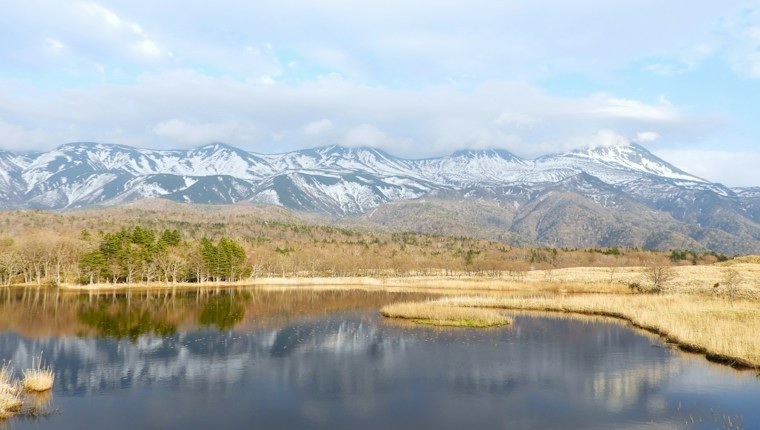
Snow still lies on the mountains when the road reopens in spring, and open does not mean open all day (illustrative image)
The road is not simply open or shut. GoodCars flags three things:
- Night closures continue after the spring opening. At first the road may only be passable from about 9:30 to 16:00, with hours extended in stages.
- Autumn closes in stages too. Night closures come first, followed by the full closure.
- It can shut at short notice even in season. The pass runs about 4 to 5°C colder than the towns below, the weather turns quickly, and the Rausu side has a grade of about 8%. Ice or avalanche risk can close it all day.
When it is closed, getting from Utoro to Rausu means going around the base of the peninsula over the Konpoku Pass area, and that road closes in blizzards too. Before early May and after late October, do not schedule Rausu as somewhere you must reach the next day. Check the Hokkaido Regional Development Bureau's road information on the day.
Wildlife is not scenery: deer, brown bears and foxes
The biggest driving hazard in eastern Hokkaido is not the bends but the animals. Hokkaido Police figures show more than 5,000 deer-related accidents a year across Hokkaido, and the record keeps being broken. October is the worst month, followed by November, and the two make up about 40 percent of the year. More than 80 percent happen at night, peaking between 18:00 and 20:00.

Deer are most active around dawn and dusk, and where there is one, there are usually more (illustrative image)
- Reach your hotel before sunset. This is why the daily distances here are conservative
- Brake when you see a deer rather than swerving hard. Oncoming traffic is more dangerous than the deer
- If you hit one, always call the police. Get to safety, dial 110, then contact the rental company. Cover is as shown on the booking page
Brown bears are not rare along Shiretoko's roads. In the national park's special zones, feeding, approaching and following bears are regulated. Shiretoko's thresholds are approaching within 30 m and following within 50 m, and ignoring an instruction to stop can bring a fine of up to 300,000 yen. If you see a bear, stay in the car, do not get out for photos and do not stop in the lane, which causes jams and teaches bears to accept people and cars. Never leave food outside the vehicle.
Foxes often approach stopped cars looking for food. Cute as they are, do not feed them. Feeding draws them onto the road, and foxes can carry parasites that infect people, so do not touch them.
Fuel: 160 km of expressway without a filling station
NEXCO East's published figures are clear: beyond Yuni PA there is no filling station on the expressway for about 160 km towards Kushiro and about 180 km towards Kitami. The Yuni PA station lists its hours as 8:00 to 20:00, so fill up there or earlier when heading east.
If you do run low, you can leave at Tokachi-Shimizu IC, refuel in town and rejoin at the same interchange for the same toll as if you had stayed on. Nearby stations are not designated by NEXCO, so check their opening days yourself, and some ETC discounts may no longer apply. This is an arrangement NEXCO has announced in the past, so check with NEXCO East first that it still applies.
Off the expressway, you need to be more deliberate. About 22 percent of Japan's municipalities have three filling stations or fewer, and in small eastern Hokkaido towns they may shut by early evening. GoodCars could not find hours for the Shiretoko Peninsula reliable enough to print, so here is the principle instead: refuel at half a tank, fill up around Shari before entering the peninsula, and check opening hours on a map. Refuelling before return is covered in the Japan gas station guide.
Winter: we advise against this route
For eastern Hokkaido from November to April, the GoodCars advice is plain: without snow experience, do not drive it, and with experience, do not use the day counts in this article.
- The Shiretoko Crossing Road is fully closed, so there is no direct link between Utoro and Rausu
- The official Sapporo to Kushiro time is not split by season, so allow extra time in winter
- The Konpoku Pass and Route 335 have been closed by ground blizzards, Route 334 on the Rausu side has been closed by avalanche, and the Shari to Utoro section also has a record of storm closures
- Lake Akan's first car park and the Shiretoko Five Lakes park shut for the season. Sights are not quieter; they are closed
At around 150 km a day in winter, New Chitose to Shiretoko takes more than two and a half days one way, which does not fit a normal holiday. To see the drift ice, fly or take the train and use local buses or tours rather than driving from New Chitose. Treat late October to early November and late April to early May as winter too. If you must drive in winter, read the Hokkaido winter driving guide first.
Pick-up, ETC and your documents
This trip covers a lot of expressway, so a car with ETC makes life easier. An ETC card depends on the supplier; add one only if it is offered. The Hokkaido Expressway Pass for foreign visitors costs about 7,700 to 15,400 yen for a standard car for 4 to 8 days. It is arranged together with your rental and not every rental company can issue it, so confirm availability when you book. The rules are in the expressway and ETC guide, and the airport process is in the New Chitose Airport car rental guide.
Most nationalities need an International Driving Permit issued under the Geneva Convention of 1949, together with their home licence and passport. The Vienna Convention format is not valid in Japan. A small group uses the original licence plus an official Japanese translation instead: Switzerland, Germany, France, Belgium, Monaco and Taiwan. Your own translation is not accepted. You may drive for up to one year from entry, and no longer than your documents remain valid.
Insurance cover varies by supplier plan, so go by what the booking page shows when you book through GoodCars. The full picture is in the complete guide to renting a car in Japan.
Frequently asked questions
Q1. How long is the drive from New Chitose Airport to Shiretoko?
About 390 km, or 6 hours or more of pure driving. With breaks and lunch it takes a full day, so do not try it the same day after an afternoon pick-up.
Q2. Are 4 days enough for eastern Hokkaido?
Not for Shiretoko, because the round trip alone uses two days. With 4 days, stick to the Kushiro Marsh, Lake Akan and Lake Mashu. GoodCars suggests saving Shiretoko for a trip of 5 days or more.
Q3. Can I return the car at Kushiro or Memanbetsu Airport?
This has not been confirmed, and GoodCars cannot promise a return in eastern Hokkaido. Plan to pick up and return at New Chitose.
Q4. When is the Shiretoko Crossing Road open?
Usually from late April to early November, with dates varying each year. Night closures apply just after opening, and ice can close it at short notice in season, so check road information on the day.
Q5. What is the best month for eastern Hokkaido?
The distances and day counts here assume June to September. Be conservative before early May and after late October. October and November are also the peak for deer accidents, so be at your hotel before sunset.
Q6. What should I do if I see a brown bear on the road?
Stay in the car. Do not get out, do not feed it and do not stop in the lane; drive slowly on. Shiretoko has clear distance rules, and ignoring an instruction to stop can bring a penalty.
Q7. Can I drive to see the drift ice in winter?
GoodCars does not recommend driving there from New Chitose. The distance is long, closures are frequent and some sights shut, and first-timers on snow should not attempt it. Flying or taking the train and joining a local tour is more realistic.
Book a New Chitose Airport pick-up
- Narita Airport / Chiba Station / Kinshicho Station (Tokyo and Kanto)
- New Chitose Airport (Hokkaido)
- Fukuoka Airport (Kyushu)
- Naha Airport Station (Okinawa)