






Noboribetsu and Lake Toya by car: the onsen-and-volcano run from New Chitose, winter included
Noboribetsu and Lake Toya are the two headline hot-spring destinations closest to New Chitose Airport — both a little over an hour away by car. GoodCars gets the same two questions every year: can you do both in one day, and is there anything left to see in winter? This article does not relitigate whether you need a car in Hokkaido (our Hokkaido car rental guide already sets out that decision). It takes the route down to the level that actually matters: closing times, how many parking spaces there are, and which facilities shut down for the season. On this route, what breaks an itinerary is never the distance. It is opening hours and the calendar.

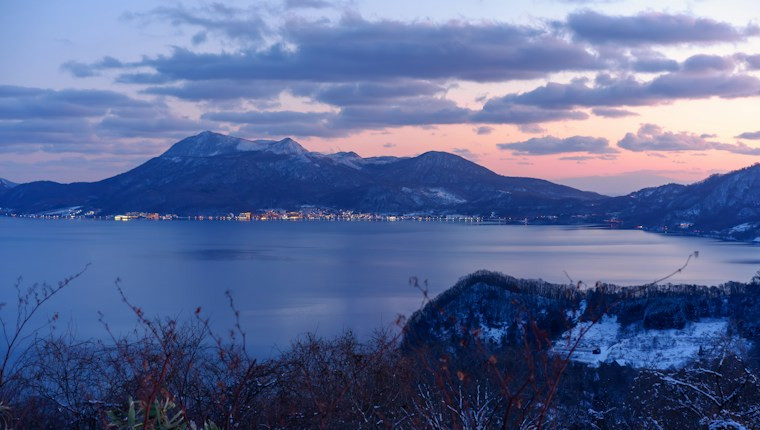
Winter dusk comes early over a lakeside onsen town: on this route, plan around opening hours and daylight, not distance (illustrative image)
First conclusion: this is not a stop on the way to Hakodate
Plenty of itineraries file Noboribetsu and Lake Toya as waypoints on the drive south to Hakodate. That is not wrong, but it makes people budget the wrong amount of time. The geography matters: neither town sits on the expressway itself. Noboribetsu Onsen is up a mountain road from the Noboribetsu-higashi interchange; Lake Toya Onsen is down a winding descent from the Abuta-Toyako interchange. They are not places you pass through. They are two separate exits and re-entries.
| Leg | Route | Reference driving time | What GoodCars wants you to notice |
|---|---|---|---|
| New Chitose Airport → Noboribetsu Onsen | Doo Expressway, exit Noboribetsu-higashi | About an hour | There is still a mountain road after the exit |
| New Chitose Airport → Lake Toya Onsen | Doo Expressway, exit Abuta-Toyako | About 90 minutes by expressway, about two hours on surface roads | Expressway toll from the airport is roughly the 3,020 yen band for a standard car |
| Noboribetsu Onsen → Lake Toya Onsen | Back onto the expressway, or over the hills on surface roads | Follow your navigation, but budget for two more interchange transitions | There is no direct road between the two |
Put the three legs together and GoodCars's advice is blunt: this is a two-day, one-night route, not a day trip. If you genuinely have only one day, pick one. Noboribetsu for the steam valley and the onsen street; Lake Toya for the lake, the ropeway and the evening fireworks. Try to squeeze in both and you will give each place forty minutes — and everything worth having here (soaking, walking the trails, waiting for the fireworks) needs more than that.
If your trip continues south to Hakodate, that is a longer route with its own logic, and GoodCars covers the southern Hokkaido haul in the Hokkaido car rental guide. This article stays with these two towns.
Parking in Noboribetsu: one ticket covers two car parks, but winter removes one

The steam vents are the most recognisable picture on this route, and also where parking is tightest (illustrative image)
Noboribetsu Onsen packs its sights close together — most are a walk apart — so the difficulty is not distance, it is parking. GoodCars lays out the three facts that decide what time you should arrive:
| Place | Parking | Capacity and fee band | Winter |
|---|---|---|---|
| Jigokudani (the steam valley) | Paid car park | About 160 spaces, around the 500 yen band for a standard car | Open as usual |
| Oyunuma pond | Paid car park | About the 410 yen band if used on its own | Closed for the season |
| Natural riverside foot bath | No dedicated car park, reached on foot | Free, open all year | Open, but the light goes early |
The Jigokudani and Oyunuma car parks share one charge: pay at one and the other is covered, so keep your ticket. That only helps you outside winter, though — the Oyunuma car park closes for the season, which leaves a single car park absorbing all the demand. GoodCars's recommendation is to schedule Noboribetsu for the morning, and especially so in winter.
The other thing visitors miss is sunset at the foot bath. The natural foot bath on the Oyunuma river is free and open year round, but its hours are sunrise to sunset — not until a set time, until it gets dark. In a Hokkaido winter that is mid-afternoon, and the trail has no lighting. GoodCars has seen too many people slot the foot bath in "just before dinner" and arrive to find it too dark to walk in safely.
The Jigokudani boardwalk itself is open to walk at any hour, year round, with no closing time. So what actually constrains you is the car park and the daylight, not the attraction. That is why GoodCars is happy to see Noboribetsu placed on a first afternoon or a second morning, but not in the early evening.
The one stop on this route that closes completely when a ropeway stops

The bear park sits on a mountaintop and the ropeway is the only way up: when it stops, there are no bears that day (illustrative image)
Whenever GoodCars plans a route, the first question is: which stop is the most likely to be shut on the day? In Noboribetsu the answer is the bear park, because it sits on a mountaintop and the ropeway is the only way up.
- Winter hours run roughly 9:30 to 16:30, adjusted by season, with last admission about forty minutes before closing.
- If the ropeway suspends service for weather, the whole park closes. Not shortened hours — closed.
- There are also around twenty closure days a year, on no fixed calendar.
- Admission includes the return ropeway ride, in the 3,000 yen band for an adult.
Taken together, GoodCars's practical advice is this: put the bear park somewhere in your day that can be deleted. Do not build the day around it and do not move your accommodation for it. Check ropeway status on the morning, and if it is blowing hard or snowing heavily, skip it and give the time back to the steam valley and the baths. Everything else on this route is outdoors and does not close outright for weather. This one does.
See GoodCars pick-up options at New Chitose Airport
Lake Toya's timing lock: fireworks at the same time every night, but only half the year

Lake Toya does not freeze, so boats run through the winter (illustrative image)
The difference between Lake Toya and Noboribetsu is that Toya has a fixed nightly timing lock that exists for only half the year. The lakeside at Toyako Onsen runs a long-season fireworks display: roughly late April to late October, every night, about 20:45 to 21:05, running about twenty minutes. Viewing is free and there is no paid seating. Rain does not stop it, but it can be cancelled when wind direction or strength is unstable.

Nightly, but only for half the year — this single fact decides whether you sleep at Lake Toya (illustrative image)
The implication is unambiguous: if you want the fireworks, you stay the night at Lake Toya. It finishes after nine, and driving a mountain descent and an expressway leg back toward the airport afterwards is not a sensible plan. Conversely, there are no fireworks in winter, so there is no reason to book a night for them — Lake Toya then works perfectly well as a half-day daytime stop. Decide which half of the year your dates fall in first, then decide where you sleep.
One more thing visitors get wrong: Lake Toya does not freeze in winter. It and Lake Shikotsu are the rare non-freezing lakes of Hokkaido, so the boats keep running and the lake views hold up. Winter here is not "nothing to see" — it is the same place minus the fireworks. GoodCars would argue that makes Lake Toya an unusually good winter half-day: simple roads, the scenery intact, and far fewer people.
Mount Usu is an active volcano: hours change several times a year, and so should your checking habit

The volcano and the lake are the same story: this landscape was made by eruptions (illustrative image)
Mount Usu, on the southern shore, is not scenery with a name — it is an active volcano, and the whole Toya-Usu area is a geopark built around volcanic landforms. For a driver this has two concrete consequences.
The first is opening hours. The Usuzan ropeway changes its timetable several times across the year: in summer it can start soon after eight in the morning and run until early evening, while in winter it shrinks to roughly nine until four. On top of that, there is a maintenance shutdown period in winter — not shorter hours, no service at all. The ride is about six minutes each way. The base station car park holds roughly four hundred cars at around the 500 yen daily band, free in some periods. It is about fifteen minutes from either the Abuta-Toyako or the Date interchange.
| Place | Parking | Fee reference | GoodCars notes |
|---|---|---|---|
| Usuzan ropeway base station | About 400 spaces | Around the 500 yen daily band | Timetable changes several times a year; winter maintenance shutdown |
| Silo Observatory | About 50 spaces (coaches separate) | Free to visit | Small — one coach fills it |
The second consequence is volcanic information. Over the last century Mount Usu erupted roughly every twenty to forty years. In the most recent eruption, craters opened directly beneath a national highway and housing at the foot of the mountain and around sixteen thousand people were evacuated — yet monitoring predicted it in advance and nobody was killed or injured. GoodCars raises this not to alarm you but to make a point: the roads and facilities here are built with volcanic activity already factored in, with established closure and evacuation procedures. All a visiting driver has to do is check the local volcanic activity and road notices before setting off — the same reflex as checking the weather.
So can you drive it in winter? Separate the law from the facilities

The real winter question on this route is not legality — it is which facilities are still open (illustrative image)
GoodCars answers "can I drive this in winter" by splitting it into two questions, because the answers are different.
The legal question: yes, with a condition. Japanese rules are not written by season, they are written by road surface. When the surface is snow-covered or icy, the driver must take anti-skid measures — winter tyres or chains — an obligation set at prefectural road-traffic-regulation level. Breaching it is handled as a public safety commission compliance offence, with a penalty in the 6,000 yen band for a standard car. In other words, legality depends on what is fitted to your car, not on the month. Rental cars in Hokkaido are normally supplied on winter tyres through the cold season, but GoodCars still suggests you confirm it face to face at the counter: thirty seconds that removes a trip's worth of risk.
The facilities question is simply the tables above. Here is what winter changes:
| Item | Winter status | Effect on your plan |
|---|---|---|
| Oyunuma car park | Closed | Noboribetsu parking concentrates at the steam valley; go in the morning |
| Natural foot bath | Open, but dark early | Early afternoon only; do not go once the light fades |
| Bear park | Closed whenever the ropeway stops | Make it deletable; check on the morning |
| Lake Toya fireworks | Not held | No reason to stay the night for them; make it a daytime half-day |
| Usuzan ropeway | Shorter hours plus a maintenance shutdown | Check the current timetable; do not plan on summer hours |
| Lake Toya itself | Does not freeze; boats run | Lake views and cruises still available |
⚠️ Snow driving technique is a separate subject. This article covers opening hours and parking on this route; it does not teach winter driving. For Hokkaido surface conditions, braking distances, visibility in blowing snow and where to check closures, GoodCars has written a dedicated Hokkaido winter driving guide — if this would be your first time driving on snow, read that before you decide to rent at all. GoodCars's position has not changed: if you are unsure, do not force it. Both towns are reachable by bus, and choosing not to drive is not a failure.
Pick-up points and the documents you need
These are the GoodCars pick-up points currently bookable online in Japan, with the destinations each one serves. This route starts from New Chitose:
| Pick-up point | Destinations | Booking link |
|---|---|---|
| New Chitose Airport | Hokkaido (Noboribetsu, Lake Toya, Sapporo, Furano) | View now |
| Chiba Narita Airport | Tokyo and Kanto | View now |
| Kinshicho Station | Central Tokyo and the Kanto fringe | View now |
| Chiba Station | Chiba and the Boso Peninsula | View now |
| Fukuoka Airport | Fukuoka and Kyushu | View now |
| Naha Airport Station | Okinawa | View now |
Counter locations, shuttles and the refuel-before-return routine at the airport end are covered in detail in the GoodCars New Chitose Airport pick-up guide, worth reading if it is your first collection there.
On documents: most visitors need an International Driving Permit in the 1949 Geneva Convention format, carried together with the home licence and a passport. A permit issued in the Vienna Convention format is not valid in Japan. A small group of countries and territories — Switzerland, Germany, France, Belgium, Monaco and Taiwan among them — instead drive on their home licence plus an official Japanese translation issued by an authorised body; a translation you make yourself is not accepted. Licences issued in mainland China cannot be used to drive in Japan at all, and an International Driving Permit does not change that. Entitlement runs for at most one year from your date of entry, and never beyond the expiry of the licence or permit itself. Full detail on documents, insurance and driving on the left is in the GoodCars complete guide to renting a car in Japan.
Book your GoodCars car at New Chitose Airport
Frequently asked questions
Q1. Can I do Noboribetsu and Lake Toya in one day?
You can physically drive it, but GoodCars does not recommend it. Neither town is on the expressway itself, so each one means leaving the expressway and climbing or descending a mountain road — two full exit-and-return cycles in a day. The things worth doing here, soaking and walking and waiting for fireworks, all need time. With one day, choose one.
Q2. What is the expressway toll from New Chitose Airport to Lake Toya?
From the New Chitose Airport interchange to the Abuta-Toyako interchange it is roughly the 3,020 yen band for a standard car, about ninety minutes of driving. Surface roads take about two hours and cost nothing. Actual amounts vary by vehicle class and time of day; use the official toll search to confirm.
Q3. Do I pay twice for the steam valley and the Oyunuma car parks?
No. The two car parks share one charge, so paying at one covers the other — keep the ticket. Note that the Oyunuma car park closes for the winter season, which leaves only the steam valley side.
Q4. What time does the natural foot bath close?
It does not have a closing time as such: it is open sunrise to sunset, free, all year. Hokkaido gets dark early in winter and the trail is unlit, so GoodCars suggests going in the early afternoon and not entering once the light starts to go.
Q5. What happens at the bear park in a blizzard?
The park closes. The ropeway is the only way up, so a weather suspension means you cannot get in that day, and there are also around twenty unscheduled closure days a year. GoodCars suggests treating it as a deletable item and checking ropeway status on the morning.
Q6. Are the Lake Toya fireworks really every night? Can I see them in winter?
They run roughly late April to late October, every night, about 20:45 to 21:05, free to watch, held in rain but cancellable in unstable wind. They are not held in winter, so a winter visit needs no overnight stay for them — treat Lake Toya as a daytime half-day instead.
Q7. Is renting a car here in winter legal, and what do I need?
Yes, with a condition. Japanese rules look at the road surface, not the month: when the surface is snow-covered or icy you must use winter tyres or chains. Breaching that is treated as a public safety commission compliance offence, penalty around the 6,000 yen band for a standard car. Rental cars in Hokkaido normally come on winter tyres in the cold season; GoodCars suggests confirming it at the counter. For driving technique, read the Hokkaido winter driving guide first.
Information currency notice: the tolls, operating hours, closure days, parking capacities and parking charges in this article are reference bands compiled by GoodCars from publicly available information at the time of writing. Japanese pricing, opening hours and seasonal conditions are revised periodically; actual amounts and conditions are governed by on-site signage and the official announcements of each facility and expressway operator. Please reconfirm before you travel. Ropeway status, whether fireworks are held, and winter road closures change daily and must be checked on the day.
Driving eligibility notice: the documents required to drive in Japan depend on where your licence was issued. Most drivers need an International Driving Permit in the 1949 Geneva Convention format, together with their home licence and passport; a permit in the Vienna Convention format is not valid in Japan. A limited group of countries and territories, Taiwan among them, drive instead on their home licence plus an official Japanese translation issued by an authorised body — self-made translations are not accepted. Licences issued in mainland China may not be used to drive in Japan. Entitlement lasts at most one year from your date of entry and never beyond the expiry of the licence or permit itself. Incorrect documents mean no car at the counter, and GoodCars cannot resolve that on your behalf.