






Hakone & Izu Self-Drive Route: Planning from Tokyo with a Kinshicho Station Pickup
Hakone and Izu are the classic hot spring drives from Tokyo, and picking up at Kinshicho Station means you can head west from the city without first travelling out to an airport. When GoodCars put this route together, the mountain roads were not what caused trouble. Two other things were: the most scenic toll roads here do not accept regular ETC, and the weekend return traffic lands right on the pickup point's closing time.
Kinshicho Station operates from 08:00 to 20:00. Local traffic bodies in Izu have advised peak-season holiday drivers to avoid leaving between 15:00 and 18:00 and to set off after 19:00, but a 19:00 departure from Izu will not get you to Tokyo by 20:00. So the first thing to decide on this route is not the order of the sights. It is what time you leave the mountains on your last day.

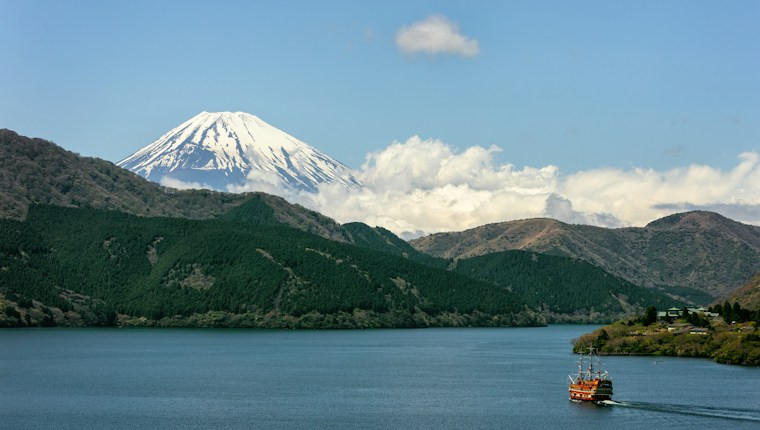
Lake Ashi is the heart of the Hakone section, with Mount Fuji in view on clear days (illustrative image)
The short answer: Hakone and Izu are two trips, not one
The two look adjacent on a map, so people plan "Hakone in the morning, Shimoda in the afternoon". The Izu Peninsula is much longer than it looks. Numazu on the Tomei Expressway to Kawazu is about 65 km, and Numazu to Shimoda at the southern tip currently takes around 150 minutes, because the Izu Jukan Expressway is still unfinished. Shimoda is not a same-day return from Tokyo.
| Length | Sensible scope | Avoid |
|---|---|---|
| One day | Hakone only, ideally on a weekday | Adding anywhere south of Atami |
| Two days, one night | A night in Hakone, or a night on the east coast of Izu (Atami, Ito, Izu Kogen) | Reaching Shimoda and back in two days |
| Three days, two nights | One night each in Hakone and Izu; Kawazu and Shimoda belong in this length | Leaving Shimoda on the afternoon of day three |
Mount Fuji is a separate trip. GoodCars covers it in the Mount Fuji and Lake Kawaguchiko route, so it is not repeated here. If you have not settled on a direction, Karuizawa and Nikko to the north and the Boso Peninsula to the east also start from Tokyo.
Leaving Kinshicho: the Shuto Expressway comes first
Kinshicho is on the east side of Tokyo and Hakone is to the southwest, so your first task is crossing the city. Tokyo to Hakone-Yumoto takes about 1 hour 20 minutes in clear traffic, but from Kinshicho you add a stretch of the Shuto Expressway, so allow more than that. Its merges are short and its junctions come quickly. The Tokyo and Kanto car rental guide explains it in full, and first-timers should read that before setting off. ETC rates on the Shuto Expressway have been revised, and the distance cap for a standard car is now 2,130 yen. Cash vehicles are charged the maximum for the section, so if your supplier offers an ETC card, it is worth adding.
After that, the route depends on where you are going:
| Destination | Main route | Note |
|---|---|---|
| Hakone-Yumoto and the Odawara side | Tomei, then the Odawara-Atsugi Road to Hakone-guchi | Route 1 before Yumoto clogs from the morning |
| Sengokuhara and north Lake Ashi | Tomei to Gotemba, then Route 138 | Bypasses the Yumoto queue |
| Shuzenji and central Izu | Tomei to Numazu, then the Izu Chuo Road and Shuzenji Road | These two toll booths do not take regular ETC |
Outbound queues build on weekend mornings. The Tomei around the Yamato Tunnel is in the middle of a multi-year widening project with narrowed lanes, and queues can form in both directions while the work continues. Renewal work further west on the Tomei has also been forecast to cause westbound queues in the morning. GoodCars suggests picking up at 08:00, leaving straight away, and checking NEXCO Central Japan's works information first.
Check Kinshicho Station pickup options
The toll road catch: ETC in the car does not get you through
This is the easiest mistake to make in the area. Expressways use ETC cards, but the scenic toll roads of Hakone and Izu mostly have separate operators, and none of the roads below accept regular ETC. You must stop at the booth and pay. Some list "ETCX", a separate service that needs online registration in advance. For short-stay visitors on a rental card it is rarely usable, so plan on these as cash roads.
| Road | Standard car | Payment | Hours |
|---|---|---|---|
| Hakone Turnpike, main line | 900 yen | Cash is safest; no regular ETC | Closed overnight; see operator |
| Hakone Turnpike, Hakone-Izu link | 200 yen | As above | As above |
| Ashinoko Skyline, main line | 1,000 yen | Cash only | 07:00–19:00; main line closed otherwise |
| Hakone Skyline | 500 yen | Cash or e-money; no ETC or credit cards | Winter: to 17:30 weekdays, 18:30 holidays |
| Izu Skyline, Atami-toge to Kameishi-toge | 500 yen | Cash; no ETC or credit cards | See operator |
| Izu Skyline, Kameishi-toge to Hiekawa | 500 yen | As above | As above |
| Izu Skyline, Hiekawa to Amagi Kogen | 300 yen | As above | As above |
| Izu Chuo Road | 200 yen | Cash; no ETC or credit cards | 24 hours |
| Shuzenji Road | 200 yen full length | As above | 24 hours |

Most of these toll roads run along ridges with continuous curves; the Ashinoko Skyline has a 40 km/h limit throughout (illustrative image)
Hakone in a day: take the ropeway to Owakudani, not the car
A workable order is this: drive up the Hakone Turnpike, stop at Daikanzan at the top for a look over Lake Ashi, drop down to Moto-Hakone and Hakone Shrine, then enter the Ashinoko Skyline at Hakone Pass. The operator notes that driving from Hakone Pass toward Gotemba keeps Mount Fuji ahead of you. Finish around Kojiri and Togendai, and switch to the ropeway for Owakudani.
Owakudani has its own car park, but only 147 spaces for standard cars and no reservations. Weekends and the autumn leaf season peak between 12:00 and 15:00, and waits of over an hour are not unusual. Holidays cost more too. Weekdays are 500 yen for the first two hours with a 1,300 yen daily cap; holidays are 500 yen for 30 minutes, 1,000 yen up to two hours, and a 2,600 yen daily cap. Entry ends at 16:20 (16:00 in December and January), and the access road is closed from 17:00 to 09:00.

The Owakudani car park is small, and on weekends the queue can outlast the visit (illustrative image)
The easier way is to park at a ropeway station. Ubako Station's car park is free with about 90 spaces, while Togendai and Sounzan stations charge 1,000 yen per visit. The ropeway can stop for weather or volcanic activity, and trails around Owakudani can be restricted, so check the operator's status that morning. If it is not running, give the time to Lake Ashi instead. In winter, scheduled inspections also suspend parts of the line for several weeks, with replacement buses that can be crowded, so check Hakone Navi before a winter trip.
Car parks by the Moto-Hakone port fill early on weekends, so visit Hakone Shrine in the morning. Hakone-machi port on the south side has a free car park with about 200 spaces and makes a better fallback.
Izu in two days: the east coast and the Skyline, with Kawazu as its own question
For a first trip, GoodCars recommends the east coast: Atami, Ito and Izu Kogen. You can follow the coast from Odawara, or link the Hakone Turnpike to the Izu Skyline and ride the ridge south to Hiekawa or Amagi Kogen before dropping to Izu Kogen, which avoids seaside Route 135.

The Izu Skyline follows the spine of the peninsula, with the sea in view on one side (illustrative image)
If you take the coast, there is a new rule to know. From late November, a one-year trial sets time-based weekend and holiday tolls at the Ishibashi exit of the Seisho Bypass (toward Atami and Yugawara). For standard cars on ETC it is 210 yen from 07:00 to 12:00, 150 yen from 12:00 to 24:00, and 110 yen from 00:00 to 07:00. The sums are small, but the message is clear: weekend mornings toward Atami are officially the congested window. Coastal roads can also be closed at short notice in torrential rain, so check conditions on wet days.

Izu's east coast is rocky and the shore road is twisty; do not stop on the shoulder for photos (illustrative image)
Mount Omuro in Izu Kogen has about 500 free parking spaces. The chairlift's last ascent is around 16:00 in winter, and it closes for maintenance at times including December. Check the operator for fares. This makes a good morning for day two, after which it is time to head back.
Kawazu cherry blossom season is a different matter. It runs from about early February to early March, temporary parking in Kawazu is around 1,000 yen for a standard car, and roads nearby get very crowded on peak weekends. A same-day return from Tokyo is not realistic. Stay in Izu and go on a weekday or very early.

Kawazu's cherry trees bloom over a month ahead of Tokyo's, and it is the busiest time of year here (illustrative image)
Coming back on a weekend: three bottlenecks and a 20:00 line
What matters on the way back is not total driving time. It is when each of the three bottlenecks fills up:
| Bottleneck | When | Effect |
|---|---|---|
| Hakone Route 1, Miyanoshita toward Yumoto | 15:00–18:00 | About 15 minutes normally; 30 minutes to 1 hour when jammed |
| Izu City to Numazu IC | 15:00–18:00 | About 30 minutes normally; about 1 hour when jammed (older official data; longer in peak seasons) |
| Tomei inbound, around the Yamato Tunnel | Often jammed Sunday afternoon into evening (check NEXCO's forecast for the day) | Queues of over 10 km have occurred around holidays |

The last stretch back to Tokyo is often the most tiring of the trip, so leave slack before your return time (illustrative image)
Add the 20:00 close at Kinshicho and refuelling before return, and Sunday afternoon gets squeezed from all sides. GoodCars boils it down to three options:
- Leave early: go after lunch and be on the expressway by 14:00, ahead of the afternoon build-up at Yamato. The most practical choice; you only get the morning of your last day.
- Leave late: move your return to Monday morning and set off after 19:00 on Sunday, missing every bottleneck. You will need to budget for the longer rental and for parking in Tokyo; go by what the booking page shows.
- Change the day: do the whole trip on weekdays. On this route it makes the biggest difference, and car parks and toll booths are far calmer too.
What we do not recommend is leaving Hakone or Izu at 16:00 on a Sunday and expecting to return by 20:00. Late returns are handled under each supplier's rules, so check when you book and do not assume a little lateness is fine.
Winter: be conservative from December to March
Tokyo rarely sees snow, which is why this section gets underestimated. Hakone is mountain country. The Hakone Shindo on Route 1 has been closed as a precaution for snow on multiple occasions, once as late as late March, and the road authority repeatedly warns that cars on normal tyres get stranded on snow or ice. On the Hakone Turnpike, snow or ice brings an anti-skid restriction that admits only winter tyres or chains, and worse conditions close the road entirely. Shizuoka Prefecture also warns of snow and ice on mountain roads in Izu such as Amagi Pass and Funabara Pass. The Izu Skyline and Ashinoko Skyline also run along ridges, so treat them the same way.
Before you go: whether your licence works in Japan
People are turned away at rental counters over this every year, so GoodCars repeats it in every route guide. For most nationalities, driving in Japan requires an International Driving Permit issued under the Geneva Convention of 1949, together with your home licence and your passport: all three, every time. The permit is a translation of your licence, not a licence in itself.
Japan does not accept other formats. The Vienna Convention format is not valid in Japan, which matters because some authorities issue both kinds, so ask for the Geneva format specifically.
A small group works differently, using the original licence plus an official Japanese translation instead of a permit: Switzerland, Germany, France, Belgium, Monaco and Taiwan. The translation must come from a recognised body such as JAF or the issuing authority; your own translation is not accepted. In all cases you may drive for up to one year from your date of entry, and no longer than your licence or permit remains valid.
On insurance, what collision cover and Non-Operation Charge cover include varies by supplier plan, so go by what the booking page shows when you book through GoodCars. The full picture is in the complete guide to renting a car in Japan.
Frequently asked questions
Q1. Can I do Hakone and Izu in one day?
We do not recommend it. Hakone alone fills a day, and the Izu Peninsula is far longer than it looks; Numazu to Shimoda currently takes about 150 minutes. Do Hakone only in one day, and allow at least two days for Izu.
Q2. If the car has ETC, why do I need cash on the toll roads?
The Hakone Turnpike, Ashinoko Skyline, Hakone Skyline, Izu Skyline, Izu Chuo Road and Shuzenji Road do not take regular ETC. ETC cards are for the Tomei and the Shuto Expressway. Whether the car has an ETC unit and a card depends on the supplier, so check when booking through GoodCars.
Q3. What time should I leave Hakone on a Sunday?
To return to Kinshicho by 20:00, GoodCars suggests leaving shortly after midday and being on the expressway by 14:00. Route 1 from Miyanoshita toward Yumoto is worst from 15:00 to 18:00, and the inbound Tomei often jams from Sunday afternoon into the evening.
Q4. Can I drive up to Owakudani myself?
Yes, but weekend midday queues can exceed an hour and the holiday daily cap is 2,600 yen. Parking at Ubako Station (free) or Sounzan Station and riding the ropeway usually saves time.
Q5. Can I go in winter on normal tyres?
The coast at Atami and Ito is usually fine, but not the Hakone and Izu ridge roads. In snow or ice, normal tyres will be turned back or simply will not make it up. Winter tyres depend on the supplier and vehicle, so confirm when booking and change the route if they are not available.
Q6. Is Kinshicho too hard for my first drive in Japan?
The hardest part is the first stretch of the Shuto Expressway. Set the navigation before moving, study the merges, and avoid weekday rush hours. If you are unsure, you could pick up at Narita Airport and use the Ken-O Expressway to skirt central Tokyo, though the drive to Hakone is longer. GoodCars suggests deciding based on where you are staying.
Q7. Can I add Mount Fuji from Hakone?
Yes. Route 138 from Sengokuhara to Gotemba connects toward Fuji. Kawaguchiko deserves a night, though, so see the Mount Fuji and Lake Kawaguchiko route rather than squeezing it into a Hakone day trip.
Book a Kinshicho Station pickup
- Narita Airport / Chiba Station / Kinshicho Station (Tokyo and Kanto)
- New Chitose Airport (Hokkaido)
- Fukuoka Airport (Kyushu)
- Naha Airport Station (Okinawa)