'%3e%3cpath%20fill='red'%20d='M0%200h720v480H0z'/%3e%3cpath%20fill='%23000095'%20d='M0%200h360v240H0z'/%3e%3cg%20fill='%23fff'%3e%3cpath%20d='m154%20126.9-2.5%209.6%209.4%202.6-1.8-7.1zm46.9%205.1-1.8%207.1%209.4-2.6-2.5-9.6zm-41.8-24-5.1%205.1%201.9%206.9z'/%3e%3cpath%20d='m155.9%20120-1.9%206.9%205.1%205.1z'/%3e%3cpath%20d='m154%20113.1-6.9%206.9%206.9%206.9%201.9-6.9zm14%2027.8%205.1%205.1%206.9-1.9zm18.9%205.1%209.6%202.5%202.6-9.4-7.1%201.8z'/%3e%3cpath%20d='m192%20140.9%207.1-1.8%201.8-7.1zm-31.1-1.8%202.6%209.4%209.6-2.5-5.1-5.1zm19.1%205%206.9%201.9%205.1-5.1z'/%3e%3cpath%20d='m173.1%20146%206.9%206.9%206.9-6.9-6.9-1.9zm-12.2-45.1-9.4%202.6%202.5%209.6%205.1-5.1zm-1.8%2031.1%201.8%207.1%207.1%201.8zm45-12%201.9-6.9-5.1-5.1z'/%3e%3cpath%20d='m168%2099.1-7.1%201.8-1.8%207.1zm32.9%208.9-1.8-7.1-7.1-1.8zm5.1%2018.9%206.9-6.9-6.9-6.9-1.9%206.9z'/%3e%3cpath%20d='m200.9%20108-8.9-8.9-12-3.2-12%203.2-8.9%208.9-3.2%2012%203.2%2012%208.9%208.9%2012%203.2%2012-3.2%208.9-8.9%203.2-12z'/%3e%3cpath%20d='m200.9%20132%205.1-5.1-1.9-6.9zm5.1-18.9%202.5-9.6-9.4-2.6%201.8%207.1zm-6.9-12.2-2.6-9.4-9.6%202.5%205.1%205.1zm-26-6.9-9.6-2.5-2.6%209.4%207.1-1.8zm6.9%201.9-6.9-1.9-5.1%205.1z'/%3e%3cpath%20d='m186.9%2094-6.9-6.9-6.9%206.9%206.9%201.9z'/%3e%3cpath%20d='m192%2099.1-5.1-5.1-6.9%201.9zM173.1%20146l-9.6%202.5%204.5%2016.6%2012-12.2zm-5.1%2019.1%2012%2044.9%2012-44.9-12-12.2zm-7.1-26-9.4-2.6-4.4%2016.4%2016.4-4.4z'/%3e%3cpath%20d='m147.1%20152.9-12%2045.1%2032.9-32.9-4.5-16.6zm-12-20.9L102%20165.1l45.1-12.2%204.4-16.4z'/%3e%3cpath%20d='m154%20126.9-6.9-6.9-12%2012%2016.4%204.5zm0-13.8-2.5-9.6-16.4%204.5%2012%2012z'/%3e%3cpath%20d='M135.1%20108%2090%20120l45.1%2012%2012-12zm90%2024-16.6%204.5%204.4%2016.4%2045.1%2012.2z'/%3e%3cpath%20d='m199.1%20139.1-2.6%209.4%2016.4%204.4-4.4-16.4zm-12.2%206.9-6.9%206.9%2012%2012.2%204.5-16.6zm19.1-19.1%202.5%209.6%2016.6-4.5-12.2-12z'/%3e%3cpath%20d='m192%20165.1%2033.1%2032.9-12.2-45.1-16.4-4.4zm7.1-64.2%209.4%202.6%204.4-16.4-16.4%204.4z'/%3e%3cpath%20d='M225.1%20108%20258%2075.1l-45.1%2012-4.4%2016.4zm-12.2-20.9L225.1%2042%20192%2075.1l4.5%2016.4zm12.2%2044.9%2044.9-12-44.9-12-12.2%2012z'/%3e%3cpath%20d='m206%20113.1%206.9%206.9%2012.2-12-16.6-4.5zm-38-38L135.1%2042l12%2045.1%2016.4%204.4z'/%3e%3cpath%20d='m160.9%20100.9%202.6-9.4-16.4-4.4%204.4%2016.4z'/%3e%3cpath%20d='m147.1%2087.1-45.1-12%2033.1%2032.9%2016.4-4.5zm39.8%206.9%209.6-2.5-4.5-16.4-12%2012z'/%3e%3cpath%20d='M192%2075.1%20180%2030l-12%2045.1%2012%2012z'/%3e%3cpath%20d='m173.1%2094%206.9-6.9-12-12-4.5%2016.4z'/%3e%3c/g%3e%3ccircle%20cx='180'%20cy='120'%20r='51.1'%20fill='%23000095'/%3e%3ccircle%20cx='180'%20cy='120'%20r='45.1'%20fill='%23fff'/%3e%3c/g%3e%3c/svg%3e)
'%20d='m0%200%2016%2011h61%2061%2061%2061%2060L47%2037h61%2061%2060%2061L16%2063h61%2061%2061%2061%2060L47%2089h61%2061%2060%2061L16%20115h61%2061%2061%2061%2060L47%20141h61%2061%2060%2061L16%20166h61%2061%2061%2061%2060L47%20192h61%2061%2060%2061L16%20218h61%2061%2061%2061%2060L0%200'/%3e%3c/svg%3e)

'%20d='M-50-12v24m6%200v-24m6%200v24m76%200V1m0-2v-11m6%200v11m0%202v11m6%200V1m0-2v-11'/%3e%3cpath%20transform='rotate(-33.69006752598)'%20d='M-50-12v24m6%200V1m0-2v-11m6%200v24m76%200V1m0-2v-11m6%200v24m6%200V1m0-2v-11'/%3e%3c/g%3e%3cg%20transform='rotate(33.69006752598)'%3e%3cpath%20fill='%23cd2e3a'%20d='M12%200a18%2018%200%2011-36%200%2024%2024%200%201148%200'/%3e%3cpath%20fill='%230047a0'%20d='M0%200a12%2012%200%201124%200%2024%2024%200%2011-48%200%2012%2012%200%201024%200'/%3e%3c/g%3e%3c/svg%3e)


Hakodate & Otaru Road Trip: How to Drive Southern Hokkaido

Hakodate's million-dollar night view and Otaru's canal warehouses are two of Hokkaido's most iconic stops. Before turning them into a road trip, GoodCars needs to be upfront about one thing: GoodCars has no pickup point in Hakodate. Our Japan locations are all airports, and in Hokkaido that means New Chitose Airport only — and New Chitose to Hakodate is about 280 km, a 3.5–4.5 hour drive. That sounds daunting, but it is actually the whole point of this route: Lake Shikotsu, Lake Toya and Onuma Park all sit along the way. Turn the transfer into the itinerary, and southern Hokkaido clicks into place.
This GoodCars guide covers the route in detail: how to make New Chitose–Hakodate a scenic two-day leg, parking and tram rules in Hakodate, which road to take from Hakodate to Otaru, where to park by the Otaru Canal — and an honest comparison of who should simply take the train. For rental decisions, costs and insurance, see the Japan Car Rental Complete Guide and the Hokkaido Car Rental Complete Guide; this article stays focused on the road.
- GoodCars has no Hakodate pickup: collect and return at New Chitose Airport, so plan a loop or an out-and-back
- Don't drive New Chitose→Hakodate nonstop: Shikotsu → Toya → Onuma Park is the way to do it
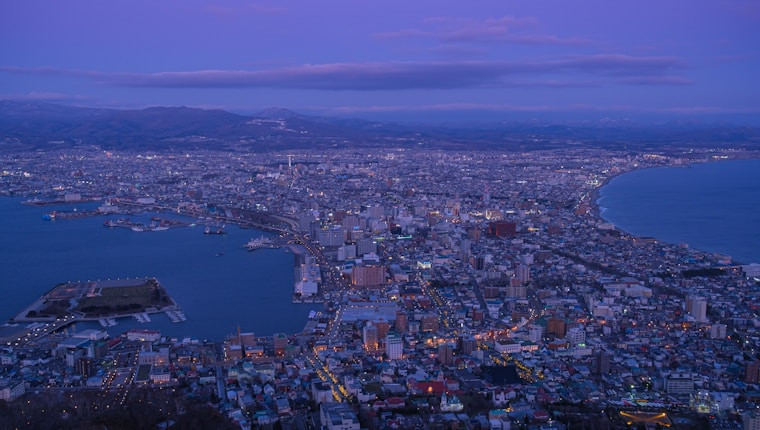
- During night-view hours, private and rental cars are banned from Mount Hakodate — park below and take the ropeway
- Hakodate→Otaru runs on inland Route 5, about 250 km with no continuous expressway — allow 4.5–5 hours
- Only visiting Hakodate and Otaru themselves? Honestly: the train is easier. Rent a car to link the lakes and Onuma
Know This First: Southern Hokkaido Starts at New Chitose Airport
The product facts first. GoodCars pickup points in Japan are all airports (New Chitose, Narita, Haneda, Kansai, Fukuoka, Naha). There is currently no location in Hakodate city or at Hakodate Airport, and no one-way rentals ending in Hakodate. That leaves two route shapes for southern Hokkaido:
- Out-and-back (2–3 days): pick up at New Chitose → lakes → Hakodate → expressway back to New Chitose. Best for short trips focused on the south.
- Grand loop (about 5 days): New Chitose → Lakes Shikotsu and Toya → Hakodate → Route 5 north → Otaru → Sapporo → return at New Chitose. Hakodate and Otaru in one sweep, no backtracking.
A 3.5–4.5 hour single leg is a fact, and GoodCars will not pretend otherwise — but with the lake stops built in below, that distance stops being a transfer and becomes the trip itself.
New Chitose → Hakodate: Turn 280 km into a Two-Day Scenic Leg

Driving straight through on the Do-o Expressway (Chitose IC to Onuma-Koen IC) takes about 3.5–4 hours with tolls in the ¥5,000 range; add 20–30% on icy winter roads. GoodCars' genuine advice: don't rush to Hakodate on day one. Break the leg at the lakes and the transfer becomes the itinerary:
| Leg | Distance | Drive time (summer) |
|---|---|---|
| New Chitose Airport → Lake Shikotsu | ~30 km | ~40–50 min |
| Lake Shikotsu → Lake Toya | ~90 km | ~1.5–2 h |
| Lake Toya → Onuma Park | ~130 km | ~2 h via expressway |
| Onuma Park → central Hakodate | ~30 km | ~40–50 min |
| (Reference) New Chitose → Hakodate direct | ~280 km | ~3.5–4 h via expressway |
- Lake Shikotsu: the crystal-clear caldera lake closest to the airport — an hour's lakeside walk is the perfect warm-up.
- Lake Toya: viewpoints, Mount Usu and Showa-Shinzan cluster on the south shore; take the Usuzan Ropeway if time allows, and the lakeside onsen hotels make a great first night.
- Onuma Park: Mount Komagatake mirrored in the lake, islet walking trails, and only 40 minutes from Hakodate — one last deep breath before the city.

GoodCars partners with local Japanese suppliers. Book New Chitose Airport pickup entirely online — transparent pricing, with CDW, ETC card and child seats added in one flow, so you can head straight for the lakes.
Check New Chitose Airport rental dealsDriving in Hakodate: Night View, Morning Market and Motomachi

Central Hakodate is compact; behind the wheel, three things matter:
- Trams share the road with cars. Trams have priority on track sections — never stop on the rails while waiting to turn, and check for an approaching tram before crossing the tracks. Follow the locals' rhythm and you will be fine.
- The morning market rewards an early start — and parking is cheap. Coin lots around the market and the station run roughly ¥200–300 per hour with daily caps of a few hundred yen, far cheaper than Tokyo or Osaka. Go at dawn for a seafood-bowl breakfast and an easy space.
- In Motomachi, park once and walk everything. Hachiman-zaka, the churches and the Old Public Hall are all within walking distance; leave the car near the bay-area red-brick warehouses and explore on foot. The slopes are steep and mostly no-parking — don't hunt for a space uphill.
Hakodate → Otaru: Inland Route 5 Is the Main Line

Hakodate to Otaru is the longest leg of the loop. The conclusion up front: there is no continuous expressway — the middle section (Oshamambe to Yoichi) is national road, which makes the "should I take the expressway?" question easy:
- Main line (recommended): Hakodate → Onuma → Mori → Yakumo → Oshamambe → Kuromatsunai → Niseko → Kutchan → Yoichi → Otaru, about 250 km and 4.5–5 hours. Use the Do-o Expressway on the Hakodate end as far as Oshamambe, join the Shiribeshi Expressway from Yoichi into Otaru, and take the middle slowly — Mount Yotei and the rolling farmland are the main course.
- Coastal Route 229: follows the Sea of Japan after Oshamambe — rugged scenery but longer in both distance and time. For slow travellers, not for making progress.
- All-expressway via Tomakomai and Sapporo: balloons to roughly 350 km with higher tolls and little time saved. Worth considering only in severe winter weather or for a night run.
GoodCars' three favourite stops: a crab bento break at Oshamambe, the Niseko roadside station for supplies and Yotei views, and the Yoichi whisky distillery (drivers stay on the tasting sideline — let a passenger take one for the team). Give this leg its own day: leave before noon, arrive in Otaru by early evening.
Otaru: Canal Strolls and City Parking

Otaru works exactly like Motomachi: park once, walk everything. The canal, Sakaimachi Street and Sushiya-dori are all within one walking circuit:
- Tourist car parks near the canal run about ¥300 per hour with daily caps around ¥1,000–1,200. In peak season choose a lot with a posted daily maximum and skip the uncapped ones.
- Sakaimachi Street is a narrow, crowded pedestrian street — don't try to drive through it. The glass studios and the music-box hall are for walking.
- After Otaru: Sapporo is 40–50 minutes on the Sasson Expressway, and New Chitose Airport about 1–1.5 hours by expressway — refuel before returning the car and keep the receipt.
Southern Hokkaido in 3 Days or a 5-Day Loop
Putting all the legs together, two copy-paste-ready plans from GoodCars (summer estimates — multiply by 1.5 in winter):
| Plan | Day by day | Driving |
|---|---|---|
| 3-day out-and-back | D1 Pick up at New Chitose → Lake Shikotsu → Lake Toya (onsen stay) | ~120 km |
| D2 Lake Toya → Onuma Park → Hakodate (stay; ropeway night view) | ~160 km | |
| D3 Morning market and Motomachi → expressway back to New Chitose | ~280 km | |
| 5-day loop | D1 New Chitose → Lake Shikotsu → Lake Toya (stay) | ~120 km |
| D2 Lake Toya → Onuma Park → Hakodate (stay) | ~160 km | |
| D3 Full day in Hakodate: market, Motomachi, ropeway night view (stay) | city driving only | |
| D4 Hakodate → Route 5 → Niseko → Yoichi → Otaru (stay) | ~250 km | |
| D5 Otaru → Sapporo or straight back to New Chitose | ~70–100 km |
The pacing rule comes straight from the Hokkaido Car Rental Complete Guide: under 300 km a day, a break every 90 minutes. Day 3 — the no-long-drive day — is what keeps this route relaxed; don't sacrifice it to squeeze in more stops.
Drive or Take the Train? GoodCars' Honest Comparison

Here GoodCars would rather lose a booking than mislead you: not every southern Hokkaido trip needs a rental car.
| Your trip looks like… | Our call |
|---|---|
| Only Hakodate and Otaru as city stops | Take the train: Hakodate⇄Sapporo limited express is about 3.5–4 hours, Hakodate to Otaru via Sapporo about 4.5 hours; both cities are walkable with trams and buses |
| You want to link Shikotsu, Toya, Onuma and Niseko — the lines and areas between cities | Drive: railways barely reach these places, and stopping freely is the whole value of this route |
| Travelling with kids, elderly parents or lots of luggage | Drive: door-to-door beats dragging bags through transfers, and costs split well across a group |
| Winter, with no snow-driving experience | Take the train: southern Hokkaido gets less snow than the central mountains, but it is still snow country — know your limits |
The verdict: two-point trips ride the rails; link-the-dots trips drive. If you have read this far and know you are the latter — slow loops around the lakes, a walk at Onuma, that Route 5 stretch under Mount Yotei with your own hands on the wheel — book the car and start from New Chitose.
Book GoodCars' New Chitose Airport pickup online: choose your car, CDW and NOC coverage, ETC card and child seats in one flow, in plain English. Fleets run tight in snow season and holidays — book ahead.
Book your New Chitose rental nowFAQ
Q1. Can I pick up or drop off a GoodCars rental in Hakodate?
Not at the moment. GoodCars' Japan pickup points are all airports — New Chitose Airport in Hokkaido — with no Hakodate city or Hakodate Airport location and no one-way rentals ending there. Plan southern Hokkaido as an out-and-back or a loop from New Chitose.
Q2. How long is the drive from New Chitose Airport to Hakodate?
About 280 km via the Do-o Expressway (Chitose IC to Onuma-Koen IC), taking 3.5–4 hours with tolls in the ¥5,000 range; add 20–30% in winter. GoodCars recommends breaking the leg at Lakes Shikotsu and Toya and making it a two-day journey.
Q3. Can I drive up Mount Hakodate for the night view?
Not during night-view hours. The mountain road is closed to general traffic, rental cars included, from late afternoon to night in the warmer months, and closed entirely in winter. Park at the base or bay area and take the ropeway; check the seasonal announcement for exact hours.
Q4. Which road should I take from Hakodate to Otaru?
Inland Route 5 via Oshamambe, Niseko, Kutchan and Yoichi — about 250 km, 4.5–5 hours, with no continuous expressway in the middle. You can use short expressway sections at both ends. The all-expressway detour via Sapporo is longer and pricier, worth it only in bad winter weather.
Q5. Is parking easy near the Otaru Canal?
Yes. Tourist lots near the canal run about ¥300 per hour with daily caps around ¥1,000–1,200. Pick a lot with a posted daily maximum in peak season, park once, and walk the canal, Sakaimachi Street and Sushiya-dori in one circuit.
Q6. I'm only visiting Hakodate and Otaru — do I need a car?
Honestly, no. Both cities are walkable with trams and buses, and JR limited expresses cover the intercity legs. GoodCars recommends renting only when you want the lakes, Onuma Park and Niseko — the places trains barely reach — which is exactly what this route is built around.
Q7. Is this route drivable in winter?
Southern Hokkaido sees milder snowfall than the central mountains, but roads are still packed snow and ice, the Mount Hakodate road closes, and mountain passes may shut temporarily. Experienced snow drivers should multiply drive times by 1.5 and arrive before sunset; without snow experience, GoodCars honestly recommends the train in winter — save the drive for summer and autumn.