'%3e%3cpath%20fill='red'%20d='M0%200h720v480H0z'/%3e%3cpath%20fill='%23000095'%20d='M0%200h360v240H0z'/%3e%3cg%20fill='%23fff'%3e%3cpath%20d='m154%20126.9-2.5%209.6%209.4%202.6-1.8-7.1zm46.9%205.1-1.8%207.1%209.4-2.6-2.5-9.6zm-41.8-24-5.1%205.1%201.9%206.9z'/%3e%3cpath%20d='m155.9%20120-1.9%206.9%205.1%205.1z'/%3e%3cpath%20d='m154%20113.1-6.9%206.9%206.9%206.9%201.9-6.9zm14%2027.8%205.1%205.1%206.9-1.9zm18.9%205.1%209.6%202.5%202.6-9.4-7.1%201.8z'/%3e%3cpath%20d='m192%20140.9%207.1-1.8%201.8-7.1zm-31.1-1.8%202.6%209.4%209.6-2.5-5.1-5.1zm19.1%205%206.9%201.9%205.1-5.1z'/%3e%3cpath%20d='m173.1%20146%206.9%206.9%206.9-6.9-6.9-1.9zm-12.2-45.1-9.4%202.6%202.5%209.6%205.1-5.1zm-1.8%2031.1%201.8%207.1%207.1%201.8zm45-12%201.9-6.9-5.1-5.1z'/%3e%3cpath%20d='m168%2099.1-7.1%201.8-1.8%207.1zm32.9%208.9-1.8-7.1-7.1-1.8zm5.1%2018.9%206.9-6.9-6.9-6.9-1.9%206.9z'/%3e%3cpath%20d='m200.9%20108-8.9-8.9-12-3.2-12%203.2-8.9%208.9-3.2%2012%203.2%2012%208.9%208.9%2012%203.2%2012-3.2%208.9-8.9%203.2-12z'/%3e%3cpath%20d='m200.9%20132%205.1-5.1-1.9-6.9zm5.1-18.9%202.5-9.6-9.4-2.6%201.8%207.1zm-6.9-12.2-2.6-9.4-9.6%202.5%205.1%205.1zm-26-6.9-9.6-2.5-2.6%209.4%207.1-1.8zm6.9%201.9-6.9-1.9-5.1%205.1z'/%3e%3cpath%20d='m186.9%2094-6.9-6.9-6.9%206.9%206.9%201.9z'/%3e%3cpath%20d='m192%2099.1-5.1-5.1-6.9%201.9zM173.1%20146l-9.6%202.5%204.5%2016.6%2012-12.2zm-5.1%2019.1%2012%2044.9%2012-44.9-12-12.2zm-7.1-26-9.4-2.6-4.4%2016.4%2016.4-4.4z'/%3e%3cpath%20d='m147.1%20152.9-12%2045.1%2032.9-32.9-4.5-16.6zm-12-20.9L102%20165.1l45.1-12.2%204.4-16.4z'/%3e%3cpath%20d='m154%20126.9-6.9-6.9-12%2012%2016.4%204.5zm0-13.8-2.5-9.6-16.4%204.5%2012%2012z'/%3e%3cpath%20d='M135.1%20108%2090%20120l45.1%2012%2012-12zm90%2024-16.6%204.5%204.4%2016.4%2045.1%2012.2z'/%3e%3cpath%20d='m199.1%20139.1-2.6%209.4%2016.4%204.4-4.4-16.4zm-12.2%206.9-6.9%206.9%2012%2012.2%204.5-16.6zm19.1-19.1%202.5%209.6%2016.6-4.5-12.2-12z'/%3e%3cpath%20d='m192%20165.1%2033.1%2032.9-12.2-45.1-16.4-4.4zm7.1-64.2%209.4%202.6%204.4-16.4-16.4%204.4z'/%3e%3cpath%20d='M225.1%20108%20258%2075.1l-45.1%2012-4.4%2016.4zm-12.2-20.9L225.1%2042%20192%2075.1l4.5%2016.4zm12.2%2044.9%2044.9-12-44.9-12-12.2%2012z'/%3e%3cpath%20d='m206%20113.1%206.9%206.9%2012.2-12-16.6-4.5zm-38-38L135.1%2042l12%2045.1%2016.4%204.4z'/%3e%3cpath%20d='m160.9%20100.9%202.6-9.4-16.4-4.4%204.4%2016.4z'/%3e%3cpath%20d='m147.1%2087.1-45.1-12%2033.1%2032.9%2016.4-4.5zm39.8%206.9%209.6-2.5-4.5-16.4-12%2012z'/%3e%3cpath%20d='M192%2075.1%20180%2030l-12%2045.1%2012%2012z'/%3e%3cpath%20d='m173.1%2094%206.9-6.9-12-12-4.5%2016.4z'/%3e%3c/g%3e%3ccircle%20cx='180'%20cy='120'%20r='51.1'%20fill='%23000095'/%3e%3ccircle%20cx='180'%20cy='120'%20r='45.1'%20fill='%23fff'/%3e%3c/g%3e%3c/svg%3e)
'%20d='m0%200%2016%2011h61%2061%2061%2061%2060L47%2037h61%2061%2060%2061L16%2063h61%2061%2061%2061%2060L47%2089h61%2061%2060%2061L16%20115h61%2061%2061%2061%2060L47%20141h61%2061%2060%2061L16%20166h61%2061%2061%2061%2060L47%20192h61%2061%2060%2061L16%20218h61%2061%2061%2061%2060L0%200'/%3e%3c/svg%3e)

'%20d='M-50-12v24m6%200v-24m6%200v24m76%200V1m0-2v-11m6%200v11m0%202v11m6%200V1m0-2v-11'/%3e%3cpath%20transform='rotate(-33.69006752598)'%20d='M-50-12v24m6%200V1m0-2v-11m6%200v24m76%200V1m0-2v-11m6%200v24m6%200V1m0-2v-11'/%3e%3c/g%3e%3cg%20transform='rotate(33.69006752598)'%3e%3cpath%20fill='%23cd2e3a'%20d='M12%200a18%2018%200%2011-36%200%2024%2024%200%201148%200'/%3e%3cpath%20fill='%230047a0'%20d='M0%200a12%2012%200%201124%200%2024%2024%200%2011-48%200%2012%2012%200%201024%200'/%3e%3c/g%3e%3c/svg%3e)


Kyushu Car Rental Complete Guide | Driving Times from Fukuoka, Cross-Prefecture Routes & the KEP

Japan has plenty of good driving regions, but if you want the most variety in a single trip, Kyushu wins. Seven prefectures share one island: from Fukuoka it is about 90 minutes to Kumamoto, two hours to Nagasaki, two hours to the hot springs of Beppu. Ramen in Hakata for lunch, an open-air onsen in Yufuin by evening — that density simply does not exist elsewhere in Japan.
Kyushu driving does come with homework of its own: expressway tolls add up (though visitors hold a flat-rate trump card), mountain and volcanic roads behave nothing like the lowlands, and the distance south to Kagoshima is routinely underestimated. This is the GoodCars complete guide to renting a car in Kyushu — Fukuoka Airport pickup, a real driving-time table, the Kyushu Expressway Pass, and what the roads are actually like.
- Seven prefectures on one island: northern Kyushu sits almost entirely within two hours of Fukuoka
- Fukuoka Airport is unusually close to the city — roughly 5 minutes by subway to Hakata Station
- KEP (Kyushu Expressway Pass): flat-rate expressway travel for foreign visitors, near-essential for cross-prefecture trips
- ⚠️ The KEP excludes urban expressways, including the Fukuoka Urban Expressway near the airport
- Kagoshima is about 290 km south — on a short trip, driving there does not pay off, and this guide says so plainly
Why Kyushu Is Japan's Best Cross-Prefecture Drive
- The distances are just right. Hokkaido is so vast a single leg can eat a whole day; Kansai is compact enough for trains. Kyushu sits in between — major cities are two to three hours apart, and covering three or four prefectures in one trip is normal.
- The best parts are where trains do not go. The grassland roads of Aso, the Yamanami Highway across the Kuju range, Takachiho Gorge, the Shimabara Peninsula, the Ibusuki coastline — no station, or a couple of buses a day.
- One spine runs the length of the island. The Kyushu Expressway runs north to south, with the Nagasaki, Oita and Miyazaki expressways branching off it. One trunk and a few branches: easy to plan, easy to drive.
- Onsen trips are built for cars. Beppu, Yufuin, Kurokawa, Unzen, Ibusuki — scattered accommodation and heavy luggage make train-and-bus transfers painful. One rental car solves all of it.
GoodCars' rule of thumb: if your trip stays inside Fukuoka city, skip the car — the subway and buses are excellent. The moment you leave Fukuoka Prefecture, renting is both the cheapest and the fastest option.
Fukuoka Airport: Japan's Most Central International Gateway
Over nine in ten Kyushu road trips start at Fukuoka Airport (FUK), and its biggest advantage is simply how close it is:
- About 5 minutes by subway to Hakata Station, about 11 minutes to Tenjin. You can go into town for a meal, drop your bags, then come back for the car — and on your last day, return the car and still have time to shop at Hakata Station.
- International and domestic terminals sit on opposite sides of the runway, linked by a free shuttle bus every 5–10 minutes. The subway station is on the domestic side, which surprises most first-time visitors.
- Rental depots are mostly just outside the airport. Head to the designated pickup point shown on your booking and ride the company shuttle — usually 10–15 minutes.
- Leave a real buffer on return. You still need the shuttle back plus check-in; for international departures, start the return process about three hours before your flight.
Terminal layouts, counter locations and late-flight opening hours are covered separately in the GoodCars Fukuoka Airport Car Rental Pickup Guide. This article is about what happens after you have the keys.
GoodCars partners with local Japanese suppliers, and Fukuoka Airport pickup can be booked entirely online — transparent pricing, with insurance, ETC card and child seats added in a single flow.
Check Fukuoka Airport rental dealsDriving Times from Fukuoka: Everything Is Closer Than You Think
Learn this table before you plan anything. Figures are from Fukuoka Airport via expressway in normal conditions; allow more in traffic or bad weather.
| Destination | Distance (approx.) | Drive time (approx.) |
|---|---|---|
| Dazaifu Tenmangu | 20 km | 30 min |
| Kumamoto city (Kumamoto Castle) | 107 km | 1 h 30 min |
| Yufuin Onsen | 122 km | 1 h 45 min |
| Beppu Onsen | 148 km | 2 h |
| Nagasaki city | 160 km | 2 h |
| Aso (Kusasenri area) | 150 km | 2 h 30 min |
| Takachiho Gorge | 200 km | 3 h |
| Kagoshima city | 290 km | 3 h 30 min – 4 h |
One thing stands out: apart from Kagoshima and Miyazaki, every major Kyushu destination is within two hours of Fukuoka. The GoodCars planning rule is simple — keep each day under 250 km with no single leg over two hours, and you still get five or six hours of actual sightseeing.
The Kyushu Expressway Pass (KEP): Rules, Coverage and the Maths

Kyushu's tolls are not cheap, but visitors have a trump card: the Kyushu Expressway Pass (KEP) from NEXCO West Japan, offering flat-rate, unlimited expressway travel for the period. The rules that matter:
- Eligibility: holders of a non-Japanese passport, or Japanese nationals with permanent residency abroad, who also hold licence documents valid for driving in Japan. Foreign residents living in Japan do not qualify.
- Duration: consecutive plans from 2 up to 10 days.
- Price: roughly ¥6,200 for 2 days, ¥12,800 for 5 days and ¥23,800 for 10 days, excluding the rental itself — confirm current pricing on the official announcement.
- Coverage: NEXCO West Japan expressways across all seven Kyushu prefectures — Fukuoka, Saga, Nagasaki, Kumamoto, Oita, Miyazaki and Kagoshima.
- How to get it: apply when you book or pick up through a participating rental company, together with that company's ETC card (card fee separate). It normally cannot be added later.
Does it pay? For reference, Fukuoka IC to Kumamoto IC costs roughly ¥2,930 by ETC for an ordinary car, and Fukuoka IC to Kagoshima IC roughly ¥5,030. So:
- Staying near Fukuoka (Dazaifu, Itoshima, Kitakyushu): skip the pass, per-use ETC billing is cheaper.
- Northern Kyushu loop (Fukuoka – Yufuin – Beppu – Aso – Kumamoto – Fukuoka): a 2- or 3-day pass usually breaks even or better.
- Any itinerary including Kagoshima or Miyazaki: the round trip alone passes ¥10,000, so the KEP is close to mandatory.
Not sure which side of the line your route falls on? Send it to GoodCars support and we will run the numbers with you.
Designing the Route: Northern Kyushu First, the South Needs Its Own Budget

Northern Kyushu, 4 days / 3 nights (the best first route)
Fukuoka → (1 h 45 min) Yufuin → (1 h) Beppu → (2 h) Aso → (1 h 15 min) Kumamoto → (1 h 30 min) Fukuoka. About 500 km in total, with no leg over two hours, and hot springs, a live volcano and a castle town along the way. It is the skeleton GoodCars recommends most often to first-time Kyushu drivers.

5 days / 4 nights: add Takachiho
Extend south from Aso to Takachiho Gorge (about 1 h 10 min from Aso) for the rowboats and Amano-Iwato Shrine, then loop back to Kumamoto or continue to Nobeoka. This leg is mountain-road heavy, so place it mid-trip while you are freshest.
Southern Kyushu: possible, but do the maths
Kagoshima and Miyazaki look nothing like the north — but distance is a real cost. A four-day trip that tries to enter and exit at Fukuoka while "doing Kagoshima" spends an entire day on the road. GoodCars' advice: either stretch to six days and make it a full loop, or use a different transport mix (see below).
Western Kyushu: Fitting In Nagasaki and Sasebo

Nagasaki is a separate spine, about two hours from Fukuoka via the Kyushu and Nagasaki expressways. What matters when planning:
- Do not drive around central Nagasaki. The harbour terrain makes streets narrow and steep, and there are tram tracks and many one-way sections. Park at your hotel or a city car park and use trams and your feet.
- Sasebo and Huis Ten Bosch are about 1 h 45 min from Fukuoka — a comfortable full day, especially with children.
- Unzen and the Shimabara Peninsula are the bonus round. A ferry links Shimabara with Kumamoto and you can drive straight onto the boat, saving a long inland detour — the single most useful trick when combining Nagasaki with Kumamoto.
- The Nagasaki Dejima Road is outside KEP coverage and is billed separately.
What Kyushu Roads Are Actually Like

Lowland Kyushu drives like anywhere else in Japan. The inland plateaus and volcanic zones are where you need to pay attention:
- Continuous mountain curves. The Yamanami Highway, the Aso outer-rim roads and the Kuju range are steep and twisty. Use a low gear and engine braking on long descents — riding the brakes causes fade.
- Highland fog arrives fast. Around Aso and Kuju, especially in spring and autumn, visibility can drop to tens of metres within minutes. Use fog lights, slow down, follow the lane markings, and never stop in the traffic lane.
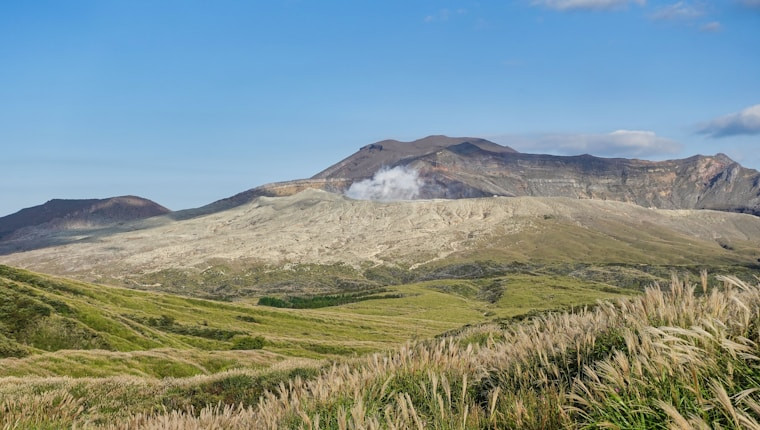
- Volcanic zones have live restrictions. Access around the Nakadake crater at Aso is adjusted continuously according to volcanic gas levels and the eruption alert level — always check the day's restriction status before setting out. Visitors with asthma or respiratory conditions are not permitted near the crater.
- Highland ice in winter. Lowland Kyushu rarely sees snow, but from late November to late March the plateau roads around Makinoto Pass and Chojabaru can be snowy or icy, and around 20 cm of accumulation can close a section. If your winter route goes up high, confirm the car's winter tire setup when you book — otherwise take the expressway around.
- Slow vehicles and wildlife. Farm vehicles and kei trucks are common on rural roads; deer and boar appear at dusk in the hills.
- Budget for city parking. Hourly rates in central Fukuoka, Kumamoto and Nagasaki are not cheap, while rural sights and onsen inns are usually free — the reason for the "trains in cities, car between them" rule.
Heading to Kagoshima: What GoodCars Will Tell You Up Front

Here is the honest part: GoodCars currently has a single Kyushu pickup point, at Fukuoka Airport — there is no local branch in Kagoshima. Fukuoka to central Kagoshima is about 290 km and 3.5–4 hours, with one-way ETC tolls around ¥5,030. That means:
- On a 3–4 day trip built around Kagoshima, do not drive down from Fukuoka. Seven or eight hours of round-trip driving swallows most of the itinerary.
- Three better options: (a) extend to six days or more and run a full loop — Fukuoka, Kumamoto, Kagoshima, Miyazaki, Oita, Fukuoka — so the driving is spread out; (b) take the Shinkansen to Kagoshima and rent locally; (c) do northern Kyushu this time and save the south for the next trip.
- If you are driving down anyway: buy the KEP (the round trip alone exceeds a 2-day pass), plan nothing else for the travel day, and save Sakurajima for the following morning — the ferry runs frequently, takes about 15 minutes, and you can take the car aboard.
Being straight with you matters more than one extra booking. GoodCars would rather your trip flows well and you come back again.
GoodCars' Fukuoka Airport pickup: choose your car, CDW and NOC coverage, ETC card and child seats in one online flow, in plain English. Fleets run tight over holidays and autumn-foliage season, so book ahead.
Book your Kyushu rental car nowFAQ
Q1. What documents do I need to rent a car in Kyushu?
For most nationalities: a 1949 Geneva Convention IDP, your original home licence and your passport — all three together. Drivers from Switzerland, Germany, France, Belgium, Monaco, Estonia and Taiwan use their licence plus an official Japanese translation instead. Licences from mainland China and Indonesia cannot be used in Japan.
Q2. Is the KEP worth buying?
The test is whether you cross south of Kumamoto. Staying near Fukuoka, skip it. A northern loop through Yufuin, Beppu, Aso and Kumamoto usually breaks even on a 2–3 day pass. Any route including Kagoshima or Miyazaki almost certainly pays. Remember it must be arranged at booking or pickup, with an ETC card.
Q3. How long does Fukuoka Airport pickup take?
Allow 45–60 minutes from landing to driving away: baggage, finding the rental shuttle point, a 10–15 minute ride, then counter paperwork and the vehicle check. Add time at peak international arrival hours. For returns, start about three hours before an international departure — details in the GoodCars Fukuoka Airport Car Rental Pickup Guide.
Q4. How many days do I need in Kyushu?
Four days and three nights is the minimum for the northern loop (Fukuoka, Yufuin, Beppu, Aso, Kumamoto). Add Takachiho and you want five. To include Kagoshima and Miyazaki, plan six or more. With fewer days, shrink the area rather than compressing the driving.
Q5. Do I need winter tires in Kyushu?
Not for lowland and expressway driving. But if your route climbs to Aso, Kuju or Unzen between late November and late March, snow and ice are possible — confirm the vehicle's winter setup when booking and check road and closure information on the day. If in doubt, take a lower-altitude alternative.
Q6. Does driving from Fukuoka to Kagoshima make sense?
It is about 290 km and 3.5–4 hours each way, which does not pay off on a short trip. Either extend the itinerary into a loop, or take the Shinkansen and rent in Kagoshima. If you do drive down, buy the KEP and keep the travel day free of sightseeing.
Q7. How should I handle city parking?
Park once and walk. Hourly rates in central Fukuoka, Kumamoto and Nagasaki add up quickly, and Nagasaki in particular is not a city to drive around because of narrow, steep streets and tram tracks. Rural sights and onsen inns almost always have free parking — treat the car as intercity transport.