'%3e%3cpath%20fill='red'%20d='M0%200h720v480H0z'/%3e%3cpath%20fill='%23000095'%20d='M0%200h360v240H0z'/%3e%3cg%20fill='%23fff'%3e%3cpath%20d='m154%20126.9-2.5%209.6%209.4%202.6-1.8-7.1zm46.9%205.1-1.8%207.1%209.4-2.6-2.5-9.6zm-41.8-24-5.1%205.1%201.9%206.9z'/%3e%3cpath%20d='m155.9%20120-1.9%206.9%205.1%205.1z'/%3e%3cpath%20d='m154%20113.1-6.9%206.9%206.9%206.9%201.9-6.9zm14%2027.8%205.1%205.1%206.9-1.9zm18.9%205.1%209.6%202.5%202.6-9.4-7.1%201.8z'/%3e%3cpath%20d='m192%20140.9%207.1-1.8%201.8-7.1zm-31.1-1.8%202.6%209.4%209.6-2.5-5.1-5.1zm19.1%205%206.9%201.9%205.1-5.1z'/%3e%3cpath%20d='m173.1%20146%206.9%206.9%206.9-6.9-6.9-1.9zm-12.2-45.1-9.4%202.6%202.5%209.6%205.1-5.1zm-1.8%2031.1%201.8%207.1%207.1%201.8zm45-12%201.9-6.9-5.1-5.1z'/%3e%3cpath%20d='m168%2099.1-7.1%201.8-1.8%207.1zm32.9%208.9-1.8-7.1-7.1-1.8zm5.1%2018.9%206.9-6.9-6.9-6.9-1.9%206.9z'/%3e%3cpath%20d='m200.9%20108-8.9-8.9-12-3.2-12%203.2-8.9%208.9-3.2%2012%203.2%2012%208.9%208.9%2012%203.2%2012-3.2%208.9-8.9%203.2-12z'/%3e%3cpath%20d='m200.9%20132%205.1-5.1-1.9-6.9zm5.1-18.9%202.5-9.6-9.4-2.6%201.8%207.1zm-6.9-12.2-2.6-9.4-9.6%202.5%205.1%205.1zm-26-6.9-9.6-2.5-2.6%209.4%207.1-1.8zm6.9%201.9-6.9-1.9-5.1%205.1z'/%3e%3cpath%20d='m186.9%2094-6.9-6.9-6.9%206.9%206.9%201.9z'/%3e%3cpath%20d='m192%2099.1-5.1-5.1-6.9%201.9zM173.1%20146l-9.6%202.5%204.5%2016.6%2012-12.2zm-5.1%2019.1%2012%2044.9%2012-44.9-12-12.2zm-7.1-26-9.4-2.6-4.4%2016.4%2016.4-4.4z'/%3e%3cpath%20d='m147.1%20152.9-12%2045.1%2032.9-32.9-4.5-16.6zm-12-20.9L102%20165.1l45.1-12.2%204.4-16.4z'/%3e%3cpath%20d='m154%20126.9-6.9-6.9-12%2012%2016.4%204.5zm0-13.8-2.5-9.6-16.4%204.5%2012%2012z'/%3e%3cpath%20d='M135.1%20108%2090%20120l45.1%2012%2012-12zm90%2024-16.6%204.5%204.4%2016.4%2045.1%2012.2z'/%3e%3cpath%20d='m199.1%20139.1-2.6%209.4%2016.4%204.4-4.4-16.4zm-12.2%206.9-6.9%206.9%2012%2012.2%204.5-16.6zm19.1-19.1%202.5%209.6%2016.6-4.5-12.2-12z'/%3e%3cpath%20d='m192%20165.1%2033.1%2032.9-12.2-45.1-16.4-4.4zm7.1-64.2%209.4%202.6%204.4-16.4-16.4%204.4z'/%3e%3cpath%20d='M225.1%20108%20258%2075.1l-45.1%2012-4.4%2016.4zm-12.2-20.9L225.1%2042%20192%2075.1l4.5%2016.4zm12.2%2044.9%2044.9-12-44.9-12-12.2%2012z'/%3e%3cpath%20d='m206%20113.1%206.9%206.9%2012.2-12-16.6-4.5zm-38-38L135.1%2042l12%2045.1%2016.4%204.4z'/%3e%3cpath%20d='m160.9%20100.9%202.6-9.4-16.4-4.4%204.4%2016.4z'/%3e%3cpath%20d='m147.1%2087.1-45.1-12%2033.1%2032.9%2016.4-4.5zm39.8%206.9%209.6-2.5-4.5-16.4-12%2012z'/%3e%3cpath%20d='M192%2075.1%20180%2030l-12%2045.1%2012%2012z'/%3e%3cpath%20d='m173.1%2094%206.9-6.9-12-12-4.5%2016.4z'/%3e%3c/g%3e%3ccircle%20cx='180'%20cy='120'%20r='51.1'%20fill='%23000095'/%3e%3ccircle%20cx='180'%20cy='120'%20r='45.1'%20fill='%23fff'/%3e%3c/g%3e%3c/svg%3e)
'%20d='m0%200%2016%2011h61%2061%2061%2061%2060L47%2037h61%2061%2060%2061L16%2063h61%2061%2061%2061%2060L47%2089h61%2061%2060%2061L16%20115h61%2061%2061%2061%2060L47%20141h61%2061%2060%2061L16%20166h61%2061%2061%2061%2060L47%20192h61%2061%2060%2061L16%20218h61%2061%2061%2061%2060L0%200'/%3e%3c/svg%3e)

'%20d='M-50-12v24m6%200v-24m6%200v24m76%200V1m0-2v-11m6%200v11m0%202v11m6%200V1m0-2v-11'/%3e%3cpath%20transform='rotate(-33.69006752598)'%20d='M-50-12v24m6%200V1m0-2v-11m6%200v24m76%200V1m0-2v-11m6%200v24m6%200V1m0-2v-11'/%3e%3c/g%3e%3cg%20transform='rotate(33.69006752598)'%3e%3cpath%20fill='%23cd2e3a'%20d='M12%200a18%2018%200%2011-36%200%2024%2024%200%201148%200'/%3e%3cpath%20fill='%230047a0'%20d='M0%200a12%2012%200%201124%200%2024%2024%200%2011-48%200%2012%2012%200%201024%200'/%3e%3c/g%3e%3c/svg%3e)


Osaka Car Rental Guide: City Parking Traps and When You Should (and Shouldn't) Rent
Osaka is where many first-time drivers in Japan begin: land at Kansai Airport, stay in Namba or Umeda, squeeze in Universal Studios Japan and a day trip or two. The real question is whether a car should follow you around on your Osaka city days. What does a night of parking cost, will the hotel car park even take your car, how does the Hanshin Expressway charge you, and how do you drive a city built on one-way avenues? This GoodCars guide answers all of it. One fact first: GoodCars' pickup and return point for the Kansai region is Kansai International Airport. There is no branch in central Osaka, so every option below shows how to combine an airport pickup with a city hotel without wasting money.

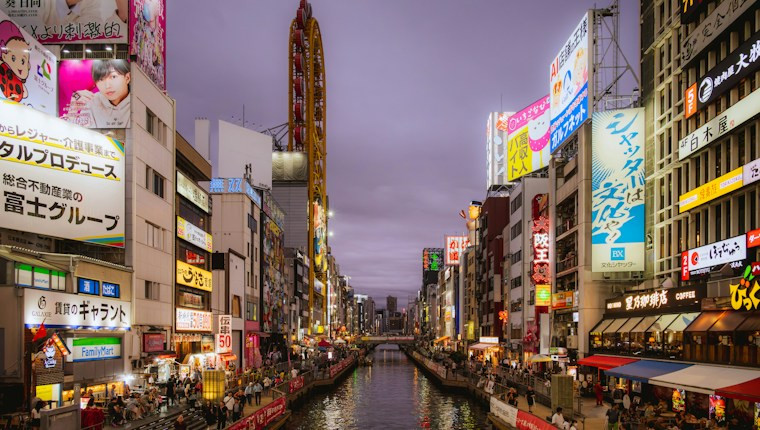
Dotonbori is walking and subway territory — bring a car here and you will spend the evening looking for a space (illustrative image)
Documents, insurance and the general pickup process are covered in our Complete Guide to Renting a Car in Japan. For the wider Kansai picture — why the cities are best without a car and why Wakayama, Awaji Island and Amanohashidate are where driving shines — see the Kansai Car Rental Guide. This article is about Osaka itself: which days you need a car, where to park it and how to drive in the city.
First Decide: Which Days of Your Osaka Trip Actually Need a Car?

Osaka Castle, Shinsaibashi and Tsutenkaku are all on the subway network — no car needed on city days (illustrative image)
Central Osaka is layered with the Midosuji subway line, the JR Osaka Loop Line and the Nankai, Hankyu, Hanshin and Keihan railways. Almost every sight has a station at the door. GoodCars suggests deciding by where you are going that day, not where you are sleeping that night:
| That day's plan | Need a car? | Why |
|---|---|---|
| Namba, Shinsaibashi, Umeda, Osaka Castle, Tsutenkaku | No | Subway plus walking covers it; a car only adds a parking bill |
| Universal Studios Japan | No | JR drops you at the gate; the official car park charges roughly ¥2,600–3,600 a day for a regular car, depending on the date |
| Kyoto, Nara or Kobe city centres | Usually not | Frequent direct trains, and parking is even harder than in Osaka |
| Wakayama and Shirahama, Awaji Island, Amanohashidate, the Rokko–Arima mountains | Yes | Scattered sights and sparse buses — this is where driving in Kansai pays off |
In short: city days in Osaka do not need a car; the days you leave the city do. Split your itinerary that way and the pickup options below become obvious.
Three Ways to Pick Up: On Arrival, Back at the Airport, or at a City Branch
If you are staying in central Osaka, there are really only three ways to arrange a rental. GoodCars has laid out the cost and risk of each:
| Option | How it works | Best for | Costs to watch |
|---|---|---|---|
| A. Pick up on arrival | Collect the car at Kansai Airport and drive straight to your city hotel | Travellers heading to Wakayama or Awaji on day one; families with elderly relatives or lots of luggage | Nightly city parking, Hanshin Expressway tolls and evening traffic into the city |
| B. No car on city days, return to the airport to pick up | Take the train into the city on arrival, then ride Nankai or JR back to Kansai Airport on the day you leave town | Anyone spending the first two or three days in the city; anyone who wants to pay for fewer rental days | One extra train ride plus moving around the airport — allow about an hour and a half |
| C. City branch pickup | Collect a car from a branch around Namba, Umeda or Shin-Osaka | Travellers with a fixed plan who happen to stay next to a branch | Usually fewer car types and shorter hours than airport branches; GoodCars currently offers Kansai pickup at Kansai Airport only |
If your first days are city-only, GoodCars recommends Option B. Japanese rentals are priced by time block, so skipping the city days means paying for fewer days and fewer nights of parking — and you never have to drive into Namba at rush hour.
You land in the early evening, spend two nights in Namba for the city and Universal Studios, then drive to Wakayama and Shirahama for two days before flying home from Kansai on day five. With Option A you rent from day one to day five and the car sleeps in a car park for two nights. With Option B you ride Nankai back to the airport on the morning of day three — two fewer rental days and two fewer nights of parking. The only extra cost is one train fare, and since Wakayama lies south of the airport, you simply drive south after pickup.
GoodCars works with local Japanese rental suppliers, and our Kansai pickup point is Kansai International Airport. You can set the pickup time for the day you leave Osaka rather than your arrival flight, and add car class, insurance, an ETC card and child seats in one booking.
Option B Step by Step: Getting Back to Kansai Airport from Namba, Tennoji or Shin-Osaka

The Nankai line from Namba is the most direct way back to Kansai Airport if you stay in the south of the city (illustrative image)
Choose your train by where you are staying:
- Namba or Shinsaibashi: the Nankai limited express "Rapi:t" from Nankai Namba takes about 40 minutes (all seats reserved); the Airport Express takes around 45 minutes with no limited-express surcharge.
- Tennoji, Shin-Osaka or coming from Kyoto: the JR limited express "Haruka" — about half an hour from Tennoji and roughly 50 minutes from Shin-Osaka.
- Umeda: take the Midosuji subway line to Namba for Nankai, or to Shin-Osaka for the Haruka. Allow more than an hour in total.
At the airport, the rental counters are not inside the terminal. They sit in the separate Aeroplaza building on the airport island, about three minutes from Terminal 1 via the second-floor walkway, and some suppliers then shuttle you across the bridge to a branch on the mainland. Details are in our Kansai Airport Car Rental Pickup Guide. From your hotel door, allow about an hour and a half before paperwork.
Heading north? Budget for a detour. Kansai Airport is south of Osaka. After pickup, Wakayama and Shirahama are on the way; but for northern Kyoto, Amanohashidate or Rokko–Arima you first have to drive back north through the whole city — around 50 km and an hour extra, plus Hanshin Expressway tolls. Option B still saves money on such trips; just build that hour into your first driving day.
Namba, Umeda or Shin-Osaka? Parking Rates and Three Traps

Namba and Nipponbashi are packed with shops, and hotel parking is limited — you will often use a nearby coin car park (illustrative image)
If you choose Option A, the car lives in the city with you. Parking in Osaka costs more than in Naha but somewhat less than central Tokyo. Typical daily caps at coin car parks (market reference values):
| Area | Typical 24-hour cap | Driving difficulty |
|---|---|---|
| Namba / Shinsaibashi | Weekdays about ¥1,300–1,900; weekends about ¥1,800–2,200 | Highest: crowds, taxis and dense one-way streets |
| Umeda (Osaka Station) | Weekdays around ¥1,700; weekends around ¥2,000 | High: big junctions and complicated entrances |
| Shin-Osaka | Mostly around ¥1,500 | Moderate: business district with steadier traffic |
Hotel car parks commonly charge ¥2,000–3,000 a night and are usually first come, first served. Beyond price, GoodCars flags three traps specific to parking in Osaka:
Trap 1: "Maximum charge" is written three different ways
The cap on the sign may be 当日最大 (same-day maximum, valid only until midnight), 入庫後24時間最大 (maximum for 24 hours from entry) or a day-time / night-time maximum. Park at 10 p.m. under a same-day cap and a new charge starts at midnight. Some signs add 繰り返し適用なし — the cap applies only once, after which normal hourly rates resume. For an overnight stay, look for the "24 hours from entry" type.
Trap 2: Car parks have opening hours

A sign like this, open 7:00–21:00, means your car cannot come out outside those hours (illustrative image)
Many mechanical parking towers and department-store car parks around Namba and Shinsaibashi close at around 11 p.m. and reopen at 7 or 8 a.m. Outside those hours your car cannot be retrieved. If you plan a dawn start, check the hours before you park, or use a 24-hour open-air lot instead.
Trap 3: Mechanical bays often have a 1.55 m height limit
Urban mechanical parking systems commonly limit vehicle height to 1.55 m; self-park and underground garages are usually around 2.1 m. Seven-seaters and tall SUVs may simply not fit. Ask your hotel "mechanical or flat?" and "what is the height limit?" before booking — you can then pick a suitable car class with GoodCars.
Hanshin Expressway: No ETC Card Means Paying the Maximum

The Hanshin Expressway stacks ramp upon ramp over central Osaka — plan your exit before you get on (illustrative image)
Driving from Kansai Airport into Osaka, or from Osaka towards Kobe and Kyoto, almost always puts you on the Hanshin Expressway. Its toll rules are unlike most countries':
- ETC cars pay by distance: about ¥300–1,950 for a regular car, based on the distance actually driven.
- Cash cars pay the maximum: most Hanshin exits have no toll booth, so the system cannot know how far you drove. Cash users are charged at the entrance for the farthest exit reachable from that entrance — a short city hop can cost the full ¥1,950 cap.
- ETC-only entrances are spreading: Hanshin Expressway is converting entrances to ETC-only in stages, with over twenty more in the latest round and around a hundred planned within a few years. Without a card, some entrances will not let you in at all.
An ETC card rents for about ¥330 per rental, so it pays for itself on a single Hanshin trip; GoodCars recommends it for every booking. If you enter an ETC-only lane by mistake and the barrier stays down, never reverse or make a U-turn — stop, press the intercom, or follow the signs to the lane marked "サポート" (Support) and wait for staff.
The Loop Route runs clockwise only. Hanshin Route 1 (Loop Route) is one-way all the way round, with four lanes and very short gaps between merges and splits, and exits and branch routes come one after another. On your first drive, decide your exit before you join; if you miss it, go round again rather than cutting across lanes at the last second.
Driving in Central Osaka: One-Way Avenues, Bicycles and Kerbside Stops

Most of central Osaka's north–south avenues are one-way, so the way out and the way back are rarely the same road (illustrative image)
Even a short city drive in Osaka has a few habits locals take for granted. GoodCars sums them up in four points:
- The main north–south avenues are one-way. Midosuji runs southbound (Umeda towards Namba) and Yotsubashi-suji northbound; Sakaisuji runs northbound between Tenjinbashi and Nipponbashi, while Matsuyamachi-suji runs southbound. Your return route will almost always be a different street.
- Bicycles are everywhere. Cyclists weave between the pavement and the road, so check your mirrors and over your shoulder before every turn.
- Back streets are 30 km/h. Japan has lowered the default limit on residential roads without a centre line from 60 to 30 km/h (about 19 mph), and it applies even without a sign. Sat-navs love these shortcuts.
- Kerbside stopping is expensive. Parking enforcement officers patrol central Osaka. If your rental car gets a yellow parking-violation sticker, you must settle it at the police station before you can return the car; without proof of payment, rental terms commonly charge a penalty (often ¥30,000) and may add lost-business compensation.
The GoodCars bottom line: use your car in Osaka only to leave the city and to get back to the airport, and leave in-city trips to the subway.
Return Day and Documents: The Last Leg to Kansai Airport
Central Osaka to Kansai Airport is about 50 km — 50 minutes to an hour in free-flowing traffic, but it can double on weekday evenings and holidays. Work backwards from your departure:
- For international flights, return the car at least three hours before take-off; add an hour in peak season.
- Refuel before the bridge: there is no public petrol station on the airport island.
- Bridge toll: about ¥420 one way for a regular car, plus Izumisano City's airport bridge tax; rental terms usually make these the renter's cost.
- Staying in the city on your last night with an early flight? Return the car at the airport the evening before, take the train back into town and ride the train to your flight in the morning.
Document requirements are the same wherever you pick up:
- Most countries (US, UK, Australia, Canada, Singapore, Malaysia, Hong Kong, South Korea, Thailand and others): an International Driving Permit in the 1949 Geneva Convention format, plus your original home licence and passport. Get the IDP at home before you travel — it cannot be issued inside Japan.
- Vienna Convention–format IDPs are not valid in Japan. If your country issues both formats, ask for the Geneva one.
- Switzerland, Germany, France, Belgium, Monaco and Taiwan: an official Japanese translation of your licence instead of an IDP, with the original licence and passport.
- Mainland China and Indonesia: these licences cannot be used to drive in Japan, even with an IDP.
You may drive for up to one year from your date of entry. Full details on documents and insurance are in our Complete Guide to Renting a Car in Japan. GoodCars has six pickup points across Japan, all booked the same way:
| Pickup point | Region | Book |
|---|---|---|
| Kansai Airport | Osaka, Kyoto and Kansai (this guide) | Pick up at Kansai |
| Narita Airport (Chiba) | Tokyo and Kanto | Pick up at Narita |
| Haneda Airport | Tokyo and Kanto | Pick up at Haneda |
| New Chitose Airport | Hokkaido | Pick up at New Chitose |
| Fukuoka Airport | Kyushu | Pick up at Fukuoka |
| Naha Airport | Okinawa | Pick up at Naha |
FAQ
Q1. Can I pick up a GoodCars rental in Namba or Umeda?
Not at the moment. GoodCars' Kansai pickup and return point is Kansai Airport. If you are staying in the city, ride Nankai or JR back to the airport on the day you leave town — about 40 minutes from Namba — and allow roughly an hour and a half in total.
Q2. Do I need a car for Osaka city and Universal Studios Japan?
No. The subway and JR reach every major sight, and JR runs right to Universal Studios. Driving would add about ¥1,500–2,200 a day in city parking, and the official USJ car park costs around ¥2,600–3,600 a day. Save your rental days for places trains cannot reach, such as Wakayama and Awaji Island.
Q3. How much does hotel parking cost in central Osaka?
Hotel car parks commonly charge ¥2,000–3,000 a night. Nearby coin car parks around Namba cap at about ¥1,300–1,900 on weekdays and ¥1,800–2,200 at weekends. Mechanical bays often have a 1.55 m height limit and fixed opening hours, so check before booking a tall car or planning an early start.
Q4. Can I drive the Hanshin Expressway without an ETC card?
You can use entrances with a staffed or cash lane, but cash cars are charged for the farthest exit reachable from that entrance — often the full ¥1,950 cap even for a short hop. ETC-only entrances are also increasing, and some will not accept cash at all. At about ¥330 to rent, GoodCars recommends always adding an ETC card.
Q5. How long is the drive from Kansai Airport to Namba, and what are the tolls?
About 50 km, roughly 50 minutes to an hour without traffic. Costs include the airport bridge (about ¥420 one way plus the airport bridge tax) and distance-based expressway and Hanshin tolls with ETC. The exact amount depends on your route; use the expressway operators' official toll calculators before you set off.
Q6. What is the most common mistake when driving in Osaka?
Getting confused by the one-way avenues, stopping at the kerb and collecting a parking ticket, and treating the Hanshin Loop Route as a two-way road. GoodCars suggests driving only two legs in the city — out of town and back to the airport — with navigation on the whole way.
Q7. What licence do I need to drive in Osaka?
Most visitors need a 1949 Geneva Convention–format International Driving Permit, their original home licence and their passport; the IDP must be obtained before travelling. Drivers from Switzerland, Germany, France, Belgium, Monaco and Taiwan use an official Japanese translation instead. Licences from mainland China and Indonesia cannot be used in Japan.
📸 Image credits: photos in this article are from Unsplash's free commercial-use library and are illustrative only. They do not show actual GoodCars vehicles, branches or customers.
⚠️ Disclaimer and AI assistance: this article was planned by the GoodCars team and drafted with the help of AI tools. Parking charges, train times, Hanshin Expressway tolls and ETC-only conversion plans, traffic rules and penalties are compiled from public information from the relevant operators and Japanese authorities. They are market reference values and may change at any time; on-site signs, official notices and the rental supplier's terms always take precedence.