'%3e%3cpath%20fill='red'%20d='M0%200h720v480H0z'/%3e%3cpath%20fill='%23000095'%20d='M0%200h360v240H0z'/%3e%3cg%20fill='%23fff'%3e%3cpath%20d='m154%20126.9-2.5%209.6%209.4%202.6-1.8-7.1zm46.9%205.1-1.8%207.1%209.4-2.6-2.5-9.6zm-41.8-24-5.1%205.1%201.9%206.9z'/%3e%3cpath%20d='m155.9%20120-1.9%206.9%205.1%205.1z'/%3e%3cpath%20d='m154%20113.1-6.9%206.9%206.9%206.9%201.9-6.9zm14%2027.8%205.1%205.1%206.9-1.9zm18.9%205.1%209.6%202.5%202.6-9.4-7.1%201.8z'/%3e%3cpath%20d='m192%20140.9%207.1-1.8%201.8-7.1zm-31.1-1.8%202.6%209.4%209.6-2.5-5.1-5.1zm19.1%205%206.9%201.9%205.1-5.1z'/%3e%3cpath%20d='m173.1%20146%206.9%206.9%206.9-6.9-6.9-1.9zm-12.2-45.1-9.4%202.6%202.5%209.6%205.1-5.1zm-1.8%2031.1%201.8%207.1%207.1%201.8zm45-12%201.9-6.9-5.1-5.1z'/%3e%3cpath%20d='m168%2099.1-7.1%201.8-1.8%207.1zm32.9%208.9-1.8-7.1-7.1-1.8zm5.1%2018.9%206.9-6.9-6.9-6.9-1.9%206.9z'/%3e%3cpath%20d='m200.9%20108-8.9-8.9-12-3.2-12%203.2-8.9%208.9-3.2%2012%203.2%2012%208.9%208.9%2012%203.2%2012-3.2%208.9-8.9%203.2-12z'/%3e%3cpath%20d='m200.9%20132%205.1-5.1-1.9-6.9zm5.1-18.9%202.5-9.6-9.4-2.6%201.8%207.1zm-6.9-12.2-2.6-9.4-9.6%202.5%205.1%205.1zm-26-6.9-9.6-2.5-2.6%209.4%207.1-1.8zm6.9%201.9-6.9-1.9-5.1%205.1z'/%3e%3cpath%20d='m186.9%2094-6.9-6.9-6.9%206.9%206.9%201.9z'/%3e%3cpath%20d='m192%2099.1-5.1-5.1-6.9%201.9zM173.1%20146l-9.6%202.5%204.5%2016.6%2012-12.2zm-5.1%2019.1%2012%2044.9%2012-44.9-12-12.2zm-7.1-26-9.4-2.6-4.4%2016.4%2016.4-4.4z'/%3e%3cpath%20d='m147.1%20152.9-12%2045.1%2032.9-32.9-4.5-16.6zm-12-20.9L102%20165.1l45.1-12.2%204.4-16.4z'/%3e%3cpath%20d='m154%20126.9-6.9-6.9-12%2012%2016.4%204.5zm0-13.8-2.5-9.6-16.4%204.5%2012%2012z'/%3e%3cpath%20d='M135.1%20108%2090%20120l45.1%2012%2012-12zm90%2024-16.6%204.5%204.4%2016.4%2045.1%2012.2z'/%3e%3cpath%20d='m199.1%20139.1-2.6%209.4%2016.4%204.4-4.4-16.4zm-12.2%206.9-6.9%206.9%2012%2012.2%204.5-16.6zm19.1-19.1%202.5%209.6%2016.6-4.5-12.2-12z'/%3e%3cpath%20d='m192%20165.1%2033.1%2032.9-12.2-45.1-16.4-4.4zm7.1-64.2%209.4%202.6%204.4-16.4-16.4%204.4z'/%3e%3cpath%20d='M225.1%20108%20258%2075.1l-45.1%2012-4.4%2016.4zm-12.2-20.9L225.1%2042%20192%2075.1l4.5%2016.4zm12.2%2044.9%2044.9-12-44.9-12-12.2%2012z'/%3e%3cpath%20d='m206%20113.1%206.9%206.9%2012.2-12-16.6-4.5zm-38-38L135.1%2042l12%2045.1%2016.4%204.4z'/%3e%3cpath%20d='m160.9%20100.9%202.6-9.4-16.4-4.4%204.4%2016.4z'/%3e%3cpath%20d='m147.1%2087.1-45.1-12%2033.1%2032.9%2016.4-4.5zm39.8%206.9%209.6-2.5-4.5-16.4-12%2012z'/%3e%3cpath%20d='M192%2075.1%20180%2030l-12%2045.1%2012%2012z'/%3e%3cpath%20d='m173.1%2094%206.9-6.9-12-12-4.5%2016.4z'/%3e%3c/g%3e%3ccircle%20cx='180'%20cy='120'%20r='51.1'%20fill='%23000095'/%3e%3ccircle%20cx='180'%20cy='120'%20r='45.1'%20fill='%23fff'/%3e%3c/g%3e%3c/svg%3e)
'%20d='m0%200%2016%2011h61%2061%2061%2061%2060L47%2037h61%2061%2060%2061L16%2063h61%2061%2061%2061%2060L47%2089h61%2061%2060%2061L16%20115h61%2061%2061%2061%2060L47%20141h61%2061%2060%2061L16%20166h61%2061%2061%2061%2060L47%20192h61%2061%2060%2061L16%20218h61%2061%2061%2061%2060L0%200'/%3e%3c/svg%3e)

'%20d='M-50-12v24m6%200v-24m6%200v24m76%200V1m0-2v-11m6%200v11m0%202v11m6%200V1m0-2v-11'/%3e%3cpath%20transform='rotate(-33.69006752598)'%20d='M-50-12v24m6%200V1m0-2v-11m6%200v24m76%200V1m0-2v-11m6%200v24m6%200V1m0-2v-11'/%3e%3c/g%3e%3cg%20transform='rotate(33.69006752598)'%3e%3cpath%20fill='%23cd2e3a'%20d='M12%200a18%2018%200%2011-36%200%2024%2024%200%201148%200'/%3e%3cpath%20fill='%230047a0'%20d='M0%200a12%2012%200%201124%200%2024%2024%200%2011-48%200%2012%2012%200%201024%200'/%3e%3c/g%3e%3c/svg%3e)


Okinawa 4-Day 3-Night Self-Drive Itinerary: Routes and Daily Driving Times

GoodCars acts as an agent for local Japanese rental suppliers, and Okinawa is one of the destinations we are asked about most. Okinawa's main island is only about 100 kilometres from end to end, which is exactly why so many travellers overload their plans. On a four-day trip the real question is never "which attractions" — it is how long you drive each day and where you sleep each night. The same four days can cost you four or five extra hours behind the wheel if you base yourself in the wrong place.
The mechanics of renting (documents, insurance, refuelling and return) are covered in the GoodCars complete guide to renting a car in Japan, and Okinawa's road conditions are covered in our Okinawa car rental guide. This article does not repeat either. It does one thing: it gives you a four-day skeleton that never doubles back, with real driving times so you can swap in your own stops.
- Staying all three nights in Naha is the expensive mistake — it adds roughly 3 hours of driving just going north and back
- Naha Airport to the Churaumi area: about 96 km / 2 hours by expressway, about 90 km / 2 hours 50 minutes on ordinary roads
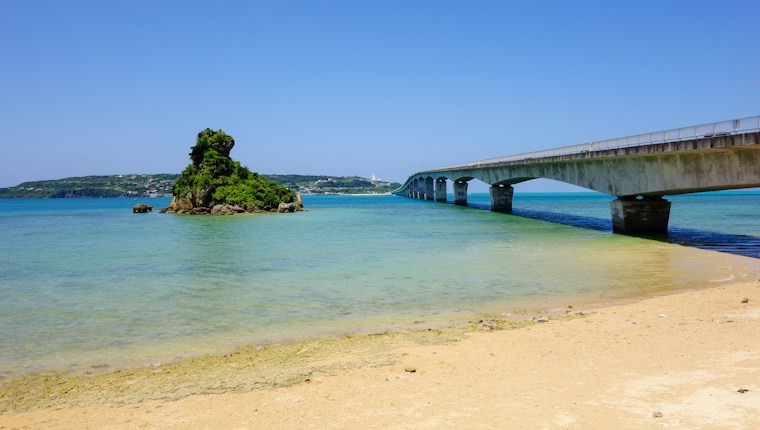
- Naha Airport to Kouri Bridge: about 85 km / 1 hour 30 minutes by expressway
- Okinawa Expressway, Naha IC to Kyoda IC: about ¥1,040 with ETC, about ¥1,610 in cash
- Day 4 catches the most people out: return the car 2 hours before departure, as the shuttle can take up to an hour
Decide where you sleep before you decide what you see

This is the pattern GoodCars hears about most often. Travellers book Naha by instinct — close to the airport, plenty of restaurants, easy for the return. But Okinawa's sightseeing weight sits firmly in the north: the Churaumi aquarium area is on the Motobu Peninsula, Kouri Island is further north again, and Naha is at the very southern tip. Three nights in Naha means driving the same north-south corridor twice, every single day.
Here is the arithmetic. Naha to the Churaumi area is about 2 hours each way by expressway, so 4 hours return. If your second night is around Onna Village, the same trip is about 1 hour each way — 2 hours return. Changing one hotel booking saves you roughly two hours of driving, before you even account for traffic.
| Basing strategy | Estimated total driving | Who it suits |
|---|---|---|
| All three nights in Naha | About 12–14 hours | Travellers staying south, treating the north as an optional day trip |
| 1 night Naha + 2 nights central/north (recommended) | About 8–9 hours | Anyone wanting the full north-south trip without daily long hauls |
| 2 nights central/north + 1 night Naha | About 8–9 hours | Travellers with an early flight on the final day |
In practice GoodCars recommends the second option: first night in Naha or the south, second and third nights further north. That turns your route into a single northward sweep and one return leg, instead of a daily radial run from the southern tip.
The driving-time table: check the numbers before you plan
Before you build the itinerary, learn these intervals. GoodCars has gathered the ones travellers ask about most. Distances in Okinawa are easy to underestimate — two points that look close on a map can be well over an hour apart.
| Leg | Distance | Expressway | Ordinary roads |
|---|---|---|---|
| Naha Airport → Onna Village area | About 50 km | About 50 min–1 hour | About 1 hour 20 min |
| Naha Airport → Churaumi area | About 96 km | About 2 hours | About 2 hours 50 min |
| Naha Airport → Kouri Bridge | About 85 km | About 1 hour 30 min | About 2 hours |
| Onna Village → Churaumi area | About 42 km | About 1 hour | |
| Churaumi area → Kouri Island | — | About 30 min | |
| Nago city → Kouri Island | — | About 30 min | |
GoodCars suggests reading this table backwards: take the farthest point you plan to reach, add the return leg, and subtract that from the hours you actually have. What remains is your real sightseeing time. Most overloaded itineraries fail because the drive home was never counted.
Day 1: land, collect the car, stay local (do not overfill it)

The classic day-one error is treating your landing time as the start of sightseeing. At Naha Airport the usual model is check in at the terminal, then take a shuttle to the branch office to collect the car. Add immigration, baggage, the contract and the vehicle inspection, and 60–90 minutes from landing to driving away is the safe estimate.
So treat Day 1 as a transition day, not a sightseeing day. The arrangements GoodCars recommends:
- Landing before noon: collect the car, head south, fit in one or two nearby stops, reach your base by evening
- Afternoon landing: drive straight towards your accommodation and lower the day's ambition to a good dinner and an early night
- Evening landing: stay near the airport and collect the car the next morning — far safer than learning unfamiliar roads in the dark
Also remember that many car parks, restaurants and visitor facilities in Okinawa close early in the evening. Do not schedule a day-one arrival at your destination after dark.
Day 2: head north while you are freshest

The GoodCars pick-up point for Okinawa is at Naha Airport, which is where most itineraries begin. Day 2 covers the longest distance of the trip, so it belongs on the day you have the most energy and are most comfortable with the car. The flow is a single northward push: leave Naha or the south, run up the west coast, and sleep in the centre or north so you never retrace the route.
How long? From Naha via the Okinawa Expressway, the Motobu Peninsula is about 2 hours. If you stayed near Onna Village the night before, it is about 1 hour. That single hour decides whether the day is spent rushing or enjoying.
| Starting point | Time to the main northern sights | Suggested departure |
|---|---|---|
| Central Naha | About 2 hours (expressway) | Before 08:00, or the afternoon gets tight |
| Onna Village area | About 1 hour | Before 09:00 is enough |
| Nago city | About 30–40 min | The most flexible option |
Movement between northern sights counts too: the Churaumi area to Kouri Island is about 30 minutes, and Nago city to Kouri Island is also about 30 minutes. Two major stops plus one small one on the way is the sensible daily ceiling — add a third major stop and you will spend the day chasing the clock. GoodCars covers the detailed northern route separately; this article keeps to the skeleton and the driving times.
Day 3: work back down the central coast

GoodCars finds Day 3 is the one most often planned badly. Its job is to break the long run from the north back to Naha into a day with something in it, rather than grinding out two hours in one go. Heading south, the central coast is the natural midpoint: resorts and coastal scenery on the west side, and a group of small islands linked by causeway on the east.
The rhythm to aim for is finish in the north in the morning, set off south around midday, fit one or two stops into the centre in the afternoon, reach Naha by evening. Total driving works out at a little over 2 hours, broken up by stops, so it never feels like a long haul.
- West coast: dense with resort hotels and sea-view restaurants; easy going, with places to pull over and look at the water
- East coast: the causeway-linked islands are visually striking, but the detour adds roughly an hour
- Trying to do both pushes the day past 4 hours of driving — on a four-day trip, pick one
If your final flight is early, put the third night in Naha or near the airport so the last day is only "return the car and fly". If your flight is in the afternoon, staying in the centre and driving south on the final morning works perfectly well.
Day 4: the return day people misjudge

GoodCars stresses one thing for the final day: arrive at the branch office 2 hours before your flight departs. That is not excessive caution — it is the standard advice from Okinawa rental operators, because after returning the car you still have to take a shuttle to the terminal, and at peak times that shuttle can take close to an hour.
Working backwards makes it obvious:
| Step | Time to allow | Notes |
|---|---|---|
| Return formalities (inspection, fuel check) | 10–20 min | Longer queues in peak season |
| Branch office → airport shuttle | 20–60 min | Fixed departures; miss one and you wait |
| Check-in, bags, security | 60 min or more | Add more for international flights |
| Total: arrive at the office before departure | 2 hours | For early flights, refuel the night before |
Do not forget the full-tank return. Most Okinawa rental terms require the car back full, and the filling stations near the airport queue up morning and evening. The safest approach is to fill up the night before, on your way back to the hotel, and drive straight to the return in the morning. GoodCars has seen far too many travellers hunting for a petrol station and chasing a shuttle in the same final hour — the most stressful thirty minutes of the trip.
Is the Okinawa Expressway worth it?

Travellers regularly ask GoodCars whether to use the expressway. The island's only one is the Okinawa Expressway, running roughly from Naha up to Kyoda in the north. Whether to take it depends entirely on where you are going that day.
| Section | ETC | Cash | Time saved |
|---|---|---|---|
| Naha IC → Kyoda IC (full length) | About ¥1,040 | About ¥1,610 | About 40–50 minutes |
The rule is simple: if you are going north to the Motobu Peninsula or Kouri Island, the expressway pays for itself. If you are staying in the centre or south, the ordinary national routes offer more coastal scenery and more places to stop.
- The ETC discount is significant: cash is roughly fifty percent more for the same section, so renting an ETC card usually pays off if you will use the expressway more than once
- The expressway ends at Kyoda: from there to the Churaumi area is still a stretch of ordinary road — allow another 30–40 minutes
One road condition is specific to Okinawa: parts of the local network are surfaced with Ryukyu limestone, which is noticeably more slippery in the wet than surfaces on the mainland. In rain, reduce speed and increase your braking distance. GoodCars covers this in more depth in the dedicated Okinawa rental guide.
Frequently asked questions
Q1. Do I really need a car for four days in Okinawa?
If you are staying in central Naha and its immediate surroundings, the monorail plus taxis will do. But as soon as your plan includes the centre or north — Churaumi, Kouri Island, the Onna coast — bus frequencies and transfers consume an enormous amount of time. For a trip covering both ends of the island, driving is effectively the only workable option.
Q2. How should I split the three nights?
The most efficient split is one night in Naha or the south plus two nights in the centre or north. That gives you a single northward run and one return leg, with no repeated sections. If your final flight is early, invert it: two nights north, last night back near Naha.
Q3. How much daily driving is reasonable?
GoodCars suggests keeping total driving to 2–3 hours a day on a four-day trip. Anything over 4 hours means the day is spread too thin, usually because the northern sights and the eastern islands have been squeezed together. Add up the legs in the table above, then decide what to cut.
Q4. My flight lands in the afternoon — how should I adjust?
Treat Day 1 as pure transit: collect the car and drive towards your accommodation, avoiding anything ticketed or with fixed opening hours. Move the southern stops you had planned for Day 1 to the morning of Day 4 — you have to head south to return the car anyway.
Q5. What is the easiest way to pay expressway tolls?
Renting an ETC card with the car is the simplest option: you drive through without stopping and the rate is lower than cash. Without one, use the lanes marked "General" or the combined "ETC/General" lanes, and never enter an ETC-only lane. The GoodCars complete guide to renting in Japan explains the gates and payment methods in full.
Q6. Must I refuel before returning the car?
Most contracts require a full tank on return, and the operator will charge a higher per-litre rate if it is short. Fill up the evening before, near your accommodation, rather than competing with every other departing traveller at the stations around Naha Airport in the morning.
Q7. Is Okinawa difficult for a first-time driver in Japan?
In the GoodCars experience it is one of the friendlier places in Japan to start: the main routes are simple, signage is clear, and there is very little mountain driving. What genuinely needs attention is driving on the left, the bus-only lanes at rush hour in Naha, and the limestone surfaces in wet weather. Take a short drive on day one to get used to the car and the rest of the trip flows.