'%3e%3cpath%20fill='red'%20d='M0%200h720v480H0z'/%3e%3cpath%20fill='%23000095'%20d='M0%200h360v240H0z'/%3e%3cg%20fill='%23fff'%3e%3cpath%20d='m154%20126.9-2.5%209.6%209.4%202.6-1.8-7.1zm46.9%205.1-1.8%207.1%209.4-2.6-2.5-9.6zm-41.8-24-5.1%205.1%201.9%206.9z'/%3e%3cpath%20d='m155.9%20120-1.9%206.9%205.1%205.1z'/%3e%3cpath%20d='m154%20113.1-6.9%206.9%206.9%206.9%201.9-6.9zm14%2027.8%205.1%205.1%206.9-1.9zm18.9%205.1%209.6%202.5%202.6-9.4-7.1%201.8z'/%3e%3cpath%20d='m192%20140.9%207.1-1.8%201.8-7.1zm-31.1-1.8%202.6%209.4%209.6-2.5-5.1-5.1zm19.1%205%206.9%201.9%205.1-5.1z'/%3e%3cpath%20d='m173.1%20146%206.9%206.9%206.9-6.9-6.9-1.9zm-12.2-45.1-9.4%202.6%202.5%209.6%205.1-5.1zm-1.8%2031.1%201.8%207.1%207.1%201.8zm45-12%201.9-6.9-5.1-5.1z'/%3e%3cpath%20d='m168%2099.1-7.1%201.8-1.8%207.1zm32.9%208.9-1.8-7.1-7.1-1.8zm5.1%2018.9%206.9-6.9-6.9-6.9-1.9%206.9z'/%3e%3cpath%20d='m200.9%20108-8.9-8.9-12-3.2-12%203.2-8.9%208.9-3.2%2012%203.2%2012%208.9%208.9%2012%203.2%2012-3.2%208.9-8.9%203.2-12z'/%3e%3cpath%20d='m200.9%20132%205.1-5.1-1.9-6.9zm5.1-18.9%202.5-9.6-9.4-2.6%201.8%207.1zm-6.9-12.2-2.6-9.4-9.6%202.5%205.1%205.1zm-26-6.9-9.6-2.5-2.6%209.4%207.1-1.8zm6.9%201.9-6.9-1.9-5.1%205.1z'/%3e%3cpath%20d='m186.9%2094-6.9-6.9-6.9%206.9%206.9%201.9z'/%3e%3cpath%20d='m192%2099.1-5.1-5.1-6.9%201.9zM173.1%20146l-9.6%202.5%204.5%2016.6%2012-12.2zm-5.1%2019.1%2012%2044.9%2012-44.9-12-12.2zm-7.1-26-9.4-2.6-4.4%2016.4%2016.4-4.4z'/%3e%3cpath%20d='m147.1%20152.9-12%2045.1%2032.9-32.9-4.5-16.6zm-12-20.9L102%20165.1l45.1-12.2%204.4-16.4z'/%3e%3cpath%20d='m154%20126.9-6.9-6.9-12%2012%2016.4%204.5zm0-13.8-2.5-9.6-16.4%204.5%2012%2012z'/%3e%3cpath%20d='M135.1%20108%2090%20120l45.1%2012%2012-12zm90%2024-16.6%204.5%204.4%2016.4%2045.1%2012.2z'/%3e%3cpath%20d='m199.1%20139.1-2.6%209.4%2016.4%204.4-4.4-16.4zm-12.2%206.9-6.9%206.9%2012%2012.2%204.5-16.6zm19.1-19.1%202.5%209.6%2016.6-4.5-12.2-12z'/%3e%3cpath%20d='m192%20165.1%2033.1%2032.9-12.2-45.1-16.4-4.4zm7.1-64.2%209.4%202.6%204.4-16.4-16.4%204.4z'/%3e%3cpath%20d='M225.1%20108%20258%2075.1l-45.1%2012-4.4%2016.4zm-12.2-20.9L225.1%2042%20192%2075.1l4.5%2016.4zm12.2%2044.9%2044.9-12-44.9-12-12.2%2012z'/%3e%3cpath%20d='m206%20113.1%206.9%206.9%2012.2-12-16.6-4.5zm-38-38L135.1%2042l12%2045.1%2016.4%204.4z'/%3e%3cpath%20d='m160.9%20100.9%202.6-9.4-16.4-4.4%204.4%2016.4z'/%3e%3cpath%20d='m147.1%2087.1-45.1-12%2033.1%2032.9%2016.4-4.5zm39.8%206.9%209.6-2.5-4.5-16.4-12%2012z'/%3e%3cpath%20d='M192%2075.1%20180%2030l-12%2045.1%2012%2012z'/%3e%3cpath%20d='m173.1%2094%206.9-6.9-12-12-4.5%2016.4z'/%3e%3c/g%3e%3ccircle%20cx='180'%20cy='120'%20r='51.1'%20fill='%23000095'/%3e%3ccircle%20cx='180'%20cy='120'%20r='45.1'%20fill='%23fff'/%3e%3c/g%3e%3c/svg%3e)
'%20d='m0%200%2016%2011h61%2061%2061%2061%2060L47%2037h61%2061%2060%2061L16%2063h61%2061%2061%2061%2060L47%2089h61%2061%2060%2061L16%20115h61%2061%2061%2061%2060L47%20141h61%2061%2060%2061L16%20166h61%2061%2061%2061%2060L47%20192h61%2061%2060%2061L16%20218h61%2061%2061%2061%2060L0%200'/%3e%3c/svg%3e)

'%20d='M-50-12v24m6%200v-24m6%200v24m76%200V1m0-2v-11m6%200v11m0%202v11m6%200V1m0-2v-11'/%3e%3cpath%20transform='rotate(-33.69006752598)'%20d='M-50-12v24m6%200V1m0-2v-11m6%200v24m76%200V1m0-2v-11m6%200v24m6%200V1m0-2v-11'/%3e%3c/g%3e%3cg%20transform='rotate(33.69006752598)'%3e%3cpath%20fill='%23cd2e3a'%20d='M12%200a18%2018%200%2011-36%200%2024%2024%200%201148%200'/%3e%3cpath%20fill='%230047a0'%20d='M0%200a12%2012%200%201124%200%2024%2024%200%2011-48%200%2012%2012%200%201024%200'/%3e%3c/g%3e%3c/svg%3e)


Okinawa Car Rental Complete Guide | Costs, Car Types, Routes & Local Driving Tips

Okinawa is Japan's easiest case for renting a car, because there is simply no train network. The monorail loops only through central Naha; buses are slow and infrequent; and the Churaumi Aquarium, Kouri Island and Cape Manzamo are scattered along 130 km of coastline. Land, pick up a car, and Okinawa actually begins.
The good news: Okinawa is also Japan's friendliest place to drive for the first time — wide roads, light traffic, slow local pace. But it has a few traps only locals talk about: rush-hour bus lanes in Naha, roads that turn slippery in the rain, and predictable city congestion. This GoodCars guide covers costs, car types, routes and the local driving quirks in one read.
- No rail network — a rental car is effectively the only way to see the island
- Most visitors need a 1949 Geneva Convention IDP plus home licence and passport
- Naha enforces weekday rush-hour bus lanes — tourists get fined like everyone else
- Okinawan asphalt contains limestone: rain makes it unusually slippery
- High season (summer, holidays) sells out — book online early
Why Okinawa Is a Driving Paradise (and Drive-Only)
- Public transport doesn't connect. The monorail covers only Naha; beyond it, buses run once or twice an hour and the northern sights take two to three hours each way.
- The sights line 130 km of coast. Sefa-Utaki in the south, American Village and Cape Manzamo in the centre, Churaumi and Kouri in the north — only a car strings them into one trip.
- The gentlest introduction to driving on the left. Wide lanes, light traffic and a slow local pace (urban flow often sits at 40–50 km/h) give first-timers far more margin than Tokyo or Osaka ever would.
GoodCars' rule: if your whole trip is Kokusai Street shopping, the monorail is enough. The moment Churaumi, Kouri or Manzamo appears in your plan, budget for a car.
Documents: What You Need Before You Fly
Japanese rental counters check documents strictly — incomplete paperwork means a refusal on the spot. For most nationalities you need all three of:
- An International Driving Permit (IDP) under the 1949 Geneva Convention — the only format Japan recognises. 1968 Vienna Convention IDPs are not valid.
- Your home driving licence — the IDP works only together with the original licence.
- Your passport — you may drive for up to one year from entry, within your documents' validity.
Picking Up at Naha Airport
Every Okinawa road trip starts at Naha Airport. After arrival, follow your booking voucher to the pickup point; paperwork, vehicle check and briefing take 30–60 minutes in total. Practical tips:
- Return with a wide margin. Return, inspection and the ride back to the terminal take time — leave at least 90 minutes before boarding, more in peak season.
- Book early for high season. Summer and holiday weeks empty the fleets; compact cars and 7-seaters go first. Book the car when you book the flight.
- Photograph the car at pickup. Scratches, dents, wheel marks — your best protection at return.
- Add an ETC card. You'll want it for the Okinawa Expressway run to the north.
GoodCars partners with local Japanese suppliers — Naha Airport pickup, transparent pricing, and insurance, ETC card and child seats added in one online flow.
Check Naha Airport rental dealsCosts and Choosing the Right Car
Your real total stacks up in layers: base rate (volatile in high season) + CDW + NOC coverage + fuel + parking + tolls. Add 20–30% on top of the base rate and you'll land close to the final bill. GoodCars' sizing rules:
- Two adults, light luggage: compact car. Easy to park, fits mechanical car parks near Kokusai Street, sips fuel.
- Four to five with suitcases: mid-size sedan or small SUV. The boot must actually close.
- Six or more, or three generations: 7-seater van. The first class to sell out — book well ahead.
- Travelling with small children: add a child seat at booking. Japanese law requires one under age six, and counters don't always have spares.
On insurance, GoodCars gives the same advice as everywhere in Japan: take CDW and NOC coverage together. NOC (non-operation charge) bills you for the days a damaged car can't be rented out — typically around ¥20,000 if the car can be driven back, ¥50,000 if not. A few hundred yen a day makes that risk disappear.
Local Driving Traps: Read This Section Twice
Three things are uniquely Okinawan. GoodCars puts them in one place — read before you go.

Bus lanes: the fine tourists actually get
On weekdays during rush hours (roughly 7:30–9:00 and 17:30–19:30, varying by section), central Naha enforces bus-lane rules on Route 58, Route 330 and around Kokusai Street. Two forms to distinguish:
- Multi-lane roads (e.g. Route 58): the kerbside lane becomes bus-only — drive in it and you're fined, several thousand yen.
- Single-lane roads (e.g. Kokusai Street): during controlled hours the entire street is buses only.
No enforcement on weekends and public holidays. Watch for「バス専用」painted on the road and the blue time signs; police patrol these streets routinely, and rental tourists are fined like anyone else.
Rain makes the roads slippery — it's the asphalt
Okinawan road surfaces mix in Ryukyu limestone (coral-derived, soft, polishes smooth), and sea-breeze salt settles on top. The result: noticeably slick roads the moment it rains — locals treat this as common knowledge. Drop a gear of speed, double your following distance, and be gentle on brakes and throttle. The expressway uses mainland stone and grips much better.
Naha congestion and the slow local pace
- Naha jams every weekday rush hour. Avoid crossing the city around 8–9 am and 6 pm, or bypass it on the expressway.
- Traffic flows slowly — often 40–50 km/h in town. Follow the pace; nobody honks in Okinawa.
- US military vehicles ("Y" plates) share the roads. If a collision happens, the drill is unchanged: police first, then the rental company.
The Expressway: Far Cheaper Than the Mainland

Okinawa has exactly one expressway — the Okinawa Expressway, about 57 km from Naha to Kyoda, the gateway to the north. Key points:
- Gentle tolls: a full one-way run costs around a thousand yen for an ordinary car — nothing like the mainland's long-haul tolls.
- Take it north: for Churaumi, ride the expressway to Kyoda then surface roads — over half an hour faster than Route 58 all the way, and it skips the city jams.
- Rent an ETC card at pickup for non-stop tolling; if you'll shuttle north repeatedly, ask GoodCars about flat-rate expressway options when booking.
Classic Routes: South, Centre, North — One Zone a Day

- Southern half-day: Naha Airport → Senaga Island (~15 min) → Sefa-Utaki → Cape Chinen. Short hops — perfect for arrival or departure day.
- Central west coast (1 day): Naha → American Village (~40–50 min) → Cape Zanpa → Cape Manzamo (~1 h). Save sunset for American Village or Zanpa.
- Northern Churaumi line (1 day): Naha → expressway → Churaumi Aquarium (~2 h) → Kouri Bridge. The main course — start early.
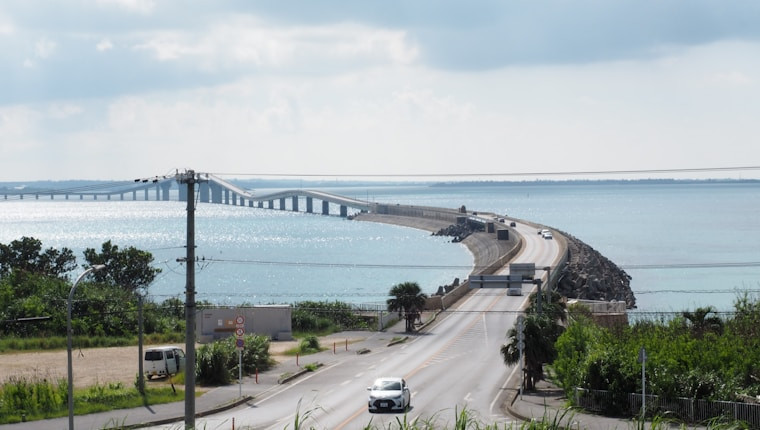
- East-coast Kaichu Doro (half–1 day): via Uruma, drive onto the Kaichu Doro sea road — water on both sides, the closest thing to driving on the ocean.

Quick distance reference (normal conditions; add margin at rush hour):
| From Naha Airport | Distance | Drive time |
|---|---|---|
| Kokusai Street (central Naha) | ~6 km | ~20–30 min |
| Senaga Island | ~6 km | ~15 min |
| American Village (Chatan) | ~20 km | ~40–50 min |
| Cape Manzamo | ~50 km | ~1 h |
| Kouri Island | ~85 km | ~2 h |
| Churaumi Aquarium | ~90 km | ~2 h |

GoodCars' planning rule: one zone per day — south, centre and north each deserve their own. Drop any "round the island in a day" ambitions; you'd spend the whole day driving past beaches you never stop at. In typhoon season (roughly June–October) keep plans flexible: rental companies have suspension and early-return procedures when a storm approaches — watch the forecast and stay in touch.

GoodCars' Naha Airport pickup: car, CDW and NOC coverage, ETC card and child seats in one online flow, in plain English. Summer fleets run out — book with your flights.
Book your Okinawa rental car nowFAQ
Q1. What documents do I need to rent a car in Okinawa?
For most nationalities: a 1949 Geneva Convention IDP, your home licence and your passport — all three together. Swiss, German, French, Belgian, Monegasque, Estonian and Taiwanese drivers use an official Japanese translation instead. Mainland Chinese and Indonesian licences cannot be used in Japan.
Q2. Is Okinawa a good place for my first time driving on the left?
The best in Japan, in GoodCars' view: wide roads, light traffic, a slow pace and simple routes. Ease in around the airport for the first fifteen minutes, then take the main roads once the mirror-image feels natural.
Q3. When exactly can't I use the bus lanes?
Weekday rush hours — roughly 7:30–9:00 and 17:30–19:30 depending on the section — mainly on Route 58, Route 330 and Kokusai Street in Naha. Multi-lane roads lose the kerbside lane; Kokusai Street closes entirely to cars. Weekends and holidays are exempt. Follow the painted「バス専用」markings and blue time signs.
Q4. How long is the drive from Naha Airport to Churaumi Aquarium?
About 90 km, ~2 hours via the expressway to Kyoda and surface roads from there. Leave early: aquarium in the morning, Kouri Island in the afternoon, an easy cruise back at dusk.
Q5. Is it safe to drive in Okinawa in the rain?
Yes, with an adjusted style: the limestone-mix asphalt gets unusually slick when wet. Slow down a notch, double the gap, avoid sharp braking. Heavy squalls pass quickly — a coffee stop often solves it.
Q6. What happens if a typhoon comes while I have the car?
Contact the rental company as soon as a typhoon approaches — procedures typically include early return or suspension, and you should never drive through peak winds. Flexible plans, flights and rental periods are basic typhoon-season practice in Okinawa.
Q7. How many sights per day? Can I loop the island in one day?
GoodCars' honest answer: one zone and two or three major stops a day. The island runs 130 km north to south — a one-day loop means a whole day of driving past the sea without ever stopping. That's the one way to waste Okinawa.