'%3e%3cpath%20fill='red'%20d='M0%200h720v480H0z'/%3e%3cpath%20fill='%23000095'%20d='M0%200h360v240H0z'/%3e%3cg%20fill='%23fff'%3e%3cpath%20d='m154%20126.9-2.5%209.6%209.4%202.6-1.8-7.1zm46.9%205.1-1.8%207.1%209.4-2.6-2.5-9.6zm-41.8-24-5.1%205.1%201.9%206.9z'/%3e%3cpath%20d='m155.9%20120-1.9%206.9%205.1%205.1z'/%3e%3cpath%20d='m154%20113.1-6.9%206.9%206.9%206.9%201.9-6.9zm14%2027.8%205.1%205.1%206.9-1.9zm18.9%205.1%209.6%202.5%202.6-9.4-7.1%201.8z'/%3e%3cpath%20d='m192%20140.9%207.1-1.8%201.8-7.1zm-31.1-1.8%202.6%209.4%209.6-2.5-5.1-5.1zm19.1%205%206.9%201.9%205.1-5.1z'/%3e%3cpath%20d='m173.1%20146%206.9%206.9%206.9-6.9-6.9-1.9zm-12.2-45.1-9.4%202.6%202.5%209.6%205.1-5.1zm-1.8%2031.1%201.8%207.1%207.1%201.8zm45-12%201.9-6.9-5.1-5.1z'/%3e%3cpath%20d='m168%2099.1-7.1%201.8-1.8%207.1zm32.9%208.9-1.8-7.1-7.1-1.8zm5.1%2018.9%206.9-6.9-6.9-6.9-1.9%206.9z'/%3e%3cpath%20d='m200.9%20108-8.9-8.9-12-3.2-12%203.2-8.9%208.9-3.2%2012%203.2%2012%208.9%208.9%2012%203.2%2012-3.2%208.9-8.9%203.2-12z'/%3e%3cpath%20d='m200.9%20132%205.1-5.1-1.9-6.9zm5.1-18.9%202.5-9.6-9.4-2.6%201.8%207.1zm-6.9-12.2-2.6-9.4-9.6%202.5%205.1%205.1zm-26-6.9-9.6-2.5-2.6%209.4%207.1-1.8zm6.9%201.9-6.9-1.9-5.1%205.1z'/%3e%3cpath%20d='m186.9%2094-6.9-6.9-6.9%206.9%206.9%201.9z'/%3e%3cpath%20d='m192%2099.1-5.1-5.1-6.9%201.9zM173.1%20146l-9.6%202.5%204.5%2016.6%2012-12.2zm-5.1%2019.1%2012%2044.9%2012-44.9-12-12.2zm-7.1-26-9.4-2.6-4.4%2016.4%2016.4-4.4z'/%3e%3cpath%20d='m147.1%20152.9-12%2045.1%2032.9-32.9-4.5-16.6zm-12-20.9L102%20165.1l45.1-12.2%204.4-16.4z'/%3e%3cpath%20d='m154%20126.9-6.9-6.9-12%2012%2016.4%204.5zm0-13.8-2.5-9.6-16.4%204.5%2012%2012z'/%3e%3cpath%20d='M135.1%20108%2090%20120l45.1%2012%2012-12zm90%2024-16.6%204.5%204.4%2016.4%2045.1%2012.2z'/%3e%3cpath%20d='m199.1%20139.1-2.6%209.4%2016.4%204.4-4.4-16.4zm-12.2%206.9-6.9%206.9%2012%2012.2%204.5-16.6zm19.1-19.1%202.5%209.6%2016.6-4.5-12.2-12z'/%3e%3cpath%20d='m192%20165.1%2033.1%2032.9-12.2-45.1-16.4-4.4zm7.1-64.2%209.4%202.6%204.4-16.4-16.4%204.4z'/%3e%3cpath%20d='M225.1%20108%20258%2075.1l-45.1%2012-4.4%2016.4zm-12.2-20.9L225.1%2042%20192%2075.1l4.5%2016.4zm12.2%2044.9%2044.9-12-44.9-12-12.2%2012z'/%3e%3cpath%20d='m206%20113.1%206.9%206.9%2012.2-12-16.6-4.5zm-38-38L135.1%2042l12%2045.1%2016.4%204.4z'/%3e%3cpath%20d='m160.9%20100.9%202.6-9.4-16.4-4.4%204.4%2016.4z'/%3e%3cpath%20d='m147.1%2087.1-45.1-12%2033.1%2032.9%2016.4-4.5zm39.8%206.9%209.6-2.5-4.5-16.4-12%2012z'/%3e%3cpath%20d='M192%2075.1%20180%2030l-12%2045.1%2012%2012z'/%3e%3cpath%20d='m173.1%2094%206.9-6.9-12-12-4.5%2016.4z'/%3e%3c/g%3e%3ccircle%20cx='180'%20cy='120'%20r='51.1'%20fill='%23000095'/%3e%3ccircle%20cx='180'%20cy='120'%20r='45.1'%20fill='%23fff'/%3e%3c/g%3e%3c/svg%3e)
'%20d='m0%200%2016%2011h61%2061%2061%2061%2060L47%2037h61%2061%2060%2061L16%2063h61%2061%2061%2061%2060L47%2089h61%2061%2060%2061L16%20115h61%2061%2061%2061%2060L47%20141h61%2061%2060%2061L16%20166h61%2061%2061%2061%2060L47%20192h61%2061%2060%2061L16%20218h61%2061%2061%2061%2060L0%200'/%3e%3c/svg%3e)

'%20d='M-50-12v24m6%200v-24m6%200v24m76%200V1m0-2v-11m6%200v11m0%202v11m6%200V1m0-2v-11'/%3e%3cpath%20transform='rotate(-33.69006752598)'%20d='M-50-12v24m6%200V1m0-2v-11m6%200v24m76%200V1m0-2v-11m6%200v24m6%200V1m0-2v-11'/%3e%3c/g%3e%3cg%20transform='rotate(33.69006752598)'%3e%3cpath%20fill='%23cd2e3a'%20d='M12%200a18%2018%200%2011-36%200%2024%2024%200%201148%200'/%3e%3cpath%20fill='%230047a0'%20d='M0%200a12%2012%200%201124%200%2024%2024%200%2011-48%200%2012%2012%200%201024%200'/%3e%3c/g%3e%3c/svg%3e)


Kyoto Car Rental Guide: Peak-Season Parking Bans, Road Closures and What to Do Instead
Kyoto is the city where visitors most often get car rental wrong in Kansai. Not because the roads are hard to drive, but because the City of Kyoto actively uses policy to keep private cars out of its sightseeing districts. The municipal car park closest to Kiyomizu-dera stops accepting private cars in peak season, Arashiyama's main street becomes pedestrian-only in the afternoon, and Shijo-dori was deliberately narrowed to one lane each way. This GoodCars guide skips the tired "should you rent a car in Kyoto" debate and gives you the rules you will actually hit, and the workaround the city itself recommends.

In peak season, Kyoto's bottleneck is not the expressway — it is the handful of roads around each sightseeing district (illustrative image)
Documents, insurance and general pickup procedures for renting in Japan are covered in the Complete Guide to Renting a Car in Japan. The wider Kansai logic — skip the car downtown, rent it for the countryside — plus routes to Wakayama, Awaji Island and Amanohashidate, is in the Complete Kansai Car Rental Guide. This article deals only with Kyoto: which rules bite in peak season, where the car should go, and when renting is genuinely worth it.
The short answer: your car should not enter Kyoto's sightseeing districts

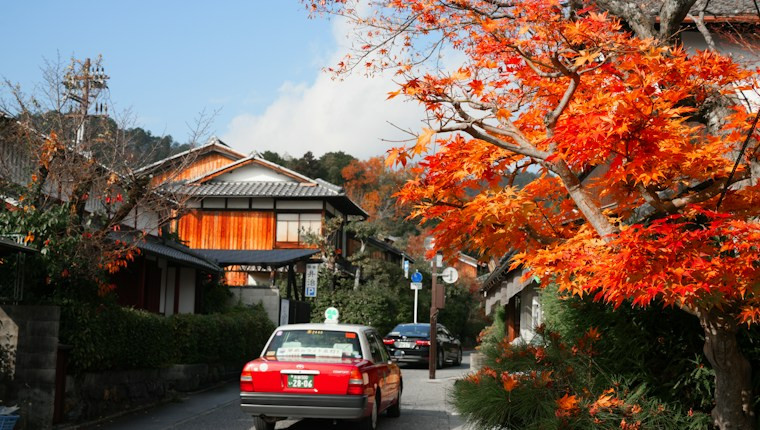
Kyoto's most charming lanes are exactly where a navigation system will send you in and a car struggles to get out (illustrative image)
Kyoto's grid looks easy to drive. In practice it is a dense network of one-way streets plus residential lanes that are not wide enough for two cars. Sightseeing is concentrated in two clusters — Higashiyama (Kiyomizu-dera and Gion) and Arashiyama — and in peak season the approach roads to both behave nothing like they do the rest of the year. GoodCars suggests deciding day by day, based on where you are going:
| That day's plan | Car needed? | Why |
|---|---|---|
| Kiyomizu-dera, Gion, Yasaka, Ninenzaka | No | Temporary traffic restrictions apply in peak season, and the nearest municipal car park stops taking private cars |
| Arashiyama and Sagano | No | The main street becomes pedestrian-only in the afternoon; the municipal car park is small and fills up by mid-morning |
| Kinkaku-ji, Ginkaku-ji, Fushimi Inari | Usually no | All are served by city buses or trains; car parks are small and queueing for a space takes longer than the drive |
| Northern Kyoto (Amanohashidate, Ine), Lake Biwa, Miyama | Yes | Public transport is sparse or non-existent — this is where a rental car earns its keep |
In one line: use trains and buses on your city sightseeing days, and save the rental days for trips out of the city. That is not GoodCars being cautious — as the rules below show, it is exactly how Kyoto has designed things.
The hard rules in peak season: no private cars at Kiyomizu-zaka, surcharges at Arashiyama

Higashiyama is the most tightly managed district in peak season, and its nearest municipal car park refuses private cars (illustrative image)
Many visitors assume that arriving early solves everything. At Kyoto's two municipal sightseeing car parks, the peak-season problem is not a shortage of spaces — the rules change whether your car is accepted at all:
| Car park | Peak-season measure | Rest of the year |
|---|---|---|
| Kyoto City Kiyomizu-zaka Sightseeing Car Park (closest to Kiyomizu-dera) | Private cars not accepted at any time of day; only tour buses on a full reservation system | Private cars accepted |
| Kyoto City Arashiyama Sightseeing Car Park | Private cars pay a special peak rate, roughly twenty per cent above normal | Around 1,040 yen per entry; capacity in the region of a hundred cars |
The measures run in two blocks: spring, roughly late March to late June (with normal operation usually restored around the Golden Week holidays), and autumn, roughly mid-October to early December. The Arashiyama peak rate lands around the 1,250 yen mark, but the fee is not the point. The point is that at Kiyomizu-zaka you simply cannot park, and the private car parks nearby cannot absorb anything like the demand.
The dates shift every year — do not memorise them: the periods and rates above reflect recent practice, and Kyoto City re-announces them each season. GoodCars recommends checking the city government and the Kyoto City Urban Development Public Corporation websites in the week before you travel, especially for the Kiyomizu-zaka restriction. That single rule decides whether you should drive into Higashiyama at all that day.
Temporary traffic restrictions in Arashiyama and Higashiyama

The streets around Togetsukyo Bridge fall under timed restrictions in peak season, closing to all vehicles for part of the day (illustrative image)
More damaging to an itinerary than a full car park are the timed traffic restrictions. Working groups made up of Kyoto Prefectural Police and local organisations impose these on the Arashiyama and Higashiyama districts during peak weekends. Typical measures look like this:
- Arashiyama, Nagatsuji-dori (around the north side of Togetsukyo Bridge): becomes a pedestrian-only road during set hours, closed to all vehicles — commonly from early afternoon until around five in the evening.
- Arashiyama, the Saga road (from the north end of Togetsukyo Bridge to Hankyu Arashiyama Station): one-way only during set hours, commonly from mid-morning to late afternoon, with route buses among the exceptions.
- Higashiyama, Higashioji-dori: northbound vehicles banned from turning right into Kodaiji Minamimon-dori; southbound vehicles banned from turning left towards the municipal Kiyomizu-zaka car park. Both run for most of the day and into the evening.
- Togetsukyo Bridge itself: may be closed to vehicles at short notice depending on conditions on the day.
These measures cluster on peak-season Saturdays, Sundays and public holidays, and the hours can be adjusted on the spot. The awkward part for a self-drive visitor is that your navigation system has no idea whether a restriction is in force today. You can drive all the way to Arashiyama and be waved off in the final few hundred metres, forced to look for another car park — by which time every nearby car park is full.
If your plan is "two days in central Kyoto plus one day out of the city", book the rental for the day you leave the city. Car rental in Japan is charged by time blocks, so not renting on those city days saves the rental fee, the parking, and the risk of being caught by a restriction. The same logic applies to central Osaka, which is covered in the Osaka Car Rental Guide.
Two structural traps: height limits and Shijo-dori

Height limits at mechanical car parks are what most seven-seater renters discover only on arrival (illustrative image)
Even outside peak season, two structural issues catch visitors out.
The first is vehicle height. A large share of car parks in central Kyoto are mechanical stacker systems, and their height limit is usually set at 1.55 metres; self-park and underground facilities are more commonly 2.1 metres. That line is unforgiving: seven-seaters and most high-roof SUVs will not fit a 1.55-metre mechanical bay. If you are travelling with older relatives or a large group and need a bigger vehicle, GoodCars recommends confirming the type of car park at your hotel and your destinations before booking — not merely whether parking exists.
The second is Shijo-dori. Along roughly 1.1 kilometres between Karasuma-dori and Kawabata-dori, the city cut the road from two lanes each way to one and widened the footpath from 3.5 to 6.5 metres, specifically to discourage private cars. Kyoto City even asked navigation providers to stop listing Shijo-dori as a major road. The message for visitors is blunt: Shijo-dori is Kyoto's liveliest street, but it was deliberately designed not to be a good road to drive. If your navigation sends you down it, sitting in traffic is the normal outcome.
Kyoto's official answer: park on the edge, switch to the train

Parking at an outlying interchange and taking the train for the last stretch is the approach the city itself promotes (illustrative image)
Kyoto City runs a Park & Ride scheme, and it is the official answer: leave the car at a registered car park on the edge of the city, near a station or an expressway interchange, then switch to a train or bus for the sightseeing districts. The registered car parks are grouped by the direction you are arriving from:
| Arriving from | Representative park-and-ride car parks | Onward connection |
|---|---|---|
| Osaka and Kansai Airport (from the south) | Near the Kamogawa-nishi interchange, the Kamigamo Hamaoji area, and the municipal car park at the west exit of Nagaokakyo Station | Hankyu or JR into the centre, then the subway to Shijo or Karasuma Oike |
| Nagoya and Shiga (from the east) | Public car parks around Hamaotsu, and the car park in front of Kyoto Yamashina Station | JR, Keihan or the Tozai subway line straight into the centre |
Here is how GoodCars would actually use it: for the leg that takes in Kiyomizu-dera, Kinkaku-ji, Ginkaku-ji, Nijo Castle or Arashiyama, leave the car behind. Park at Yamashina Station or the west exit of Nagaokakyo Station, and you are in the centre in little more than ten minutes by train. What you save is not only the parking fee but the hour or two spent hunting for a space in peak season.
Two caveats on Park & Ride: first, rates, opening hours and any transfer discount are set by each operator individually, so check them one by one rather than assuming a discount exists; second, the list of registered car parks changes, and the city's own website is the authoritative version. GoodCars suggests treating your transfer point as a planned stop on the itinerary rather than something to improvise at the edge of the city.
So when is a rental car in Kyoto genuinely worth it?

Kyoto beyond the city limits is where a rental car finally earns its place (illustrative image)
None of the above means you should not rent. It means the car belongs somewhere else. Kyoto Prefecture is long and narrow, reaching all the way north to the Sea of Japan, and most of it is effectively out of reach without a car:
- Northern Kyoto: about two hours north of the city lies Amanohashidate, and beyond it the boat houses of Ine. Public transport is infrequent, so driving is the sensible option.
- Miyama and the Nantan area: thatched-roof mountain villages served by only a handful of buses a day.
- Uji, Fushimi and the south: tea country and sake breweries scattered around the city fringe, far quicker to link by car than by three train changes.
- Lake Biwa and Shiga: heading east out of Kyoto, the loop around the lake is one of the few long drives in Kansai that suits a first-timer.
The full planning for these routes, including Wakayama, Awaji Island and Amanohashidate, is already written up by GoodCars in the Complete Kansai Car Rental Guide, so it is not repeated here. The single takeaway: in Kyoto, pick the car up at the moment you leave the city, not before.
Where to collect the car: Kyoto has no branch, so the numbers are from Kansai Airport
An honest note first: the GoodCars pickup and drop-off point in Kansai is Kansai Airport — there is currently no branch in central Kyoto or at Kyoto Station. So for a Kyoto itinerary, the real question is which day you go back to the airport to collect the car.
| Item | Kansai Airport to Kyoto, in practice |
|---|---|
| Distance | Around 100 kilometres (about 98 km to the Kyoto-minami interchange) |
| Driving time | Roughly 1 hour 20 minutes to 1 hour 30 minutes without congestion |
| Expressway tolls | Around the 3,300 to 4,300 yen range with ETC, depending on direction and route; higher without ETC |
| Train alternative | The JR Haruka limited express runs airport to Kyoto Station in about an hour and twenty minutes |
That makes the sequencing obvious: use the Haruka for your city days, and go back to Kansai Airport for the car on the day you head out of the city. If returning to the airport feels like a detour, the alternative is to put Kyoto at the end of the trip — collect the car at Kansai Airport, drive Wakayama or Awaji Island first, return it, then take the train into Kyoto for the final nights. Note that the rental counters at Kansai Airport are not inside the terminal but in the Aeroplaza building on the airport island; the walking route is covered in the Kansai Airport Car Rental Pickup Guide, and GoodCars suggests allowing at least ninety minutes from your city hotel.
GoodCars currently has six pickup points in Japan. For a Kyoto itinerary, choose Kansai Airport:
| Pickup point | Destination cluster | Booking link |
|---|---|---|
| Kansai Airport | Osaka, Kyoto and Kansai | Pick up at Kansai Airport |
| Narita Airport, Chiba | Tokyo and Kanto | Pick up at Narita |
| Haneda Airport | Tokyo and Kanto | Pick up at Haneda |
| New Chitose Airport | Hokkaido | Pick up at New Chitose |
| Fukuoka Airport | Kyushu | Pick up at Fukuoka |
| Naha Airport Station | Okinawa | Pick up at Naha |
Frequently asked questions
Q1. What actually happens if I drive into central Kyoto during cherry blossom or autumn leaf season?
The likely outcome is full car parks, timed restrictions on the main approach roads, and a thirty-minute drive taking well over an hour. The municipal car park at Kiyomizu-zaka does not accept private cars in peak season, and the Arashiyama municipal car park applies a surcharge and has limited capacity. GoodCars recommends not driving in the centre at all during these periods — use park-and-ride or the train.
Q2. Is there a park-and-ride scheme in Kyoto, and where do I leave the car?
Yes. Kyoto City publishes a list of registered car parks, grouped by approach direction. Arriving from Osaka, options include the Kamogawa-nishi interchange area, Kamigamo Hamaoji, and the west exit of Nagaokakyo Station. Arriving from Nagoya or Shiga, options include the Hamaotsu area and the car park in front of Kyoto Yamashina Station. From there you switch to a train. Rates and any discounts are set by each operator, so confirm before you travel.
Q3. I have booked a seven-seater. Can I park it in central Kyoto?
It depends on the type of car park. Mechanical stacker car parks usually cap vehicle height at 1.55 metres, which rules out seven-seaters and high-roof SUVs; self-park and underground facilities are more often around 2.1 metres. Confirm the type when you book your hotel rather than only checking that parking is available.
Q4. Can I drive along Shijo-dori?
You can, but it is not advisable. The section between Karasuma-dori and Kawabata-dori has been reduced from two lanes each way to one so that the footpath could be widened, and the city has asked navigation providers not to treat it as a major road. It is a shopping and sightseeing artery, so getting stuck in traffic there is the norm.
Q5. How long does it take to drive from Kansai Airport to Kyoto, and what does it cost?
About 100 kilometres, roughly an hour and twenty to an hour and thirty minutes without congestion, with ETC tolls in the region of 3,300 to 4,300 yen depending on direction and route. If you only need to reach central Kyoto, the JR Haruka limited express takes a similar time and removes the parking problem entirely.
Q6. Can I stop briefly at the roadside in Kyoto?
It is not advisable. Parking enforcement officers patrol the areas around the sightseeing districts and will ticket illegally parked cars, and stopping on a one-way street or a narrow lane can block the entire road. If you need a short stop, use a coin-operated car park — they are dense enough in Japan that finding one is usually faster than risking a ticket.
Q7. What licence do I need to drive in Kyoto?
For most visitors the answer is an International Driving Permit issued under the 1949 Geneva Convention, carried together with your own national licence and your passport. Japan does not accept permits issued in the Vienna Convention format, so check which one your country issues before you travel — an IDP cannot be obtained once you are in Japan. A small group of countries and regions, including Switzerland, Germany, France, Belgium, Monaco, Estonia and Taiwan, instead use their own licence plus an official Japanese translation from an authorised body; a self-made translation is not valid. Driving on a mainland Chinese licence is not permitted in Japan under any arrangement. Full details are in the Complete Guide to Renting a Car in Japan.
📸 About the images: photographs in this article come from the Unsplash free commercial library and are illustrative only. They do not depict actual GoodCars vehicles, actual branch conditions or real customers.
⚠️ Disclaimer and AI collaboration note: this article was planned by the GoodCars team with the help of AI tools for drafting and research. Parking rates, peak-season measures at municipal sightseeing car parks, the timing and routes of temporary traffic restrictions, the park-and-ride car park list, toll costs and train journey times are compiled from public information published by Kyoto City, Kyoto Prefectural Police and the relevant operators. They are reference figures, revised each season. On-site signage, official announcements and the rental operator's terms always take precedence.