'%3e%3cpath%20fill='red'%20d='M0%200h720v480H0z'/%3e%3cpath%20fill='%23000095'%20d='M0%200h360v240H0z'/%3e%3cg%20fill='%23fff'%3e%3cpath%20d='m154%20126.9-2.5%209.6%209.4%202.6-1.8-7.1zm46.9%205.1-1.8%207.1%209.4-2.6-2.5-9.6zm-41.8-24-5.1%205.1%201.9%206.9z'/%3e%3cpath%20d='m155.9%20120-1.9%206.9%205.1%205.1z'/%3e%3cpath%20d='m154%20113.1-6.9%206.9%206.9%206.9%201.9-6.9zm14%2027.8%205.1%205.1%206.9-1.9zm18.9%205.1%209.6%202.5%202.6-9.4-7.1%201.8z'/%3e%3cpath%20d='m192%20140.9%207.1-1.8%201.8-7.1zm-31.1-1.8%202.6%209.4%209.6-2.5-5.1-5.1zm19.1%205%206.9%201.9%205.1-5.1z'/%3e%3cpath%20d='m173.1%20146%206.9%206.9%206.9-6.9-6.9-1.9zm-12.2-45.1-9.4%202.6%202.5%209.6%205.1-5.1zm-1.8%2031.1%201.8%207.1%207.1%201.8zm45-12%201.9-6.9-5.1-5.1z'/%3e%3cpath%20d='m168%2099.1-7.1%201.8-1.8%207.1zm32.9%208.9-1.8-7.1-7.1-1.8zm5.1%2018.9%206.9-6.9-6.9-6.9-1.9%206.9z'/%3e%3cpath%20d='m200.9%20108-8.9-8.9-12-3.2-12%203.2-8.9%208.9-3.2%2012%203.2%2012%208.9%208.9%2012%203.2%2012-3.2%208.9-8.9%203.2-12z'/%3e%3cpath%20d='m200.9%20132%205.1-5.1-1.9-6.9zm5.1-18.9%202.5-9.6-9.4-2.6%201.8%207.1zm-6.9-12.2-2.6-9.4-9.6%202.5%205.1%205.1zm-26-6.9-9.6-2.5-2.6%209.4%207.1-1.8zm6.9%201.9-6.9-1.9-5.1%205.1z'/%3e%3cpath%20d='m186.9%2094-6.9-6.9-6.9%206.9%206.9%201.9z'/%3e%3cpath%20d='m192%2099.1-5.1-5.1-6.9%201.9zM173.1%20146l-9.6%202.5%204.5%2016.6%2012-12.2zm-5.1%2019.1%2012%2044.9%2012-44.9-12-12.2zm-7.1-26-9.4-2.6-4.4%2016.4%2016.4-4.4z'/%3e%3cpath%20d='m147.1%20152.9-12%2045.1%2032.9-32.9-4.5-16.6zm-12-20.9L102%20165.1l45.1-12.2%204.4-16.4z'/%3e%3cpath%20d='m154%20126.9-6.9-6.9-12%2012%2016.4%204.5zm0-13.8-2.5-9.6-16.4%204.5%2012%2012z'/%3e%3cpath%20d='M135.1%20108%2090%20120l45.1%2012%2012-12zm90%2024-16.6%204.5%204.4%2016.4%2045.1%2012.2z'/%3e%3cpath%20d='m199.1%20139.1-2.6%209.4%2016.4%204.4-4.4-16.4zm-12.2%206.9-6.9%206.9%2012%2012.2%204.5-16.6zm19.1-19.1%202.5%209.6%2016.6-4.5-12.2-12z'/%3e%3cpath%20d='m192%20165.1%2033.1%2032.9-12.2-45.1-16.4-4.4zm7.1-64.2%209.4%202.6%204.4-16.4-16.4%204.4z'/%3e%3cpath%20d='M225.1%20108%20258%2075.1l-45.1%2012-4.4%2016.4zm-12.2-20.9L225.1%2042%20192%2075.1l4.5%2016.4zm12.2%2044.9%2044.9-12-44.9-12-12.2%2012z'/%3e%3cpath%20d='m206%20113.1%206.9%206.9%2012.2-12-16.6-4.5zm-38-38L135.1%2042l12%2045.1%2016.4%204.4z'/%3e%3cpath%20d='m160.9%20100.9%202.6-9.4-16.4-4.4%204.4%2016.4z'/%3e%3cpath%20d='m147.1%2087.1-45.1-12%2033.1%2032.9%2016.4-4.5zm39.8%206.9%209.6-2.5-4.5-16.4-12%2012z'/%3e%3cpath%20d='M192%2075.1%20180%2030l-12%2045.1%2012%2012z'/%3e%3cpath%20d='m173.1%2094%206.9-6.9-12-12-4.5%2016.4z'/%3e%3c/g%3e%3ccircle%20cx='180'%20cy='120'%20r='51.1'%20fill='%23000095'/%3e%3ccircle%20cx='180'%20cy='120'%20r='45.1'%20fill='%23fff'/%3e%3c/g%3e%3c/svg%3e)
'%20d='m0%200%2016%2011h61%2061%2061%2061%2060L47%2037h61%2061%2060%2061L16%2063h61%2061%2061%2061%2060L47%2089h61%2061%2060%2061L16%20115h61%2061%2061%2061%2060L47%20141h61%2061%2060%2061L16%20166h61%2061%2061%2061%2060L47%20192h61%2061%2060%2061L16%20218h61%2061%2061%2061%2060L0%200'/%3e%3c/svg%3e)

'%20d='M-50-12v24m6%200v-24m6%200v24m76%200V1m0-2v-11m6%200v11m0%202v11m6%200V1m0-2v-11'/%3e%3cpath%20transform='rotate(-33.69006752598)'%20d='M-50-12v24m6%200V1m0-2v-11m6%200v24m76%200V1m0-2v-11m6%200v24m6%200V1m0-2v-11'/%3e%3c/g%3e%3cg%20transform='rotate(33.69006752598)'%3e%3cpath%20fill='%23cd2e3a'%20d='M12%200a18%2018%200%2011-36%200%2024%2024%200%201148%200'/%3e%3cpath%20fill='%230047a0'%20d='M0%200a12%2012%200%201124%200%2024%2024%200%2011-48%200%2012%2012%200%201024%200'/%3e%3c/g%3e%3c/svg%3e)


Japan Traffic Rules and Fines Explained: The New 30 km/h Limit, How Tickets Are Actually Paid, and Why Parking Violations Cost Renters the Most
What catches visiting drivers out in Japan is rarely the rules themselves. It is what happens after a violation: what the ticket looks like, where the money has to be paid, whether you can still return the car, and whether it follows you home. This GoodCars guide skips the basics of driving on the left (those are covered in our complete Japan car rental guide) and focuses on the penalty system, the real amounts, and the full process after you are pulled over — including the traps that only apply to rental customers.

The rules are not difficult. The paperwork afterwards is (illustrative image)
Japan has two penalty tracks, and the difference is a criminal record
This is the layer most visitors never hear about. Japanese traffic offences split into two completely separate routes:
- The blue ticket (aokippu) covers comparatively minor offences under the traffic infraction notification system. Pay the infraction levy within the deadline and the case simply ends — no criminal proceedings, no record.
- The red ticket (akakippu) covers drink driving, unlicensed driving, exceeding the limit by 30 km/h or more on ordinary roads, or by 40 km/h or more on expressways. These fall outside the levy system entirely and go straight to criminal proceedings. What you pay then is a criminal fine, and it leaves a record.
GoodCars stresses that the difference is not the size of the payment — it is whether this is an administrative matter or a criminal case. Drivers who assume speeding just means paying a bit more are in for a shock: crossing that threshold means being taken to a police station for questioning, and your itinerary is finished for the day.
To drive in Japan on a visit you need either an International Driving Permit issued under the 1949 Geneva Convention (the standard route for the United States, the United Kingdom, Australia, Canada, New Zealand and most of Asia) or, for a short list of countries including Switzerland, Germany, France, Belgium, Monaco and Taiwan, your home licence with an official Japanese translation. Two things travellers get wrong: an IDP must be obtained in your home country before departure — it cannot be issued or replaced inside Japan, and a permit issued under the 1968 Vienna Convention is not valid here.
Because demerit points are recorded against a Japanese licence, visiting drivers have no points to lose. That is not a free pass: Japan can impose a driving prohibition order of up to six months on foreign-licence holders who accumulate violations, and driving without valid documents — an expired translation, or the wrong type of permit — carries up to three years' confinement or a fine of up to 500,000 yen.
Learn this new rule first: narrow local roads are now limited to 30 km/h

No centre line usually now means 30 km/h, with nothing posted to tell you (illustrative image)
A recent amendment to Japan's road traffic regulations has cut the statutory speed limit on "living roads" from 60 km/h to 30 km/h — roughly 37 mph down to 19 mph. GoodCars puts this near the top because it has three features that are brutal for visiting drivers:
- It is defined by the shape of the road, not by a sign. A living road is one used mainly for local daily life that has no centre line and no lane markings dividing traffic. Nothing is posted. You drive in, the limit applies.
- A posted sign always wins. A road with no centre line but a posted 40 sign is 40. A road with no centre line and nothing posted is 30.
- Roads outside the definition stay at 60. Ordinary roads with a centre line or lane markings, and roads where the directions are physically separated by a barrier, are unaffected.
GoodCars flags this because navigation apps love exactly these roads: the lanes between machiya townhouses in Kyoto, village streets in Okinawa, farm roads across Hokkaido, old hot-spring high streets. The instinctive speed on a road like that is 40 to 50 km/h. The legal ceiling is now 30.
What the common violations actually cost

Expressway speeding bands differ from ordinary roads, and the top of the scale is not a fine at all (illustrative image)
Amounts below are the infraction levy for ordinary passenger cars, based on the schedule published by the police:
| Violation | Levy (ordinary car) | Notes |
|---|---|---|
| Speeding: ordinary road, under 15 km/h over | 9,000 yen | The most common band |
| Speeding: ordinary road, 15–20 km/h over | 12,000 yen | |
| Speeding: ordinary road, 20–25 km/h over | 15,000 yen | |
| Speeding: ordinary road, 25–30 km/h over | 18,000 yen | Above this it stops being a levy |
| Speeding: expressway, 30–35 km/h over | 25,000 yen | |
| Speeding: expressway, 35–40 km/h over | 35,000 yen | Top of the levy scale |
| Running a red light | 9,000 yen | |
| Entering a prohibited road | 7,000 yen | One-way streets, time-restricted streets |
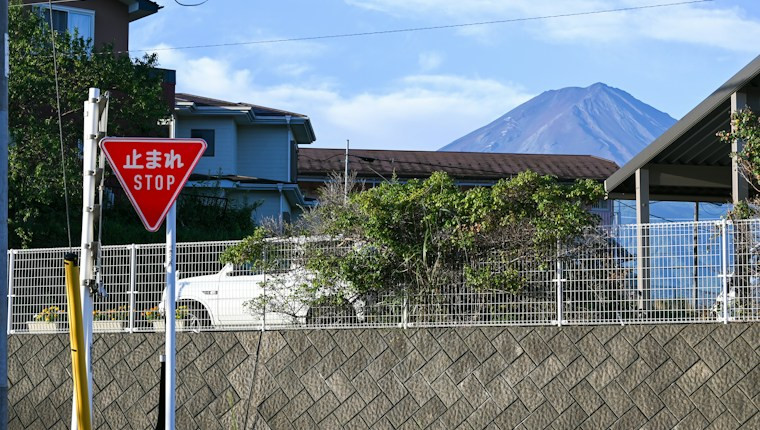
| Failing to stop where required | 7,000 yen | The red triangular "tomare" sign |
| Obstructing a pedestrian at a crossing | 9,000 yen | Someone waiting and you did not stop |
| Failing to stop at a railway crossing | 9,000 yen | A full stop is required every time |
| Handheld phone use | 18,000 yen | One of the most expensive routine offences |
| Not carrying your licence | 3,000 yen | Permit and home licence, both on you |
| Seat belt not worn | No levy | Still a violation and still recorded |
Memorise the thresholds. Only speeding of under 30 km/h over on ordinary roads, or under 40 km/h over on expressways, stays inside the levy system. Beyond that it is a red ticket and a criminal matter. For reference: the default limit is 60 km/h on ordinary roads (30 on living roads) and 100 km/h on expressways. The 120 km/h limit applies only to specific stretches — for example roughly 145 km of the Shin-Tomei between the Gotemba and Hamamatsu-Inasa junctions, and the Tohoku Expressway between Hanamaki-Minami and Morioka-Minami. Heavy goods vehicles remain at 80. Drive 120 only where 120 is posted.
After you are pulled over: this ticket cannot be paid online

You leave with two documents. The hard part is where to take them (illustrative image)
This is the single biggest gap between expectation and reality, and the question GoodCars fields most often. Once the officer confirms the violation you are handed a traffic infraction notice and a payment slip. The clock then runs on a fixed schedule:
- Pay within eight days of the notice and the matter is fully closed. You never have to visit any office. This is the only easy path.
- Miss the eight days and you must attend a traffic infraction notification centre on an assigned date, collect a formal notification and a fresh payment slip, then pay within eleven days of that. If you have already left the country, this step is effectively impossible.
The part that surprises everyone: the payment slip can only be handed over at the counter of a bank, credit union or post office. Not at a convenience store, not at an ATM, and there is no online option — and those counters are generally open on weekdays only, during business hours. A driver ticketed on Friday evening with a Monday morning flight has, in practice, no window in which to pay. If you are used to settling a citation on a website in five minutes, unlearn that before you drive in Japan.
Three practical moves: ask the officer on the spot where the nearest counter is and when it opens; if any weekday remains in your trip, go and pay then; and if the timing genuinely cannot work, keep both documents and take them home intact. Do not treat it as forgotten — unpaid levies convert into criminal proceedings, and the record does not vanish when you fly out. If you are unsure, ask GoodCars before you collect the car and we will advise based on your pickup point and itinerary.
Parking violations are the most expensive thing a renter can do

In any city, use a paid lot. It is always the cheaper answer (illustrative image)
If you remember one thing from this guide, make it this one. GoodCars sees a handful of customers caught by it every year: parking illegally in a rental car in Japan costs far more than the ticket itself.
When a parked vehicle is booked, a yellow abandoned vehicle confirmation sticker goes on the car. What makes this brutal for renters is that the process is tied to returning the vehicle:
- You must go to the police station with jurisdiction, complete the paperwork and pay before returning the car.
- At return you must produce the infraction notice and the date-stamped payment slip and receipt.
- Without them, the standard terms of major Japanese rental operators impose a contractual penalty — commonly 30,000 yen — and allow them to bill you separately for up to a month of rental charges on that vehicle, because it cannot be re-let until the matter is closed. That is real lost revenue, and they will claim it.
The logic behind it matters: the registered owner is the rental company, not you. If the driver does not come forward, liability shifts to the owner, the demand notice goes to the rental company, and the company recovers it from you with handling charges on top.
Ordinary infraction levies can only be paid at a counter — but the payment slip for a parking-related demand can usually be settled at a convenience store or through Pay-easy. Similar names, opposite rules. Do not mix them up.
Prevention is always cheaper. In Osaka, Kyoto, Fukuoka and Naha, where enforcement is heaviest, the GoodCars advice is blunt: never park on the street "just for five minutes". Use a paid lot. City parking strategy for driving in Kansai is covered separately.
Alcohol and accidents: two lines that void your insurance

On a day with drinks in the plan, leave the car parked (illustrative image)
Drink driving. GoodCars leaves no grey area here. The threshold is 0.15 mg of alcohol per litre of breath, at which point the driver faces up to three years' confinement or a fine of up to 500,000 yen. The more serious category of driving while intoxicated carries up to five years or one million yen, and the authorities have signalled that a numerical threshold of 0.5 mg per litre of breath will be added to that category.
What visitors rarely expect is that liability extends to the people around the driver:
- Passengers who knowingly ride with a drinking driver face up to three years' confinement or 500,000 yen.
- Whoever served the alcohol faces up to two years or 300,000 yen, rising to three years or 500,000 yen in the more serious category.
- Whoever handed over the vehicle knowing it would be driven after drinking faces penalties on a par with the driver.
"I wasn't driving, I was just in the passenger seat" is not a defence in Japan. The practical rule is simple: on the day you visit an izakaya, a sake brewery or a beer hall, the car stays parked. Designated-driver services common elsewhere are not something you can summon in most Japanese tourist areas.
Accidents. Article 72 of the Road Traffic Act imposes a duty to report: every collision must be reported to the police, including a minor scrape with no injuries. Failing to report carries up to three months' confinement or a fine of up to 50,000 yen.
The worst consequence of not reporting is not the penalty — it is losing your insurance. Without a police report there is no traffic accident certificate, and both the operator's insurance and any collision damage waiver you bought are conditional on that document. Without it, repairs and damages come out of your own pocket in full. So even if the other party suggests settling privately, call the police. The order on scene: make the scene safe, dial 110, notify the rental operator, obtain the certificate. Customers who booked through GoodCars can contact us to help liaise with the Japanese operator.
Mountain roads in Kyushu and Shikoku have poor night visibility, a real risk of animals on the carriageway, and much longer response times than a city — schedule long transfers in daylight.
What to watch at each of the six pickup points

Straight rural roads are where speed creeps up unnoticed (illustrative image)
The law is national, but what actually gets enforced varies by area. Here is what GoodCars flags at each of our six Japanese pickup points:
| Pickup point | What to watch | Book |
|---|---|---|
| Narita Airport, Chiba | Expressway straight out of the airport, then city streets straight off the ramp — huge swings in the limit; Narita's unmarked back streets fall under the new 30 km/h rule | Pick up at Narita |
| Haneda Airport | Very short acceleration lanes and dense junctions on the Metropolitan Expressway; lane-discipline enforcement is heavy and central Tokyo has zero tolerance for street parking | Pick up at Haneda |
| New Chitose Airport | Long straight farm roads where speed climbs without you noticing; in winter, speed restrictions and road conditions stack up | Pick up at New Chitose |
| Kansai Airport | Central Osaka has some of the heaviest parking enforcement in the country; the Hanshin Expressway splits often, punishing late lane changes | Pick up at Kansai |
| Fukuoka Airport | Hakata and Tenjin are full of one-way and time-restricted streets — entering one is a prohibited-road violation | Pick up at Fukuoka |
| Naha Airport | City bus lanes operate on time bands, and village streets are textbook examples of the new 30 km/h roads | Pick up at Naha |
GoodCars works with local Japanese suppliers across six pickup points covering Tokyo, Hokkaido, Kansai, Kyushu and Okinawa. Compare and book online, and reach a real support desk if a rules or accident question comes up mid-trip.
Frequently asked questions
Q1. Will a Japanese ticket affect my licence back home?
Not through the points system — GoodCars has confirmed that demerit points are recorded only against Japanese licences and are not exchanged between countries. However, Japan can impose a driving prohibition order of up to six months on visiting drivers who accumulate violations, and the payment itself is still owed either way.
Q2. I fly out tomorrow and cannot pay the levy in time. What now?
Infraction levies can only be paid at a bank, credit union or post office counter, and those counters are largely weekday-only, so a weekend ticket often cannot be settled before departure. Ask on the spot where the nearest counter is and pay if you possibly can. If you cannot, keep the notice and payment slip and deal with it within the deadline. Ignoring it moves the case into criminal proceedings, and it does not lapse because you left.
Q3. Is every road without a centre line limited to 30 km/h?
As a rule, yes — but a posted limit always overrides it. A road with no centre line but a posted 40 sign is 40. Ordinary roads with a centre line or lane markings, and roads with a physical barrier between directions, remain at 60. When in doubt, look for the centre line; it is the fastest test.
Q4. For a parking ticket, can I just pay and move on?
Not as a renter. You must complete the paperwork at the police station and pay before returning the car, then show the notice and the receipt at handover. Without them, operator terms commonly impose a 30,000 yen contractual penalty plus a claim for up to a month of rental charges on that vehicle.
Q5. It was a tiny scrape with no injuries. Can we settle it privately?
No. Article 72 requires reporting property damage too, and failing to report carries up to three months' confinement or a 50,000 yen fine. More importantly, without a police report there is no accident certificate, so neither the operator's insurance nor your collision damage waiver will respond, and you pay everything yourself.
Q6. Is there a fine for a rear-seat passenger not wearing a belt?
There is no levy for a seat belt violation, but it is still an offence and it is still recorded, and Japan requires belts in every seat. The real cost is not the ticket — an unbelted occupant makes injuries far worse and can affect how fault and compensation are assessed. Children under six additionally require a child seat, which should be added when you book.
Q7. Can I drive 120 km/h on Japanese expressways?
Only on specific stretches, such as parts of the Shin-Tomei between the Gotemba and Hamamatsu-Inasa junctions and the Tohoku Expressway between Hanamaki-Minami and Morioka-Minami. Everywhere else the limit is 100, and heavy goods vehicles stay at 80. Follow the posted signs rather than assumptions.
Disclaimer: the levy amounts, penalties and speed limits above are compiled from Japanese police publications and may be revised. Posted signs, current police announcements and your rental operator's terms always take precedence. The licence guidance here applies to visitors driving on a 1949 Geneva Convention International Driving Permit or, where applicable, a home licence with an official Japanese translation — the full documentation rules are in our complete Japan car rental guide.