'%3e%3cpath%20fill='red'%20d='M0%200h720v480H0z'/%3e%3cpath%20fill='%23000095'%20d='M0%200h360v240H0z'/%3e%3cg%20fill='%23fff'%3e%3cpath%20d='m154%20126.9-2.5%209.6%209.4%202.6-1.8-7.1zm46.9%205.1-1.8%207.1%209.4-2.6-2.5-9.6zm-41.8-24-5.1%205.1%201.9%206.9z'/%3e%3cpath%20d='m155.9%20120-1.9%206.9%205.1%205.1z'/%3e%3cpath%20d='m154%20113.1-6.9%206.9%206.9%206.9%201.9-6.9zm14%2027.8%205.1%205.1%206.9-1.9zm18.9%205.1%209.6%202.5%202.6-9.4-7.1%201.8z'/%3e%3cpath%20d='m192%20140.9%207.1-1.8%201.8-7.1zm-31.1-1.8%202.6%209.4%209.6-2.5-5.1-5.1zm19.1%205%206.9%201.9%205.1-5.1z'/%3e%3cpath%20d='m173.1%20146%206.9%206.9%206.9-6.9-6.9-1.9zm-12.2-45.1-9.4%202.6%202.5%209.6%205.1-5.1zm-1.8%2031.1%201.8%207.1%207.1%201.8zm45-12%201.9-6.9-5.1-5.1z'/%3e%3cpath%20d='m168%2099.1-7.1%201.8-1.8%207.1zm32.9%208.9-1.8-7.1-7.1-1.8zm5.1%2018.9%206.9-6.9-6.9-6.9-1.9%206.9z'/%3e%3cpath%20d='m200.9%20108-8.9-8.9-12-3.2-12%203.2-8.9%208.9-3.2%2012%203.2%2012%208.9%208.9%2012%203.2%2012-3.2%208.9-8.9%203.2-12z'/%3e%3cpath%20d='m200.9%20132%205.1-5.1-1.9-6.9zm5.1-18.9%202.5-9.6-9.4-2.6%201.8%207.1zm-6.9-12.2-2.6-9.4-9.6%202.5%205.1%205.1zm-26-6.9-9.6-2.5-2.6%209.4%207.1-1.8zm6.9%201.9-6.9-1.9-5.1%205.1z'/%3e%3cpath%20d='m186.9%2094-6.9-6.9-6.9%206.9%206.9%201.9z'/%3e%3cpath%20d='m192%2099.1-5.1-5.1-6.9%201.9zM173.1%20146l-9.6%202.5%204.5%2016.6%2012-12.2zm-5.1%2019.1%2012%2044.9%2012-44.9-12-12.2zm-7.1-26-9.4-2.6-4.4%2016.4%2016.4-4.4z'/%3e%3cpath%20d='m147.1%20152.9-12%2045.1%2032.9-32.9-4.5-16.6zm-12-20.9L102%20165.1l45.1-12.2%204.4-16.4z'/%3e%3cpath%20d='m154%20126.9-6.9-6.9-12%2012%2016.4%204.5zm0-13.8-2.5-9.6-16.4%204.5%2012%2012z'/%3e%3cpath%20d='M135.1%20108%2090%20120l45.1%2012%2012-12zm90%2024-16.6%204.5%204.4%2016.4%2045.1%2012.2z'/%3e%3cpath%20d='m199.1%20139.1-2.6%209.4%2016.4%204.4-4.4-16.4zm-12.2%206.9-6.9%206.9%2012%2012.2%204.5-16.6zm19.1-19.1%202.5%209.6%2016.6-4.5-12.2-12z'/%3e%3cpath%20d='m192%20165.1%2033.1%2032.9-12.2-45.1-16.4-4.4zm7.1-64.2%209.4%202.6%204.4-16.4-16.4%204.4z'/%3e%3cpath%20d='M225.1%20108%20258%2075.1l-45.1%2012-4.4%2016.4zm-12.2-20.9L225.1%2042%20192%2075.1l4.5%2016.4zm12.2%2044.9%2044.9-12-44.9-12-12.2%2012z'/%3e%3cpath%20d='m206%20113.1%206.9%206.9%2012.2-12-16.6-4.5zm-38-38L135.1%2042l12%2045.1%2016.4%204.4z'/%3e%3cpath%20d='m160.9%20100.9%202.6-9.4-16.4-4.4%204.4%2016.4z'/%3e%3cpath%20d='m147.1%2087.1-45.1-12%2033.1%2032.9%2016.4-4.5zm39.8%206.9%209.6-2.5-4.5-16.4-12%2012z'/%3e%3cpath%20d='M192%2075.1%20180%2030l-12%2045.1%2012%2012z'/%3e%3cpath%20d='m173.1%2094%206.9-6.9-12-12-4.5%2016.4z'/%3e%3c/g%3e%3ccircle%20cx='180'%20cy='120'%20r='51.1'%20fill='%23000095'/%3e%3ccircle%20cx='180'%20cy='120'%20r='45.1'%20fill='%23fff'/%3e%3c/g%3e%3c/svg%3e)
'%20d='m0%200%2016%2011h61%2061%2061%2061%2060L47%2037h61%2061%2060%2061L16%2063h61%2061%2061%2061%2060L47%2089h61%2061%2060%2061L16%20115h61%2061%2061%2061%2060L47%20141h61%2061%2060%2061L16%20166h61%2061%2061%2061%2060L47%20192h61%2061%2060%2061L16%20218h61%2061%2061%2061%2060L0%200'/%3e%3c/svg%3e)

'%20d='M-50-12v24m6%200v-24m6%200v24m76%200V1m0-2v-11m6%200v11m0%202v11m6%200V1m0-2v-11'/%3e%3cpath%20transform='rotate(-33.69006752598)'%20d='M-50-12v24m6%200V1m0-2v-11m6%200v24m76%200V1m0-2v-11m6%200v24m6%200V1m0-2v-11'/%3e%3c/g%3e%3cg%20transform='rotate(33.69006752598)'%3e%3cpath%20fill='%23cd2e3a'%20d='M12%200a18%2018%200%2011-36%200%2024%2024%200%201148%200'/%3e%3cpath%20fill='%230047a0'%20d='M0%200a12%2012%200%201124%200%2024%2024%200%2011-48%200%2012%2012%200%201024%200'/%3e%3c/g%3e%3c/svg%3e)


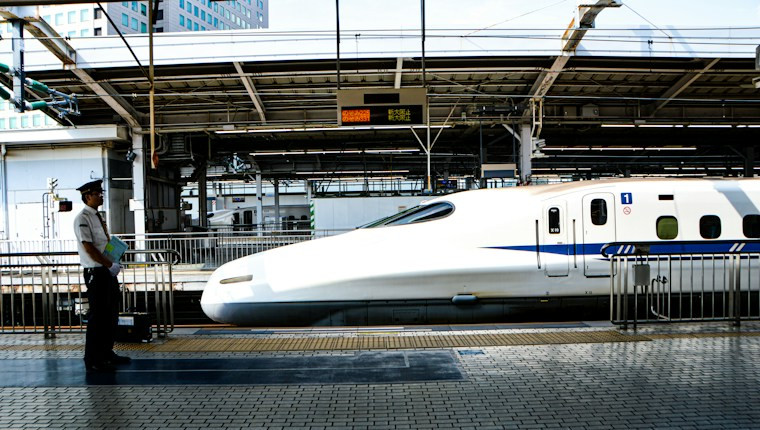
Renting a Car at Japanese Train Stations | Ekiren vs Airport Pickup

GoodCars works with local Japanese suppliers, and one question comes up again and again: "I'm taking the shinkansen to Kyoto — can I just rent a car at the station?" Or: "If I can collect a car right at Sapporo Station, isn't that easier than going out to the airport?"
The short answer is yes, you can. But station rental has changed substantially in the recent past, and most English-language guides still describe the old version. This article explains what station rental actually is, what is left of it, and when you should go back to the airport instead. General rental procedure, documents and insurance are already covered in the GoodCars complete guide to renting a car in Japan; this article does not repeat those basics and focuses only on the station route.
- "Ekiren" (駅レンタカー) is a JR brand run region by region by different JR subsidiaries — not one nationwide rental company
- The rail-plus-rental combination ticket that made station pickup genuinely cheap has been discontinued
- Several JR companies have exited the business: Aichi (home of Nagoya), Gifu, Mie, and all of Kyushu and Okinawa except Fukuoka now have no branches at all
- "Station rental" is not always at the station — Sapporo's branch is a 10-minute walk away, under the elevated tracks
- Station branches usually close by 20:00, and some close even earlier in winter — a tighter window than any airport
The short answer: when station pickup makes sense
GoodCars puts the decision rule first so you do not have to read the whole article to act on it. Station pickup has exactly one advantage: it is on your way. It works when your itinerary already passes through that station and your timing falls in daylight hours.
| Your itinerary | Recommendation | Why |
|---|---|---|
| City first, countryside later in the trip | Station pickup works | No need to travel back out to the airport just to collect a car |
| A day trip out of the city and back | Station pickup works | Departure and return both fall inside opening hours |
| You need the car on arrival day | Use the airport | Airport branches hold more vehicles and the process is built around flights |
| A late-night or very early flight | Use the airport | Station branches close early; the timing simply does not line up |
| Dropping off in a different city | Confirm before booking | One-way returns need advance arrangement and are priced by distance |
| Lots of luggage or a large group | Use the airport | Some station branches are a walk from the exit, luggage and all |
Everything below explains the reasoning — starting with a change most travellers have not heard about.
What "ekiren" actually is

First, a common misunderstanding: ekiren is not a rental company, it is a JR group brand, operated regionally by different JR subsidiaries. Hokkaido is handled by a JR Hokkaido company, the Kanto region by JR East's leasing arm, Kansai and western Japan by JR West's rental company, and Shikoku by its own dedicated operator.
That structure explains a lot: why plan names differ by region, why discount conditions are not uniform, and why when one JR company withdraws, station rental disappears from that entire area. Which is exactly what has happened.
In practical terms: if your plan was to collect a car at Nagoya Station for the Chubu region, at Kagoshima-Chuo for southern Kyushu, or at a station in Okinawa, that option no longer exists — it is not a question of price or convenience. When GoodCars receives enquiries like these, we point customers to airport pickup rather than send them chasing a service that has closed.
There is also a difference in the fleet. Ekiren uses broader vehicle classes than most operators — roughly 1,000cc to 1,400cc sits in a single band — so small cars are comparatively cheap, but the choice of models and specifications is narrower. If you need a specific model, seven seats, or winter tyres, an airport branch will give you more options.
The big change: the rail-and-rental discount ticket is gone

This is the most important section of the article, and the easiest thing to get wrong.
For decades, the real appeal of station rental was not the location but a combination ticket called the "Rail & Rent-a-Car" ticket. If you met the conditions, everyone in your party got 20% off JR fares and 10% off shinkansen limited-express charges (Nozomi and Mizuho were excluded, as were Gran Class and private compartments). For a family of four, the rail discount alone could outweigh any difference in the rental rate — that is where the received wisdom "renting from a station is cheaper" came from.
Are there still discounts? Yes, but of a different kind. The single nationwide discount is gone, replaced by web plans run by each JR company separately — an Eki-net plus ekiren plan in Hokkaido and eastern Japan, a JR West equivalent, a web-saver plan in Shikoku, and a JR-fare combination plan in Kyushu.
Three practical consequences worth putting on your pre-trip checklist:
- You can no longer assume that travelling by JR earns you a rental discount — it depends whose territory you are in
- Cross-region trips are the awkward case: drive from eastern to western Japan and the two schemes do not join up
- Value is now case by case: you have to compare properly instead of assuming station rental wins
Strip out the ticket and station pickup has one remaining advantage: it is on your route. Real, but you have to weigh it against the two costs covered next.
Station rental is not always at the station

Here is the second misunderstanding. The phrase suggests you step off the train and into a car, but actual locations vary a lot. GoodCars has put the main stations into one table so you can build the walk into your schedule.
| Station | Branch location | Opening hours |
|---|---|---|
| Kyoto | Left as you exit the Karasuma Central Gate, on the first floor of the station building car park | 08:00–20:00, open year round |
| Shin-Osaka | Below the stairs at the south exit (first floor, right-hand side), inside the station | 08:00–20:00 |
| Hakata | Reception at the general information desk on the station concourse; after 19:00 it moves to the fourth floor of the Shinkansen Hakata building, just right of the Chikushi exit | 08:00–20:00 |
| Sapporo | About a 10-minute walk from the east gate, under the JR viaduct | Summer 08:30–19:00 / winter 08:30–18:00 / new-year period 09:00–17:00 |
Kyoto and Shin-Osaka are the friendly ones — both sit within the station complex, a short walk from the gates; for the regional picture see the GoodCars Kansai car rental guide. Hakata deserves attention because the reception point moves in the evening: the concourse information desk until 19:00, then the fourth floor of a building outside the Chikushi exit. Travellers arriving at dusk are the ones who end up in the wrong place. For routes in the region, see the GoodCars Kyushu car rental guide.
Opening hours are the real constraint

The table makes it plain: station branches generally close by 20:00, and some shorten their hours by season. Airports build their rental operations around flight schedules; stations build theirs around office hours.
Sapporo is the clearest case — 19:00 in summer, 18:00 in winter, and only 09:00 to 17:00 over the new-year period. Northern Japan gets dark early in winter anyway, so an 18:00 close means returning the car before nightfall, which is precisely when you least want to be hurrying on snow.
- Pickup: allow 30 minutes from the ticket gates; add 15 minutes for a branch like Sapporo that involves a walk
- Return: allow 30 to 40 minutes, half of which goes on finding a petrol station and a parking space
- Onward travel: if a train follows the drop-off, leave another 30 minutes on top
- Winter: in Hokkaido and Tohoku, add 15 minutes to each of the above
Missing the closing time has a blunt consequence: the car cannot be returned until the branch reopens, which usually means paying for an extra day. That is more expensive than the fuel and tolls people worry about, and far easier to avoid.
One-way drop-off: the cost that gets away from you

Picking up in Kyoto and dropping off in Kanazawa — norinori-sute in Japanese, a one-way rental in English — is especially tempting with station branches, since stations sit between cities by definition. It is also the item GoodCars most often asks customers to confirm in advance.
The rules run roughly like this: you must reserve the drop-off branch in advance, and changing it after departure requires the originating branch to agree. The fee is banded by the distance between the two branches — nearby pairs may cost nothing extra, and the bands climb from there, with fees in the low thousands of yen being unremarkable when the drop-off point is changed. On top of that, islands and certain branches do not offer one-way returns at all.
What GoodCars recommends: collect at the airport, travel by rail

To be straightforward about it: every GoodCars pickup point in Japan is at an airport — we have no station branches. Saying so in an article about station rental may look like an own goal, but GoodCars would rather customers know exactly what is and is not on offer.
| Pickup point | Region | Check availability |
|---|---|---|
| Narita Airport, Chiba | Tokyo and Kanto | Narita pickup |
| Haneda Airport | Tokyo and Kanto | Haneda pickup |
| New Chitose Airport | Hokkaido | New Chitose pickup |
| Kansai Airport | Osaka and Kansai | Kansai pickup |
| Fukuoka Airport | Kyushu | Fukuoka pickup |
| Naha Airport Station | Okinawa | Naha pickup |
The approach GoodCars actually recommends is not "airport or station" but separating the two jobs:
- Anchor pickup and return at an airport: longer hours, more vehicles, a process built for arrivals
- Let rail handle the long hops between cities: the shinkansen beats the expressway and spares you city parking
- Use the car only where trains do not reach: the coast, the mountains, hot-spring towns away from a line
- Do not drive into a big city just to have rented at its station: parking and congestion will eat the time you saved
That conclusion differs from many guides, and the logic is simple: station rental was cheap because of a ticket that no longer exists. Without it, the convenience of being on your route rarely outweighs short opening hours, a narrow fleet and uncertain one-way fees — unless your plans happen to fall entirely in daylight and pass through one of the larger stations that still has a branch.
Frequently asked questions
Q1: What licence do I need to rent at a Japanese station branch?
The requirements are the same as at any airport branch. For most nationalities you need an International Driving Permit issued under the 1949 Geneva Convention, together with your home licence and passport. Japan does not accept permits issued in the Vienna Convention format. A handful of countries — Switzerland, Germany, France, Belgium, Monaco, Estonia and Taiwan — instead use their original licence plus an official Japanese translation issued by an authorised body; a self-made translation is never accepted. Licences from mainland China cannot be used in Japan at all, with or without a permit. You may drive for a maximum of one year from your date of entry, and never beyond the expiry of the underlying licence.
Q2: Is ekiren genuinely cheaper?
It used to be, because of the rail fare discount rather than the rental rate itself. With the combination ticket withdrawn, there is no nationwide discount left — only the individual regional web plans. GoodCars suggests comparing it like any other operator instead of assuming it wins.
Q3: Can I pick up at Kyoto Station and drop off in Osaka or Kanazawa?
Technically yes, subject to three conditions: the drop-off branch must be reserved in advance, the fee is banded by distance, and some branches do not accept one-way returns. If your route is one-way, settle this when you book.
Q4: How early should I arrive to collect the car?
GoodCars suggests 30 minutes from the ticket gates. Add 15 minutes for a branch some distance from the station, such as Sapporo, and add more again in winter or with bulky luggage.
Q5: Can I rent from stations in Nagoya, Kagoshima or Okinawa?
No. Station rental has no branches in those areas — Aichi, Gifu and Mie, plus all of Kyushu outside Fukuoka, and Okinawa. Use airport pickup for these destinations, or a local operator.
Q6: Can I collect a car if I arrive in the evening?
Generally no. Station branches mostly close by 20:00, and Sapporo shuts at 18:00 in winter. An evening arrival realistically means collecting the following morning, so switch to airport pickup or push the driving day back.
Q7: Does GoodCars offer station pickup?
Not at present. All six GoodCars pickup points in Japan are at airports: Narita, Haneda, New Chitose, Kansai, Fukuoka and Naha. If your itinerary calls for a station, GoodCars recommends the airport-plus-rail combination instead, which carries the least timing risk. Full procedure and document requirements are in the complete guide to renting a car in Japan.