'%3e%3cpath%20fill='red'%20d='M0%200h720v480H0z'/%3e%3cpath%20fill='%23000095'%20d='M0%200h360v240H0z'/%3e%3cg%20fill='%23fff'%3e%3cpath%20d='m154%20126.9-2.5%209.6%209.4%202.6-1.8-7.1zm46.9%205.1-1.8%207.1%209.4-2.6-2.5-9.6zm-41.8-24-5.1%205.1%201.9%206.9z'/%3e%3cpath%20d='m155.9%20120-1.9%206.9%205.1%205.1z'/%3e%3cpath%20d='m154%20113.1-6.9%206.9%206.9%206.9%201.9-6.9zm14%2027.8%205.1%205.1%206.9-1.9zm18.9%205.1%209.6%202.5%202.6-9.4-7.1%201.8z'/%3e%3cpath%20d='m192%20140.9%207.1-1.8%201.8-7.1zm-31.1-1.8%202.6%209.4%209.6-2.5-5.1-5.1zm19.1%205%206.9%201.9%205.1-5.1z'/%3e%3cpath%20d='m173.1%20146%206.9%206.9%206.9-6.9-6.9-1.9zm-12.2-45.1-9.4%202.6%202.5%209.6%205.1-5.1zm-1.8%2031.1%201.8%207.1%207.1%201.8zm45-12%201.9-6.9-5.1-5.1z'/%3e%3cpath%20d='m168%2099.1-7.1%201.8-1.8%207.1zm32.9%208.9-1.8-7.1-7.1-1.8zm5.1%2018.9%206.9-6.9-6.9-6.9-1.9%206.9z'/%3e%3cpath%20d='m200.9%20108-8.9-8.9-12-3.2-12%203.2-8.9%208.9-3.2%2012%203.2%2012%208.9%208.9%2012%203.2%2012-3.2%208.9-8.9%203.2-12z'/%3e%3cpath%20d='m200.9%20132%205.1-5.1-1.9-6.9zm5.1-18.9%202.5-9.6-9.4-2.6%201.8%207.1zm-6.9-12.2-2.6-9.4-9.6%202.5%205.1%205.1zm-26-6.9-9.6-2.5-2.6%209.4%207.1-1.8zm6.9%201.9-6.9-1.9-5.1%205.1z'/%3e%3cpath%20d='m186.9%2094-6.9-6.9-6.9%206.9%206.9%201.9z'/%3e%3cpath%20d='m192%2099.1-5.1-5.1-6.9%201.9zM173.1%20146l-9.6%202.5%204.5%2016.6%2012-12.2zm-5.1%2019.1%2012%2044.9%2012-44.9-12-12.2zm-7.1-26-9.4-2.6-4.4%2016.4%2016.4-4.4z'/%3e%3cpath%20d='m147.1%20152.9-12%2045.1%2032.9-32.9-4.5-16.6zm-12-20.9L102%20165.1l45.1-12.2%204.4-16.4z'/%3e%3cpath%20d='m154%20126.9-6.9-6.9-12%2012%2016.4%204.5zm0-13.8-2.5-9.6-16.4%204.5%2012%2012z'/%3e%3cpath%20d='M135.1%20108%2090%20120l45.1%2012%2012-12zm90%2024-16.6%204.5%204.4%2016.4%2045.1%2012.2z'/%3e%3cpath%20d='m199.1%20139.1-2.6%209.4%2016.4%204.4-4.4-16.4zm-12.2%206.9-6.9%206.9%2012%2012.2%204.5-16.6zm19.1-19.1%202.5%209.6%2016.6-4.5-12.2-12z'/%3e%3cpath%20d='m192%20165.1%2033.1%2032.9-12.2-45.1-16.4-4.4zm7.1-64.2%209.4%202.6%204.4-16.4-16.4%204.4z'/%3e%3cpath%20d='M225.1%20108%20258%2075.1l-45.1%2012-4.4%2016.4zm-12.2-20.9L225.1%2042%20192%2075.1l4.5%2016.4zm12.2%2044.9%2044.9-12-44.9-12-12.2%2012z'/%3e%3cpath%20d='m206%20113.1%206.9%206.9%2012.2-12-16.6-4.5zm-38-38L135.1%2042l12%2045.1%2016.4%204.4z'/%3e%3cpath%20d='m160.9%20100.9%202.6-9.4-16.4-4.4%204.4%2016.4z'/%3e%3cpath%20d='m147.1%2087.1-45.1-12%2033.1%2032.9%2016.4-4.5zm39.8%206.9%209.6-2.5-4.5-16.4-12%2012z'/%3e%3cpath%20d='M192%2075.1%20180%2030l-12%2045.1%2012%2012z'/%3e%3cpath%20d='m173.1%2094%206.9-6.9-12-12-4.5%2016.4z'/%3e%3c/g%3e%3ccircle%20cx='180'%20cy='120'%20r='51.1'%20fill='%23000095'/%3e%3ccircle%20cx='180'%20cy='120'%20r='45.1'%20fill='%23fff'/%3e%3c/g%3e%3c/svg%3e)
'%20d='m0%200%2016%2011h61%2061%2061%2061%2060L47%2037h61%2061%2060%2061L16%2063h61%2061%2061%2061%2060L47%2089h61%2061%2060%2061L16%20115h61%2061%2061%2061%2060L47%20141h61%2061%2060%2061L16%20166h61%2061%2061%2061%2060L47%20192h61%2061%2060%2061L16%20218h61%2061%2061%2061%2060L0%200'/%3e%3c/svg%3e)

'%20d='M-50-12v24m6%200v-24m6%200v24m76%200V1m0-2v-11m6%200v11m0%202v11m6%200V1m0-2v-11'/%3e%3cpath%20transform='rotate(-33.69006752598)'%20d='M-50-12v24m6%200V1m0-2v-11m6%200v24m76%200V1m0-2v-11m6%200v24m6%200V1m0-2v-11'/%3e%3c/g%3e%3cg%20transform='rotate(33.69006752598)'%3e%3cpath%20fill='%23cd2e3a'%20d='M12%200a18%2018%200%2011-36%200%2024%2024%200%201148%200'/%3e%3cpath%20fill='%230047a0'%20d='M0%200a12%2012%200%201124%200%2024%2024%200%2011-48%200%2012%2012%200%201024%200'/%3e%3c/g%3e%3c/svg%3e)


- Holiday Car Rental
- Taiwan
- Self-Drive Tour
- Business Vehicle
- Long -Term Car Rental
- New Member Car Rental
- Dining
Scooter Rental Recommendations

固得編輯
2026 / 04 / 30
Table of Contents
Rent a Scooter: The New Favorite for Travelers
Hey, looking for a spontaneous trip? Or planning an exciting
round-the-island tour in Taiwan? Then you can't miss renting a
scooter—it's an amazing option!
In recent years, scooter rentals have become increasingly popular in the
travel community. Why? Because they are both convenient and
cost-effective, making your trip more free and exciting!
Common Types of Scooters
Lightweight Scooters: Your Best Companion for City Tours
If you plan to explore big cities like Taipei, Taichung, or Kaohsiung,
lightweight scooters are definitely your best choice.
These scooters are usually 50cc or 125cc, compact and agile, perfect for
navigating crowded streets. Imagine riding a lightweight scooter, you
can easily tour from Ximending to Taipei 101 and then to Songshan
Cultural and Creative Park, without worrying about traffic jams or
finding parking spaces!
Benefits of Renting Lightweight Scooters:
- Easy Parking: You can find parking spaces almost everywhere
- Fuel Efficient: You can explore the entire city in one day and still spend less than NT$100 on fuel
- Easy to Operate: Even beginners can quickly get the hang of it
Medium-Sized Scooters: Ideal for Suburban Exploration
Want to take a suburban trip or plan a short two-to-three-day journey?
Medium-sized scooters are perfect for you.
These scooters usually range from 150cc to 250cc, providing enough power
to tackle hills but still light and easy to control.
Riding a medium-sized scooter, you can easily set off from Taipei,
travel along the North Coast to Yilan. You can stop whenever you want
and take pictures of the beautiful scenery along the way. How
delightful!
Advantages of Medium-Sized Scooters:
- Sufficient Power: Effortless uphill rides
- High Comfort: Long rides without getting easily tired
- Large Fuel Tank: Can go a long distance on a single tank
Large Scooters: The Best Partner for Round-the-Island Trips
If you dream of an epic round-the-island trip or need to carry multiple
people, then large scooters are your best choice. These scooters are
usually over 300cc, offering powerful performance and top-notch
comfort.
Imagine riding a stylish large scooter with your loved one, starting
from Taipei, heading south along the Suhua Highway, passing through the
East Rift Valley, then turning to Kenting, and finally heading north
along the west coast. Such a journey would be an unforgettable
experience for a lifetime!
Benefits of Large Scooters:
- Powerful Performance: No fear of steep roads
- High Comfort: Long rides without getting easily tired
- Large Luggage Space: Easily fit all your travel gear
GoodCars' scooter page currently lists the Kymco GP-125 (125cc; you need an ordinary heavy motorcycle licence or higher) and the Gogoro VIVA XL electric scooter. They are available only at some branches and in small numbers, so check the booking page. GoodCars does not rent the medium or large scooters described above; if you want one, look for a specialist heavy-motorcycle rental company and make sure your licence class fits (over 250cc counts as a large heavy motorcycle and requires a large heavy motorcycle licence). The longer you rent, the lower the average daily rate usually is.
What Are the Benefits of Renting a Scooter?
You might wonder, why rent a scooter? Isn’t taking the bus or metro an option? Sure, but renting a scooter can make your travel experience completely different!
1. Easy Access to All Attractions
With a scooter, you’re not restricted by fixed bus routes and schedules. Go wherever you want, entirely at your own pace. For example, if you’re in Hualien and want to see Qixingtan Beach and still enjoy the night market in Hualien City in one day, waiting for and transferring between buses might take most of the day; with a scooter, you set your own order and stop wherever you like. If you plan to add Taroko Gorge, note that since the April 2024 (0403) earthquake, Swallow Grotto (Yanzikou), the Tunnel of Nine Turns, Eternal Spring Shrine and Shakadang Trail remain closed, and Highway 8 between Tianxiang and the Taroko entrance only opens in announced time windows and closes at night. Check the Taroko National Park and Highway Bureau notices before you go — see our Taroko National Park self-drive guide.
2. Time and Effort Saving
The biggest advantage of renting a scooter is saving time. In the city, a scooter saves you waiting for and changing buses, so it is usually much faster than taking the bus or walking. For instance, in Taichung, getting from Fengjia Night Market to Gaomei Wetlands by bus might take over an hour with transfers, but with a scooter, it only takes about half an hour! The time saved can be used to visit more places or enjoy more delicious food.
3. Super Convenient Parking
Finding parking is a headache when driving in crowded city areas. But if you rent a scooter, it’s not a problem at all! Scooter parking spaces are everywhere, and many attractions have dedicated scooter parking lots that are convenient and safe. Even in the most popular spots like Kenting Street or Jiufen Old Street, you can easily find parking. This means you can freely explore, stop, and fully experience the charm of each place.
4. Cost-effective Helper
Don’t underestimate scooters; they are great at saving money! First, scooters have extremely low fuel consumption. Generally, a scooter’s fuel tank can be filled for less than 300 TWD and can run nearly 200 kilometers. Additionally, renting a scooter is usually cheaper than renting a car — see the live quote on our website for actual prices. If you plan to rent long-term, there are often even more discounts.
Let’s make a concrete comparison: Suppose you plan to play in Taitung for 5 days, traveling an average of 100 kilometers each day.
- 🛵 Scooter Rental: The rental fee depends on the model and dates — see the live quote on our website. You pay for scooter fuel yourself, about 150 TWD/day.
- 🚗 Car Rental: At GoodCars, economy cars start from NT$1,199 a day on weekdays and NT$1,399 on weekends and holidays (actual prices vary by pickup location and date — see the live quote on our website), plus a fuel charge charged per kilometre. Fuel is included in the fuel charge and every car comes with a dedicated fuel card, so there is no separate fuel bill.
See, for one or two people travelling light, a scooter is usually the cheaper option! The money you save can be used to enjoy more meals or visit more attractions.
Great Deals for You to Choose From
1. Longer Rentals Are More Cost-effective
If you plan to stay longer, choosing a long-term rental plan can save you a lot of money. For instance, the more days you rent, the lower the average daily rate usually is, and long-term and monthly rentals have special plans; actual prices depend on the model, dates and rental length — see the live quote on our website.
💡 Tip: Remember to ask the rental company in advance about long-term rental plans, as sometimes they have special deals that are not publicly advertised!
2. Many Benefits of Becoming a Member
Becoming a member of a rental company is really worth it! Besides enjoying member discounts, you can sometimes participate in special events. For example, some companies offer birthday discounts or let you accumulate points to exchange for free rental days. Joining as a member is usually simple and can be done online. Plus, it’s free! Even if you might only rent once, it’s worth becoming a member.
3. Don’t Miss Holiday Specials
Although holidays are peak travel seasons, don’t think renting a scooter will be expensive. In fact, many rental companies offer special deals during holidays to attract more customers. Offers and timing vary by company, so check the rental company’s website or social media for the latest updates. At GoodCars, prices vary by date, vehicle model and pickup location — see the live quote on our website.
Car Rental Information
Required Documents for Car Rental
When renting a car, you need to provide the following documents:
- For local residents: National ID card and driver's license. (Cash rentals available)
- For foreign nationals: Passport, your home-country driver's license plus a valid IDP (International Driving Permit), a credit card in your own name, visa or residence permit (valid for more than 6 months) or entry-exit proof.
- For residents of Hong Kong and Macau: a valid Hong Kong driver's license (Macau residents: a valid Macau driver's license) is enough to rent; an IDP is recommended. Also bring your passport, a credit card in your own name and your Taiwan entry permit. For residents of Mainland China: Valid Hong Kong driver's license or IDP, Mainland passport, a credit card in your own name, Taiwan entry permit.
- For Japanese citizens: Passport, Japanese driver's license and its Chinese translation, a credit card in your own name, entry-exit proof.
💡
- You must be at least 20 years old, hold a driver's license for at least one year, have no outstanding fines with the DMV, and have no criminal or civil records. If you have any of these conditions, you will not be able to rent a vehicle.
- Foreign nationals need a valid International Driving Permit (IDP) issued by a country that has reciprocal driving-licence arrangements with Taiwan, plus their original home-country licence and passport. You can drive on it for 30 days after entry; for longer stays, the IDP must be endorsed by a motor vehicles office (valid up to 1 year). Whether your country qualifies is based on the Highway Bureau's list of reciprocal driving-licence arrangements (click here for details)
Credit Card
- For foreign nationals: Please bring a credit card in your own name.
- For local residents: Cash rentals are available; credit cards are also accepted (at self-service parking-lot stations, pay online during booking).
Fuel & Charges
Scooters: you refuel the scooter yourself. How your rental is charged is shown on the booking page of our website.
Usage Duration
One day is defined as 24 hours. Late returns are charged according to your rental agreement; if your plans change, please contact your pickup branch first.
Car Rental Insurance
-
Vehicle Damage Insurance:
In the event of vehicle damage, the renter is responsible for the repair costs up to a maximum of TWD 50,000, except in cases of drunk driving, unknown vehicle damage, breach of contract, and other non-compensable actions.
Note: To reduce this amount, you can add the GO Worry-Free Protection Plan — please contact the branch representative.
(Excludes business loss and 20% depreciation)
(If the vehicle is a total loss, the renter is responsible for 25% of the vehicle's current value and 20 days of business loss)
(Applicable only to accidents involving collisions with other vehicles) -
Theft Insurance:
In the event of vehicle theft, the renter is responsible for 10% of the vehicle's current value as a deductible. -
Passenger Insurance:
Maximum compensation of TWD 1,000,000 per person within the allowed number of passengers. -
Compulsory Insurance:
Maximum compensation of TWD 2,000,000 per traffic accident victim. -
Driver Injury Insurance:
Maximum compensation of TWD 1,000,000. -
Third-Party Liability Insurance:
Voluntary third-party accident liability insurance (requires TWD 10,000 deductible for insurance compensation)
Maximum coverage of TWD 1,000,000 per person for injury or death
Maximum coverage of TWD 2,000,000 per accident for injury or death
Maximum coverage of TWD 500,000 per accident for property damage.
*Detailed coverage is based on the policy of each vehicle. The above insurance types do not include motorcycles and trucks (Revised on 2020.3.1).
Car Pickup Process
Self-service parking-lot stations have no counter: your documents, payment and contract are completed online as instructed by the system; then follow your confirmation message to the designated parking lot to collect the car, and leave the key inside the car when you return it. At staffed branches, bring the documents above and follow these steps:
- Complete the rental process: Present your ID, driver's license, and credit card, and fill out the rental contract.
- Pay the rental fee: Pay as shown on your booking; foreign travelers need a credit card in their own name.
- Inspect the car: Check the condition of the vehicle. If there is any damage, inform the rental company immediately.
- Pick up the car: Receive the car keys and related documents.
Car Pickup Notes
- Review the contract: Confirm the terms to protect your rights.
- Fuel: You refuel the scooter yourself. How your rental is charged is shown on the booking page of our website.
- Take photos of the car exterior: Verify the condition of the vehicle. If there is any damage, take photos as well.
Online Booking and Rental Calculation
You can make an online reservation and calculate the rental fee through the car rental company's website.
- Choose a car model: Select the appropriate car model based on your needs.
- Choose the rental period: Enter your rental dates and times.
- Check the price: The system will automatically calculate the rental fee.
- Book online: If you decide to rent a car, you can book and pay online.
Car Return Notes
- Late returns: Charged according to your rental agreement. If your plans change, please contact your pickup branch first.
- ETC: Taiwan highways use the ETC electronic toll collection system. Fees will be settled when the car is returned.
- Fuel & charges: You refuel the scooter yourself. Whether a fuel charge applies, and how your rental is charged, is shown on the booking page of our website.
General Road Traffic Regulations
Drive on the Right
In Taiwan, traffic keeps to the right and the driver's seat is on the left. If you are from Japan or Hong Kong, where traffic keeps to the left, take a moment to get used to the driving direction.
Right of Way

Speed Limits
The speed limit on highways is 80 to 110 KM/H, and on expressways, it is 60 to 90 KM/H. Follow the speed limit signs. If there are no speed limit signs on regular roads, the default limits are 50 KM/H for general roads, 40 KM/H for slow lanes, and 30 KM/H for urban alleys.
Speeding Fines
According to the Road Traffic Management and Penalty Act,
- General roads: Exceeding the speed limit by more than 10 km/h or driving below the minimum speed will result in a fine of NTD 1,200 to 2,400 and 1 demerit point.
- Expressways: Exceeding the speed limit by more than 10 km/h or driving below the minimum speed will result in a fine of NTD 3,000 to 6,000 and 2 demerit points.
- Severe speeding: Exceeding the speed limit by more than 40 km/h will result in a fine of NTD 6,000 to 36,000, immediate driving ban, and 3 demerit points.
Drunk Driving Fines
- A breath alcohol concentration of 0.15 mg/L or blood alcohol concentration of 0.03% is considered drunk driving and is fined under Article 35 of the Road Traffic Management and Penalty Act, with suspension of your driving licence; passengers riding with a drunk driver can also be fined.
- A breath alcohol concentration of 0.25 mg/L or blood alcohol concentration of 0.05% violates criminal law (Article 185-3 of the Criminal Code) and is punishable by up to 3 years of imprisonment, and may additionally be fined up to NTD 300,000.
Mobile Phone Usage Ban
Using a mobile phone, computer, or other device to make calls, data communication, etc., while driving will result in a fine of NTD 3,000.
Note that you cannot use your phone while waiting at a red light either!
Lane Markings
Yellow lane lines: Used to separate traffic directions.
- Broken lines: You can cross to the opposite lane when it does not affect the traffic.
- Double solid yellow lines: No crossing or U-turns allowed.
- Solid and broken lines together: No overtaking, crossing, or U-turns on the solid line side, allowed on the broken line side.
White lane lines: Used to separate same-direction lanes and identify safe driving distances.
- Broken lines: Lane changes or crossing is allowed.
- Double solid white lines: No lane changes or crossing allowed.
- Solid and broken lines together: No lane changes on the solid line side, allowed on the broken line side.
Street Parking Rules
- Red line: No parking at any time. Parking is also prohibited within 10 meters of intersections and bus stops, and within 5 meters of fire truck entrances.
- Yellow line: Temporary parking (no more than 3 minutes) is allowed during the day, and parking is allowed at night (usually from 8 PM to 7 AM). Yellow lines are often accompanied by signs.
- White line: 10 cm white line means no parking. 15 cm white line allows parking. If the roadside has a 10 cm white line, parking will occupy the slow lane and is considered a violation.
Horn Regulations
Horn usage is regulated as "single beep, no more than 3 consecutive times," and each beep should not exceed 0.5 seconds. Violating horn usage or exceeding the volume limit will result in a fine of NTD 300 to 600.
Speed Cameras
Taiwan's average speed cameras calculate the "average speed over a section" unlike traditional fixed-point speed cameras. You need to maintain the speed limit within the section to avoid fines.
Highway Traffic Regulations
ETC
Most highways are toll roads. Every GoodCars car has an eTag; tolls are charged at a single rental-car rate of NT$1.2 per km and settled when you return the car.
Speeding Fines
- Expressways: Exceeding the speed limit by over 10 km/h or driving below the minimum speed limit will result in a fine of NT$3,000 to NT$6,000 and 2 penalty points.
- Severe Speeding: Exceeding the speed limit by over 40 km/h will result in a fine of NT$6,000 to NT$36,000 and immediate suspension of driving, with 3 penalty points recorded.
Overtaking Lane Regulations
The far left lane is the overtaking lane, primarily used for passing vehicles at the highest speed limit. After overtaking, return to the original lane. Do not occupy the overtaking lane for an extended period to avoid traffic congestion.
Shoulder Regulations
The far right lane is the shoulder. During traffic jams, it may be opened to relieve traffic flow at certain times and under certain conditions. A green circle marking indicates the shoulder is open, while a red cross indicates it is closed. When drivers see the sign "No lane change ahead shoulder driving prohibited," they should return to the main lane unless exiting at the next interchange, to avoid penalties. Violating the shoulder regulations results in a fine of NT$4,000 to NT$6,000.
High Occupancy Vehicle (HOV) Regulations
Some highway sections implement high occupancy vehicle (HOV) control during peak periods, requiring at least 3 people in the vehicle, including the driver and children, to use the lane.
Traffic Signals
Traffic Lights
In addition to the basic red, yellow, and green lights, there are sometimes arrow signals.
Pay attention to situations where the red light is accompanied by a left/right arrow, allowing only left or right turns.
In other scenarios with a green light, you can go straight or turn left/right.
Flashing Red and Yellow Lights: Indicating Main and Secondary Roads
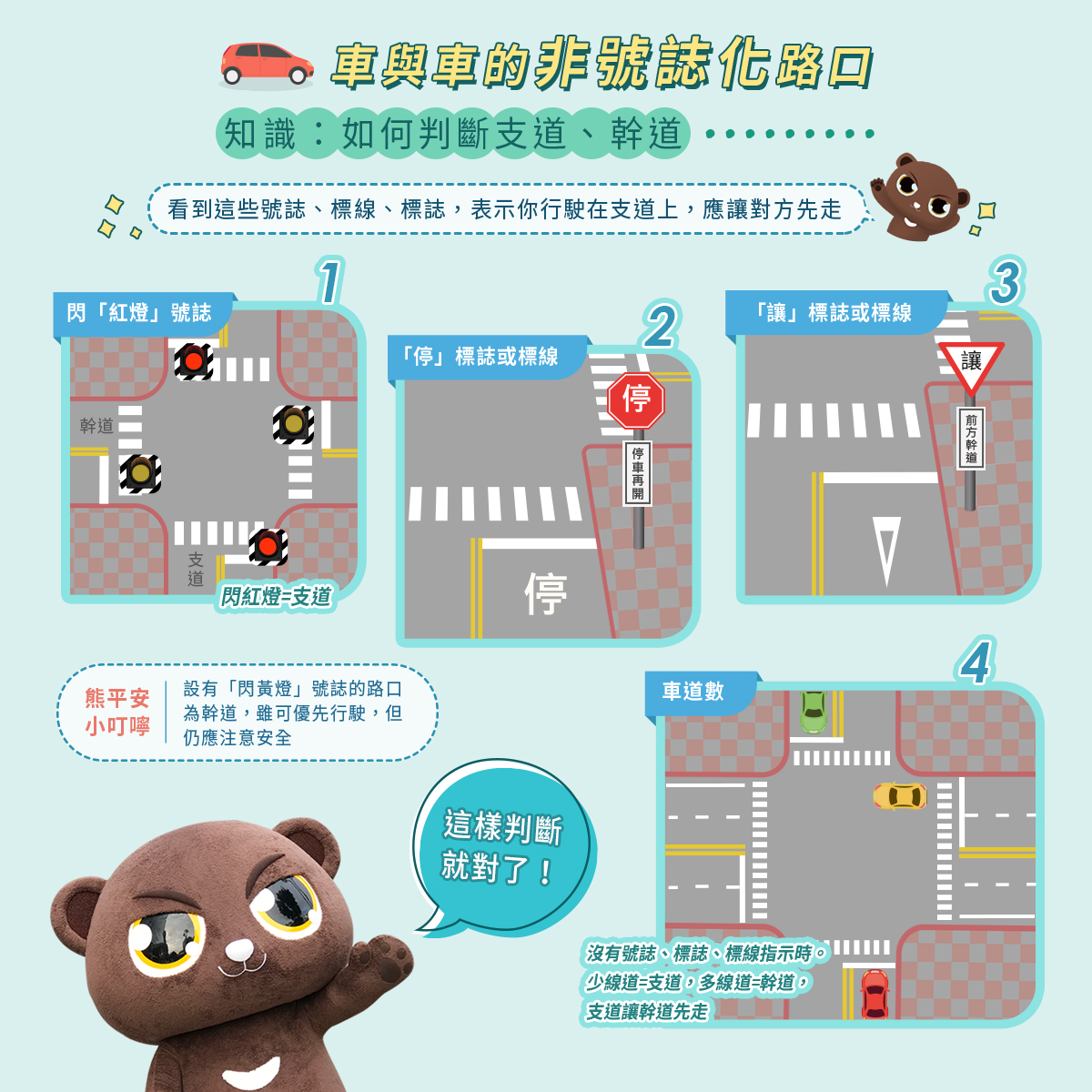
Flashing Red Light: Indicates a secondary road. You must stop at the intersection and yield to traffic from both sides before proceeding.
Flashing Yellow Light: Indicates a main road. You have the right of way but should be cautious of oncoming traffic.
Common Road Signs


Common Violations
- Right Turn on Red: Right turns are not allowed on a red light unless there is a right turn arrow.
- Speeding: As mentioned previously, speeding violations result in fines and penalty points.
- No Left Turn: No left turns or U-turns are allowed as a U-turn involves two left turns.
- No U-Turn: Left turns are allowed, but U-turns are not, as making a left turn once is not equivalent to a U-turn.
Recommended Navigation System
Google Map
Rental Car FAQs
Q: Where to pay for parking tickets?
You can pay at convenience stores such as 7-11, OK Mart, FamilyMart, and Hi-Life.
Q: What to do in case of an accident?
- Call 110 to report to the police: Preserve the scene or take photos, and do not settle privately.
- Notify the rental car company: Contact their representative or customer service.
- Submit the required claim documents.
- Complete the accident handling process.
Q: How to pay fines?
You can pay at convenience stores such as 7-11, OK Mart, FamilyMart, and Hi-Life. Fines incurred during your rental are handled according to your rental agreement; please check with your pickup branch for details.
Q: How to use gas stations?
Taiwan's fuel options include 92, 95, and 98 unleaded gasoline and diesel. Make sure to confirm before you start.
Q: Steps for self-service refueling
- Turn off the engine, engage the parking brake for cars, and set the center stand for motorcycles.
- Choose your payment method.
- Confirm the receipt option.
- After touching the static discharge zone with both hands, open the fuel cap, then follow the machine instructions to lift the nozzle and refuel.
- Refuel to the desired amount or until the nozzle automatically stops, then return the nozzle to the machine.
- After closing the fuel cap, retrieve your credit card, receipt, and invoice from the machine.
Conclusion
Now, you’ve become a scooter rental expert! What are you waiting for?
Start planning your next trip right away! Remember to book your scooter
in advance, as some popular models can be hard to come by.
Wishing you an amazing journey, safe riding, and lots of fun!
Frequently Asked Questions
Q: Where can I find GoodCars locations?
A: You can find the location at this link
Q: What should I pay attention to when renting a car?
A: When renting a car, you need to pay attention to the following:
- Prepare Valid Documents: Provide valid identification and driver's license when renting a car.
- Book in Advance: Especially during peak seasons or holidays, it's recommended to book the car in advance to avoid delays.
- Inspect the Vehicle: Carefully check the condition of the car when picking it up. Report any damages to the rental company immediately.
- Understand Rental Terms: Read the rental terms carefully before signing the rental agreement to understand both parties' rights and obligations.
Related Suggestions
- Holiday Car Rental
- Taiwan
- Self-Drive Tour
- Business Vehicle
- Long -Term Car Rental
- New Member Car Rental
- Dining