'%3e%3cpath%20fill='red'%20d='M0%200h720v480H0z'/%3e%3cpath%20fill='%23000095'%20d='M0%200h360v240H0z'/%3e%3cg%20fill='%23fff'%3e%3cpath%20d='m154%20126.9-2.5%209.6%209.4%202.6-1.8-7.1zm46.9%205.1-1.8%207.1%209.4-2.6-2.5-9.6zm-41.8-24-5.1%205.1%201.9%206.9z'/%3e%3cpath%20d='m155.9%20120-1.9%206.9%205.1%205.1z'/%3e%3cpath%20d='m154%20113.1-6.9%206.9%206.9%206.9%201.9-6.9zm14%2027.8%205.1%205.1%206.9-1.9zm18.9%205.1%209.6%202.5%202.6-9.4-7.1%201.8z'/%3e%3cpath%20d='m192%20140.9%207.1-1.8%201.8-7.1zm-31.1-1.8%202.6%209.4%209.6-2.5-5.1-5.1zm19.1%205%206.9%201.9%205.1-5.1z'/%3e%3cpath%20d='m173.1%20146%206.9%206.9%206.9-6.9-6.9-1.9zm-12.2-45.1-9.4%202.6%202.5%209.6%205.1-5.1zm-1.8%2031.1%201.8%207.1%207.1%201.8zm45-12%201.9-6.9-5.1-5.1z'/%3e%3cpath%20d='m168%2099.1-7.1%201.8-1.8%207.1zm32.9%208.9-1.8-7.1-7.1-1.8zm5.1%2018.9%206.9-6.9-6.9-6.9-1.9%206.9z'/%3e%3cpath%20d='m200.9%20108-8.9-8.9-12-3.2-12%203.2-8.9%208.9-3.2%2012%203.2%2012%208.9%208.9%2012%203.2%2012-3.2%208.9-8.9%203.2-12z'/%3e%3cpath%20d='m200.9%20132%205.1-5.1-1.9-6.9zm5.1-18.9%202.5-9.6-9.4-2.6%201.8%207.1zm-6.9-12.2-2.6-9.4-9.6%202.5%205.1%205.1zm-26-6.9-9.6-2.5-2.6%209.4%207.1-1.8zm6.9%201.9-6.9-1.9-5.1%205.1z'/%3e%3cpath%20d='m186.9%2094-6.9-6.9-6.9%206.9%206.9%201.9z'/%3e%3cpath%20d='m192%2099.1-5.1-5.1-6.9%201.9zM173.1%20146l-9.6%202.5%204.5%2016.6%2012-12.2zm-5.1%2019.1%2012%2044.9%2012-44.9-12-12.2zm-7.1-26-9.4-2.6-4.4%2016.4%2016.4-4.4z'/%3e%3cpath%20d='m147.1%20152.9-12%2045.1%2032.9-32.9-4.5-16.6zm-12-20.9L102%20165.1l45.1-12.2%204.4-16.4z'/%3e%3cpath%20d='m154%20126.9-6.9-6.9-12%2012%2016.4%204.5zm0-13.8-2.5-9.6-16.4%204.5%2012%2012z'/%3e%3cpath%20d='M135.1%20108%2090%20120l45.1%2012%2012-12zm90%2024-16.6%204.5%204.4%2016.4%2045.1%2012.2z'/%3e%3cpath%20d='m199.1%20139.1-2.6%209.4%2016.4%204.4-4.4-16.4zm-12.2%206.9-6.9%206.9%2012%2012.2%204.5-16.6zm19.1-19.1%202.5%209.6%2016.6-4.5-12.2-12z'/%3e%3cpath%20d='m192%20165.1%2033.1%2032.9-12.2-45.1-16.4-4.4zm7.1-64.2%209.4%202.6%204.4-16.4-16.4%204.4z'/%3e%3cpath%20d='M225.1%20108%20258%2075.1l-45.1%2012-4.4%2016.4zm-12.2-20.9L225.1%2042%20192%2075.1l4.5%2016.4zm12.2%2044.9%2044.9-12-44.9-12-12.2%2012z'/%3e%3cpath%20d='m206%20113.1%206.9%206.9%2012.2-12-16.6-4.5zm-38-38L135.1%2042l12%2045.1%2016.4%204.4z'/%3e%3cpath%20d='m160.9%20100.9%202.6-9.4-16.4-4.4%204.4%2016.4z'/%3e%3cpath%20d='m147.1%2087.1-45.1-12%2033.1%2032.9%2016.4-4.5zm39.8%206.9%209.6-2.5-4.5-16.4-12%2012z'/%3e%3cpath%20d='M192%2075.1%20180%2030l-12%2045.1%2012%2012z'/%3e%3cpath%20d='m173.1%2094%206.9-6.9-12-12-4.5%2016.4z'/%3e%3c/g%3e%3ccircle%20cx='180'%20cy='120'%20r='51.1'%20fill='%23000095'/%3e%3ccircle%20cx='180'%20cy='120'%20r='45.1'%20fill='%23fff'/%3e%3c/g%3e%3c/svg%3e)
'%20d='m0%200%2016%2011h61%2061%2061%2061%2060L47%2037h61%2061%2060%2061L16%2063h61%2061%2061%2061%2060L47%2089h61%2061%2060%2061L16%20115h61%2061%2061%2061%2060L47%20141h61%2061%2060%2061L16%20166h61%2061%2061%2061%2060L47%20192h61%2061%2060%2061L16%20218h61%2061%2061%2061%2060L0%200'/%3e%3c/svg%3e)

'%20d='M-50-12v24m6%200v-24m6%200v24m76%200V1m0-2v-11m6%200v11m0%202v11m6%200V1m0-2v-11'/%3e%3cpath%20transform='rotate(-33.69006752598)'%20d='M-50-12v24m6%200V1m0-2v-11m6%200v24m76%200V1m0-2v-11m6%200v24m6%200V1m0-2v-11'/%3e%3c/g%3e%3cg%20transform='rotate(33.69006752598)'%3e%3cpath%20fill='%23cd2e3a'%20d='M12%200a18%2018%200%2011-36%200%2024%2024%200%201148%200'/%3e%3cpath%20fill='%230047a0'%20d='M0%200a12%2012%200%201124%200%2024%2024%200%2011-48%200%2012%2012%200%201024%200'/%3e%3c/g%3e%3c/svg%3e)


Renting a Car in Japan: The Complete Guide to Licences, Costs, Insurance and Driving Rules

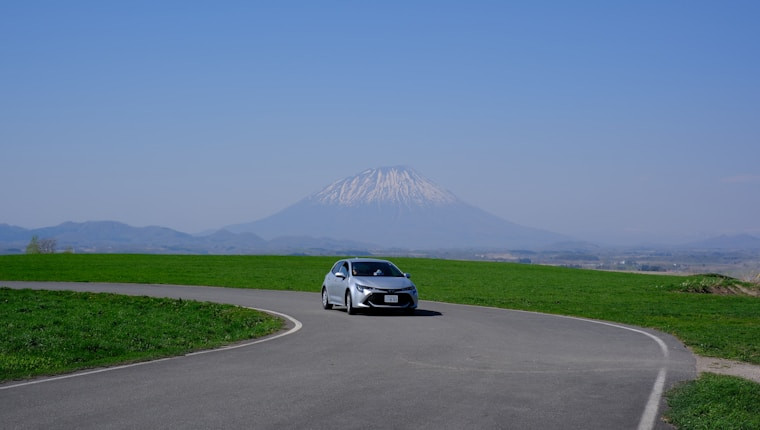
Japan has one of the finest rail networks on earth, and it still cannot take you everywhere. The morning mist over Shirakawa-go, the arrow-straight roads of Hokkaido, the turquoise causeways of Okinawa, the hot-spring valleys of Kyushu — these places are either unreachable by public transport or served by two or three buses a day. A rental car turns your itinerary from "whatever the timetable allows" into "whatever you feel like".
The catch is that renting in Japan is not like renting at home. The paperwork is stricter than most visitors expect, the driver sits on the right, traffic keeps left, the insurance vocabulary is unfamiliar, and you must return the car with a full tank. The single most common reason travellers get turned away at the counter is not money — it is the wrong piece of paper. This GoodCars guide walks through documents, booking, costs, insurance, road rules and drop-off, so you can book with confidence.
- Which licence document you need — and it is not the same for every nationality
- Why an IDP from some countries is worthless in Japan
- The real cost stack: rental, CDW, NOC, tolls, fuel, parking
- Eight rules that catch first-time drivers out
- GoodCars covers six major Japanese airports, bookable online before you fly
Step one: get your licence documents right
Read this section twice. Japanese rental counters check documents strictly, and incomplete paperwork means no car — whether your deposit is refundable depends on the terms you booked. Which document you need depends entirely on where your licence was issued.
Most nationalities: an International Driving Permit
If your licence was issued by a country that is party to the 1949 Geneva Convention on Road Traffic, you need three things at the counter:
- Your passport — the permit's validity is counted from your date of entry into Japan.
- Your original home driving licence — the IDP is only a translation companion and is invalid on its own.
- An IDP issued under the 1949 Geneva Convention, issued within the last year and still valid.
The United Kingdom, the United States, Canada, Australia, New Zealand, South Korea, Thailand, Singapore, Malaysia, Hong Kong, Macau, India, the Philippines and around a hundred other jurisdictions fall into this group.
Countries that use an official Japanese translation instead
A small group of jurisdictions do not issue 1949-Convention permits but have a separate arrangement with Japan. Drivers licensed in Switzerland, Germany, France, Belgium, Monaco, Estonia and Taiwan drive in Japan on their original licence plus an official Japanese translation, valid for up to one year from entry. The translation must come from an authorised source such as the Japan Automobile Federation (JAF) or the relevant embassy or consulate — a translation you produce yourself, or one from a commercial translation agency, will not be accepted.
Licences that cannot be used in Japan at all
This is the part that ruins trips. Licences from countries that belong to neither arrangement cannot be used to drive in Japan under any circumstances, and obtaining an IDP at home does not change that. This includes mainland China (Hong Kong and Macau are separate and are fine) and Indonesia, among others. If your group includes a driver in this category, plan around it before you book — the only route to driving legally is converting to a Japanese licence, which is available to residents, not visitors.
- Does my permit say 1949 Geneva Convention? → Good to go
- Am I licensed in Switzerland, Germany, France, Belgium, Monaco, Estonia or Taiwan? → Get the official Japanese translation instead
- Is my licence from a country in neither group? → I cannot drive in Japan; nominate another driver
- Is every intended driver covered? Only named drivers on the contract may drive
How renting in Japan actually works

The process breaks into five steps, and the first three happen before you fly. GoodCars handles Japanese rentals online, so you choose the pick-up point, vehicle and extras in advance and simply present yourself at the counter on arrival.
- 1. Choose pick-up point and times. Leave generous margin on the return — counter processing and the vehicle inspection typically take 20 to 30 minutes, and airport shuttle time is extra.
- 2. Choose the vehicle. Two people travelling light are best served by a compact car, which is far easier to park. Three or four with luggage want a mid-size sedan; families and groups need an SUV or minivan. Japanese parking bays are narrower than most visitors expect, so bigger is not automatically better.
- 3. Add your extras. Collision damage waiver, NOC cover, an ETC card, child seats, and winter tyres where relevant. Adding these at booking is cheaper and safer than hoping stock is available on the day.
- 4. Assemble your documents. Booking confirmation (saved offline and printed), passport, original licence, IDP or official translation, and a credit card in the main driver's own name for the deposit.
- 5. Check in and inspect. After the contract and insurance briefing, walk around the car with the staff member. Photograph every scratch, dent and kerbed wheel before you drive away — that photo set is your best protection at drop-off.
GoodCars works with established Japanese suppliers and covers six major airports — Narita, Haneda, New Chitose, Kansai, Fukuoka and Naha. Compare vehicles, add insurance and an ETC card, and confirm online before you fly.
Check Japan car rental optionsWhat it really costs
Travellers are often surprised by the final invoice, because the total is built in layers rather than being a single daily rate. Budget with this table and there will be no shocks.
| Item | What it is | How to budget |
|---|---|---|
| Base rental | Vehicle and duration; peaks sharply during cherry blossom, Golden Week, summer and New Year | Booking early moves this the most |
| Collision damage waiver (CDW) | Reduces your accident excess to zero | A flat charge per day |
| NOC cover | Waives the operator's loss-of-use charge after an incident | Usually a few hundred yen per day |
| Expressway tolls | Japanese tolls are high; on long routes this rivals the rental itself | Use an ETC card or a regional pass |
| Fuel | Returned full; fuel costs more than in most of Asia and North America | Roughly one fill per 400–500 km |
| Parking | Hotel and attraction parking is frequently charged separately | Confirm when booking accommodation |
| One-way fee | Charged for returning to a different branch; higher across regions | A loop itinerary avoids it entirely |
| Extras | Child seats, winter tyres, additional drivers | Add at booking, not on the day |
The GoodCars rule of thumb: total rental, insurance, fuel and tolls, then add 10–20% for parking and incidentals. That number usually lands very close to the final bill.
Insurance, the excess and NOC explained
Japanese rental insurance is the part that most confuses visitors, but it is only three layers.
- Layer one: basic cover. Third-party, property, vehicle and passenger cover is included in the rental rate. Nothing for you to arrange.
- Layer two: the collision damage waiver. The basic cover carries an excess — the portion you still pay after an incident. Buying the waiver reduces that to zero. Most travellers take it.
- Layer three: NOC cover. The Non-Operation Charge is distinctly Japanese. If the car cannot be rented out while it is being repaired, the operator bills you for that lost business. Typical figures are around ¥20,000 if the car can still be driven back to the branch, and around ¥50,000 if it cannot. NOC cover removes this, usually for a few hundred yen per day.
Driving on the left: eight things that catch visitors out

Japan drives on the left, with the steering wheel on the right. If you come from the UK, Australia, Hong Kong, Thailand, Singapore or Malaysia this will feel natural; if not, most people adapt within half an hour. The rules, not the seating position, are what actually cause trouble.
- "止まれ" means a full stop. At the red inverted triangle your wheels must come to a complete standstill. Japanese police enforce this strictly, and rolling through does not count.
- Pedestrians have absolute priority. If anyone is waiting to use a crossing, you stop. This is enforced law, not politeness.
- Indicators and wipers are reversed compared with left-hand-drive cars. Switching on the wipers at your first turn is a rite of passage.
- Think before turning. Keeping left makes left turns tight and right turns wide — take a beat at each junction.
- Children under six require a child seat. This is Japanese law; reserve the seat when you book, as counter stock is not guaranteed.
- Zero tolerance on alcohol. Penalties are severe, and passengers and whoever supplied the drink can also be prosecuted. If drinking is on the agenda, do not plan to drive.
- Do not touch your phone. In Japan even looking at the screen while driving is an offence. Stop and switch off the engine to check directions.
- Seatbelts for everyone; no turning on red. Rear passengers included, and unless a sign specifically permits it, you may not turn against a red signal.
Expressways and the ETC card

Japan's expressways are immaculate and expensive. On a long touring route, tolls are often the second-largest line on your budget after the car itself. There are two ways to handle them.
Rent an ETC card
ETC is Japan's electronic tolling system. The rental company hires you a card, you slot it into the car's onboard reader, and you pass through toll gates without stopping; charges are settled when you return the car. Japanese expressway operators have been progressively converting interchanges to ETC-only, which means that without a card you may find certain entrances and exits closed to you. GoodCars advises always taking the card — the saving from skipping it is not worth the detours.
Consider a regional expressway pass
Operators offer regional expressway passes for overseas visitors, giving unlimited travel on major expressways within a defined area for a set number of days. Points to note:
- The former nationwide and Central Nippon passes have been discontinued; the current products are region-specific.
- Eligibility is restricted to visitors holding a non-Japanese passport, and the pass must be arranged through a participating rental company when you rent.
- Pricing sits on top of the rental and ETC card fee, and durations typically run from a couple of days up to a fortnight.
- A pass only pays off on long inter-regional routes. If you are staying within one metropolitan area, paying actual tolls by ETC is normally cheaper.
Coverage areas and pricing are revised regularly, so confirm with GoodCars which product suits your route rather than relying on older information.
Fuel, parking and returning the car

Fuel: identify the grade first
Japanese pumps are colour-coded, and getting this wrong is expensive:
- レギュラー (red) — regular petrol, which almost all rental cars take.
- ハイオク (yellow) — premium petrol, specified by some imported and higher-spec models.
- 軽油 (green) — this is diesel. The name misleads people into thinking it is for small "kei" cars. Misfuelling causes severe engine damage and is not covered by any waiver.
If in doubt, show the attendant your key or the label inside the fuel flap. Self-service stations (セルフ) usually offer an English interface: pay, select the grade, then hold the trigger.
Parking: check height and width limits
Urban parking is often mechanical multi-storey, with strict limits on vehicle height and width that many SUVs and minivans exceed. Confirm parking arrangements when booking accommodation, and arrive early at popular sights in peak season.
Drop-off: full tank, inspection, time buffer
Japan operates on 満タン返し — return the car full and keep the fuel receipt for the counter. If you do not, the company refuels at a premium rate. Staff will inspect the car again, which is when your arrival photographs earn their keep. At airports, allow at least an hour for return, shuttle and check-in.
Choosing your pick-up point

GoodCars offers six airport pick-up points spanning Kanto, Kansai, Kyushu, Hokkaido and Okinawa. For a first Japanese drive, start somewhere with light traffic and simple roads.
| Pick-up point | Suits | Difficulty |
|---|---|---|
| Naha Airport | Okinawa island loop, Churaumi Aquarium, the sea roads, southern coast | Easiest — best for beginners |
| New Chitose Airport | Central Hokkaido, Furano, Otaru, Lake Toya | Easy in summer, advanced in winter |
| Kansai Airport | Kyoto's outskirts, Nara, Wakayama, Lake Biwa | Moderate — busier urban roads |
| Fukuoka Airport | Kyushu loop, Yufuin, Aso, Beppu hot springs | Moderate |
| Narita Airport | Boso Peninsula, Nikko, Karuizawa, Fuji Five Lakes | Harder — heavy Tokyo-area traffic |
| Haneda Airport | Kanagawa, Hakone, Izu Peninsula | Harder |
Okinawa: the best place to start
Okinawa has no rail network to speak of, so a car is effectively the only way to explore — and the roads are wide, quiet and straightforward. Collect the car at Naha and follow the coast north; the driving is easy the whole way.

Hokkaido in winter: be honest with yourself
Winter Hokkaido is spectacular, but snow driving is a separate skill: ice, whiteout conditions and easy loss of traction. If you have never driven on snow, GoodCars would genuinely rather you took the train and buses, or saved the driving for summer and autumn. If you do drive in winter, insist on winter tyres, halve your daily distances, and check road-closure information constantly.
Whether it is the Okinawan coast, the Hokkaido plains or a run into the mountains from Kansai, GoodCars has the car ready. Compare models and prices, add insurance and ETC in one place, and drive away on arrival.
Go to GoodCars Japan rentalsFrequently asked questions
Q1. My country issues an IDP — is that automatically enough for Japan?
No. Japan accepts only permits issued under the 1949 Geneva Convention. Permits under the 1968 Vienna Convention, or from countries in neither treaty, are refused. Check the convention printed on your permit, and remember it must be accompanied by your original licence and passport.
Q2. How long can I drive in Japan on a visitor's documents?
Up to one year from your date of entry, and never beyond the expiry of your home licence or permit. For a normal holiday this is never a constraint.
Q3. What happens if I skip the damage waiver and have an accident?
You pay the excess set out in your contract, plus the loss-of-use charge (NOC) — commonly around ¥20,000 if the car is still driveable and around ¥50,000 if it is not. GoodCars recommends buying the waiver and NOC cover together.
Q4. Do I really need an ETC card?
You can technically use cash lanes, but a growing number of interchanges are ETC-only, so you risk detours. ETC also avoids stopping at toll plazas and often carries discounts. GoodCars advises taking it every time.
Q5. Where is easiest for a first drive in Japan?
Okinawa, without question — wide, quiet roads and no complicated interchanges. Hokkaido and parts of Kyushu in summer are next. Save the Tokyo and Osaka metropolitan areas until you have a trip behind you.
Q6. We are travelling with young children — what about car seats?
Japanese law requires a child seat for children under six, matched to age and size. Reserve it with your booking; counter availability is never guaranteed. GoodCars flags this on every family reservation.
Q7. What do I do about a fine or a minor collision?
Fines and towing costs fall to the driver and are not covered by any waiver; operators usually add an administration fee. After any incident, however small, call the police and obtain an accident report before contacting the rental company — without that report your insurance may not pay out. If anything is unclear, ask GoodCars before you travel.